
After the Chuseok (Korean Thanksgiving) holiday ends, it is common to step on the scale and find the number up by 1-2 kg. After three days of jeon (pan-fried battered dishes), tteok (rice cakes), and galbi-jjim (braised short ribs), it is easy to assume you have put on that much weight, but in measured studies the weight gain over a holiday period stays at an average of 0.4-0.8 kg. Most of the number that swells right after the holiday is not fat but glycogen and the water that comes with it.
In this post, we look at the studies that actually measured holiday weight change, split the fat share of the 2 kg shown on the scale by calculation, and then lay out how to spend the two days after the holiday.
How much weight do measured studies say is gained over Chuseok?
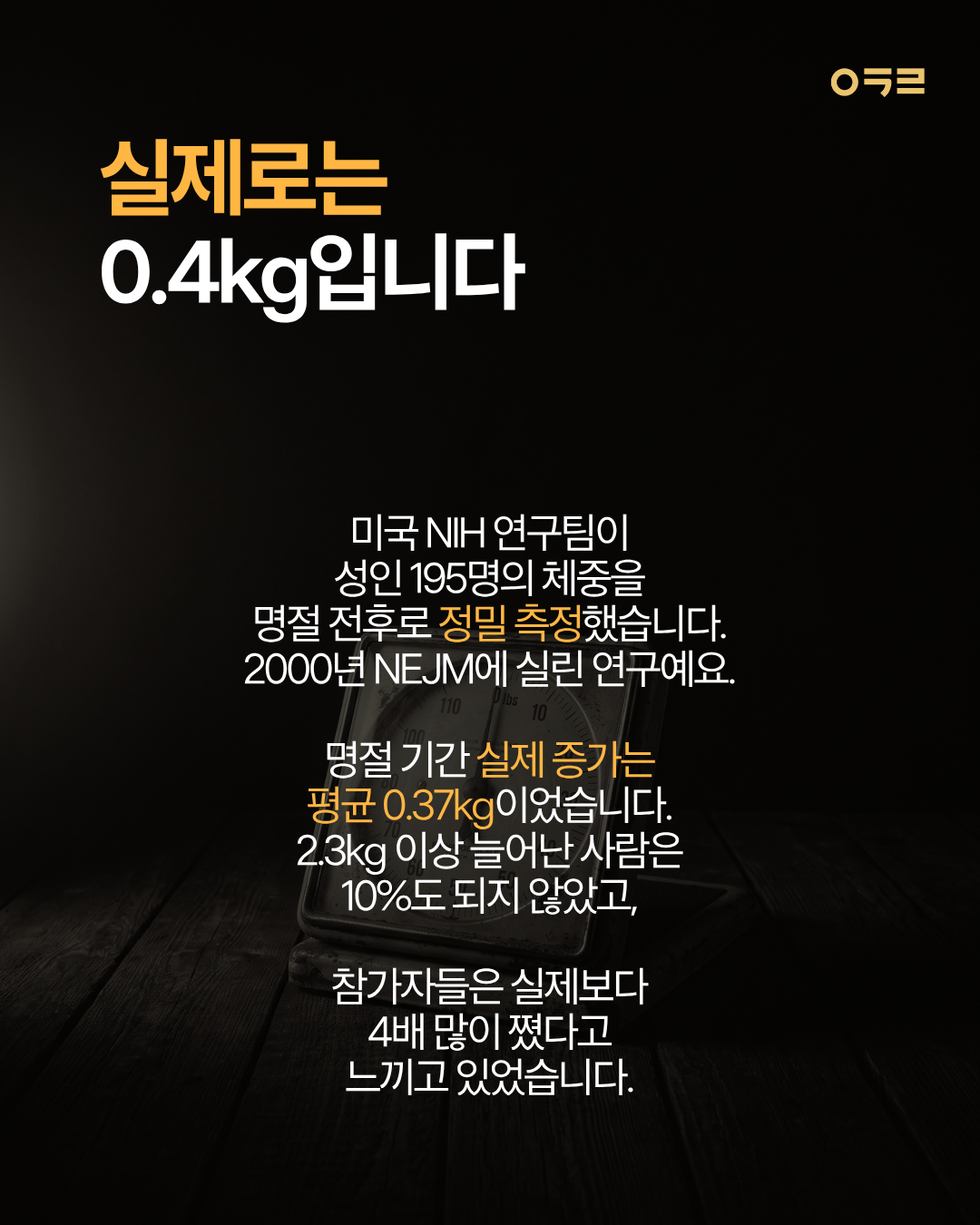
The representative study that systematically measured holiday weight gain is the prospective study published in NEJM in 2000 by Yanovski's team at the US NIH. When 195 adults were repeatedly weighed on a precision scale from before Thanksgiving until after the new year, the average gain was 0.37 kg. Fewer than 10% of people gained more than 2.3 kg, and the amount participants felt they had gained was about 4 times the actual figure.
The three-country data that Helander's team published in NEJM in 2016 are similar. In a year of daily weights from 2,924 smart-scale users in the United States, Germany, and Japan, weight rose 0.6 kg in the US and 0.8 kg in Germany over the Christmas and New Year period, and 0.5 kg in Japan during Golden Week. Even across different countries and holidays, the measured gain clusters at 0.4-0.8 kg, a clear gap from the 1-2 kg you see on the scale the day after Chuseok.
How much of the 2 kg on the scale is fat?
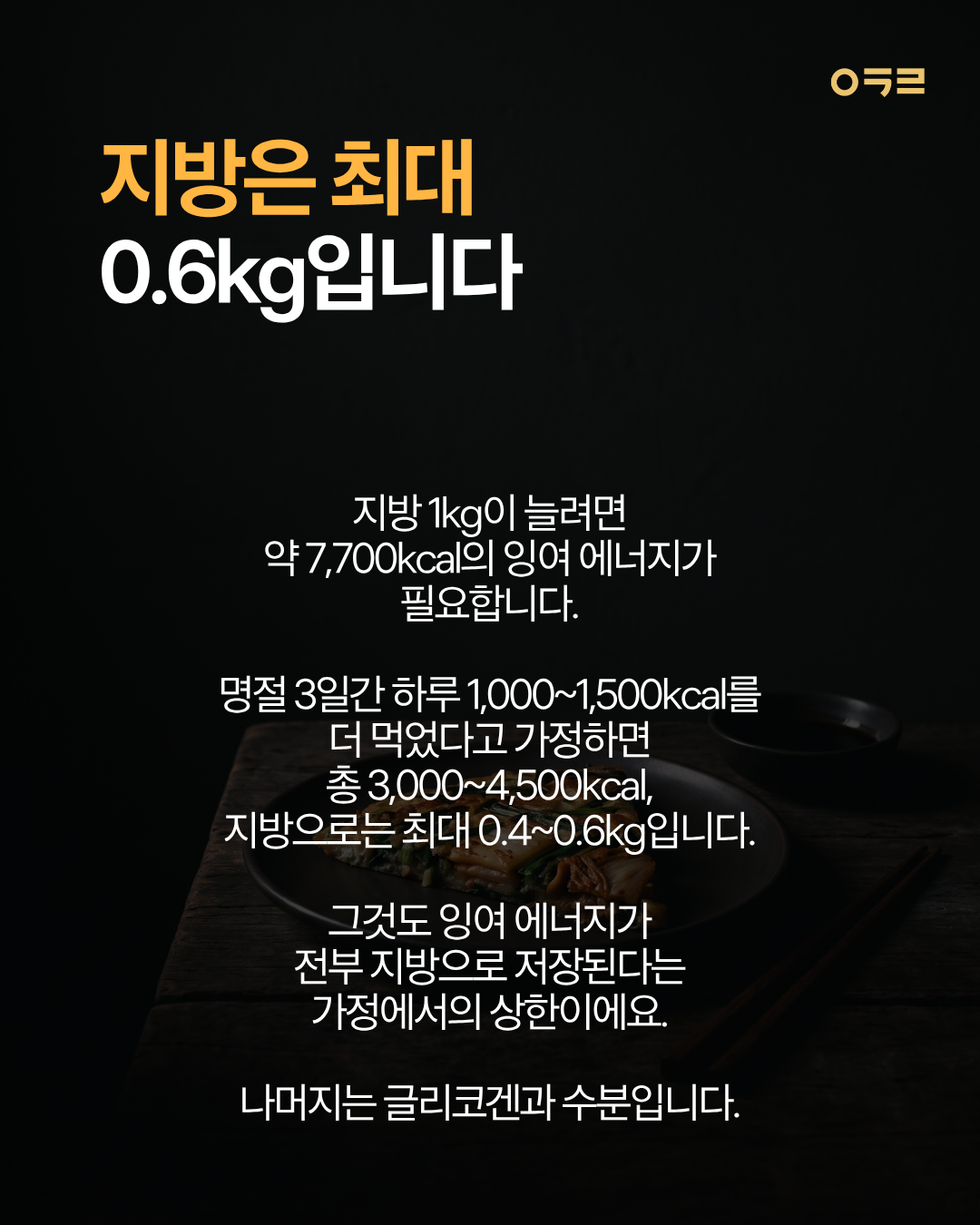
Creating 1 kg of new fat requires about 7,700 kcal of surplus energy. Even if we generously assume you ate 1,000-1,500 kcal more per day than usual over the three days of Chuseok, the total is 3,000-4,500 kcal, which converts to 0.4-0.6 kg of fat. And even that is an upper limit that assumes none of the surplus calories leaks away and all of it is stored as fat.
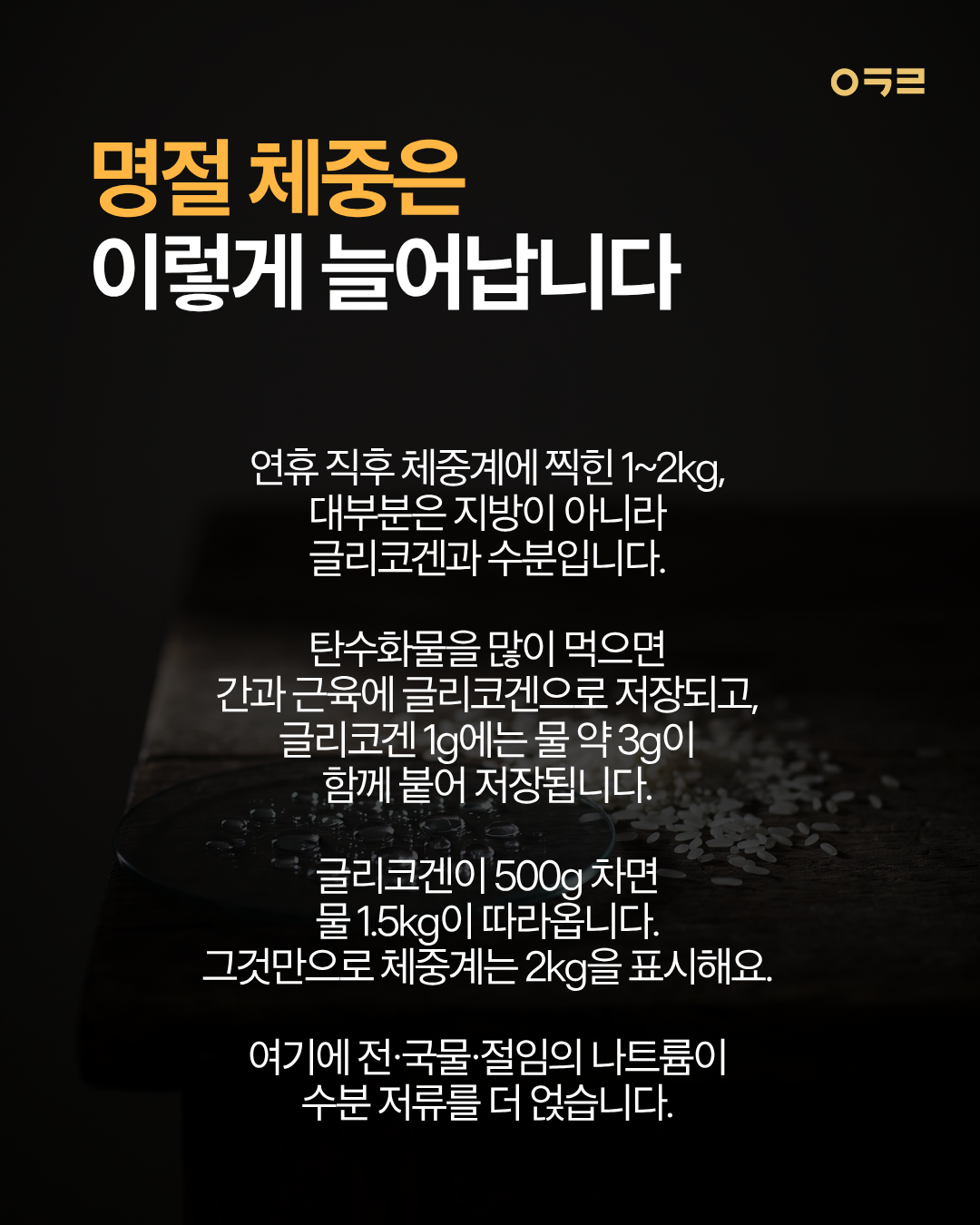
The remaining weight is glycogen and water. When you eat a lot of carbohydrates, they are stored in the liver and muscles as glycogen, and glycogen is stored with about 3 g of water bound to every 1 g (Kreitzman et al., AJCN 1992). In the overfeeding experiment by Acheson's team (AJCN 1988), when excess carbohydrate was given, glycogen stores became saturated at around 500 g within a few days, and the weight gain up to that point was mostly explained by glycogen and water. When 500 g of glycogen is accompanied by 1.5 kg of water, that alone makes the scale show 2 kg.
On top of this, the sodium in holiday food adds another layer. Salty foods such as jeon, soups, and pickled dishes make the body hold on to water, and this water retention also shows up directly on the scale. In summary, it is closer to the measured data to read the 1-2 kg right after the holiday as a combination of 0.5 kg or less of fat overlapped with 1 kg or more of glycogen and water.
The real problem is the two weeks after the holiday
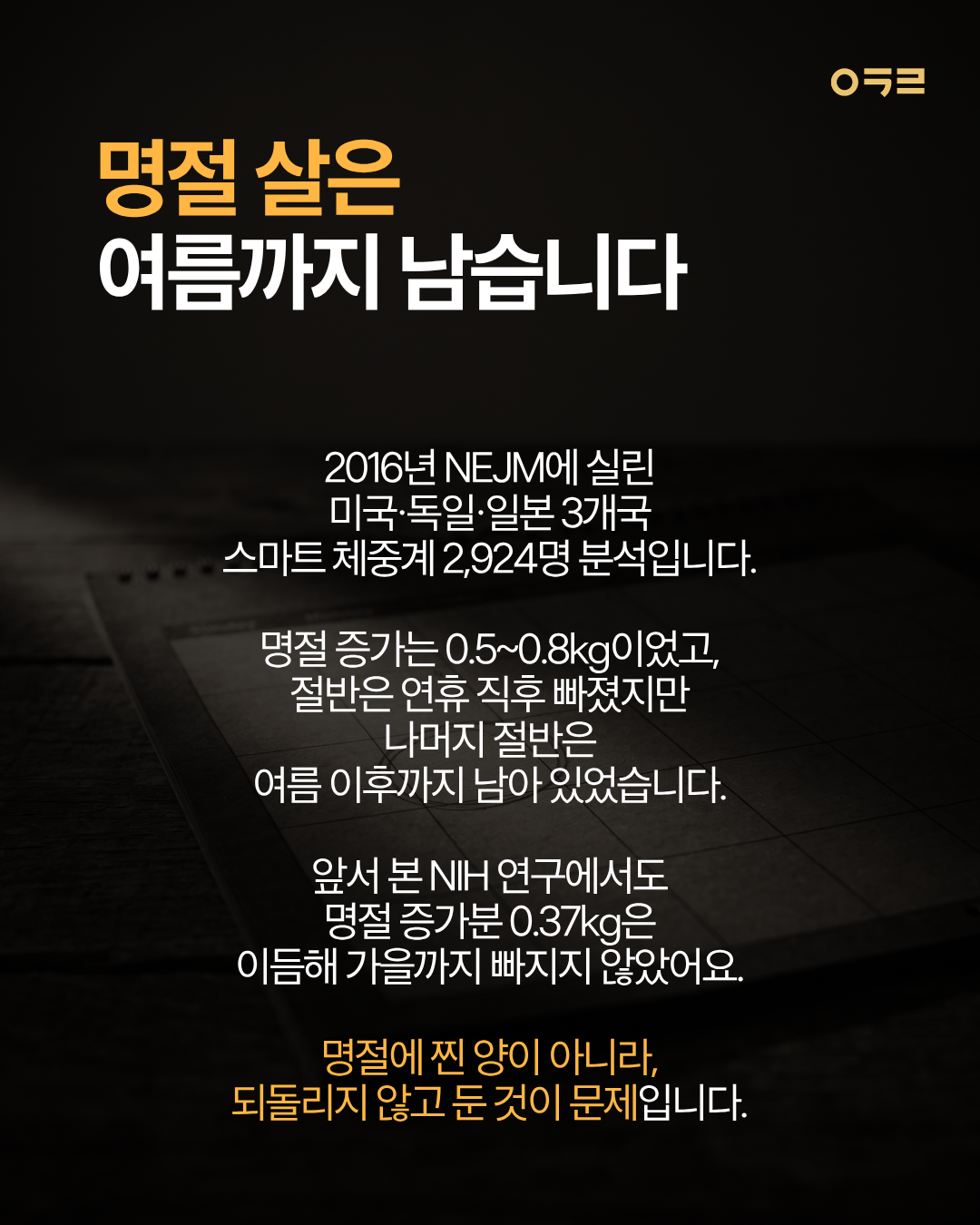
What matters is not the amount gained at Chuseok but the time that follows. In the Yanovski study, the 0.37 kg gained was still not gone by the following March, and even among the 165 people followed until the next autumn there was no significant further loss. The researchers concluded that this gain does not offset itself naturally in spring and summer and contributes to the slow weight gain of adulthood. In the Helander study as well, half was lost right after the holiday, but the other half stayed on until after summer.
The path is generally like this. Even though the holiday is over, the increased meal portions and snacking habits kept up “because it is a holiday” continue for another 1-2 weeks, and during that time actual fat is added on top of the swollen glycogen and water. Even 0.4 kg, if it remains every year, adds up to 4 kg in 10 years.
For the two days from the day after the holiday, and the original diet on day 3
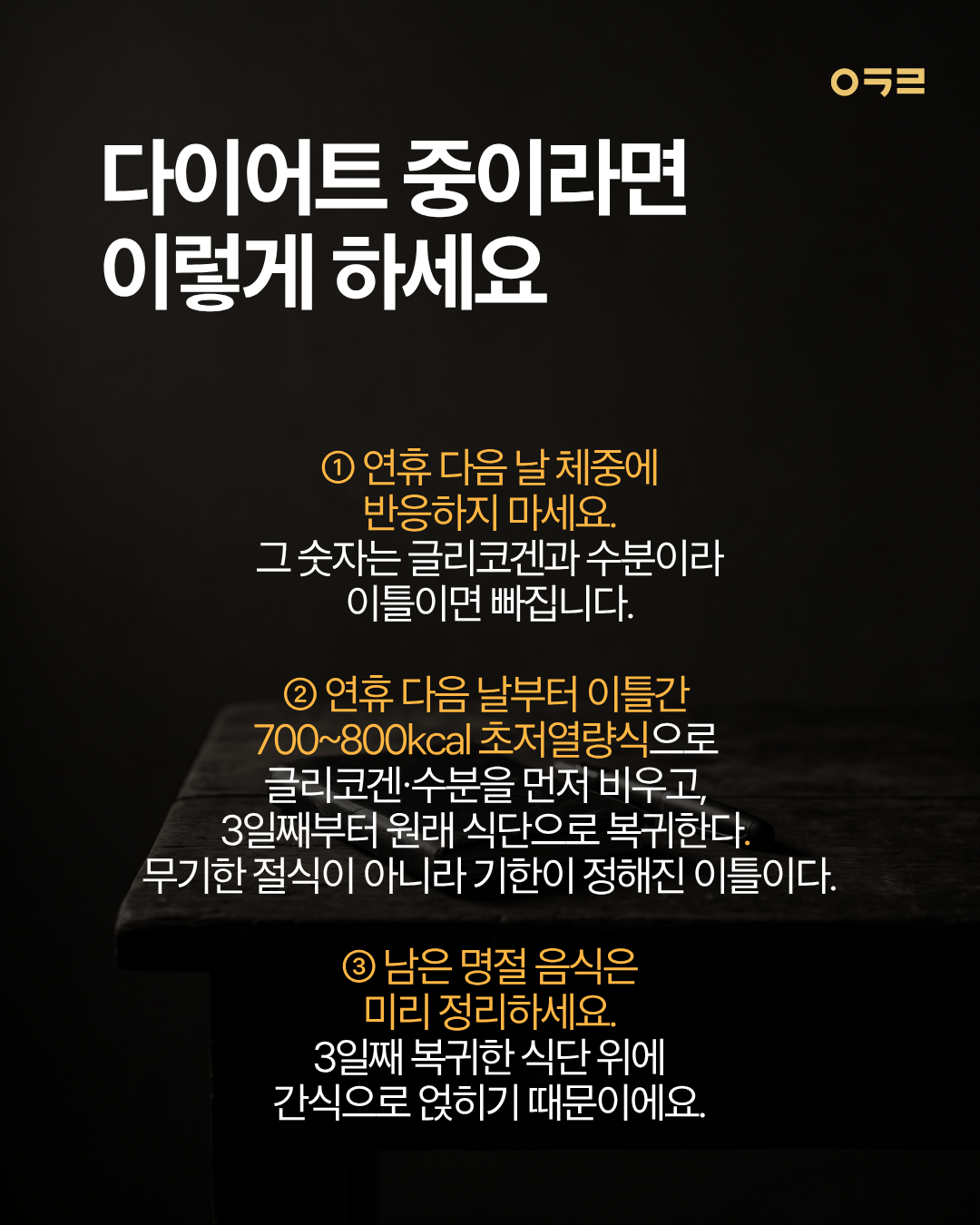
First, cut back to 700-800 kcal for two days. That is about 1/3 to 1/2 of an average adult's daily intake. Split protein such as eggs, tofu, chicken breast, and fish, along with vegetables, into two or three meals, and take carbohydrates such as rice, tteok, bread, and fruit, as well as strongly seasoned foods, off the plate for those two days. The reason for fixing the period at two days is that what increased is glycogen and water. When you cut carbohydrates and lower calories, glycogen is used up first and the water attached to it goes out with it. Two days is enough for this process, and if you drag it out longer, what decreases next is not water but muscle and your condition.
Second, return to your pre-holiday diet from day 3. Restoring not only the amount you eat but also the meal times to normal is the other half of this method. In the consultation room, we more often see people who try to keep eating less on the momentum of the two days and then slide into rebound binge eating.
Third, clear away the leftover holiday food before you start the two days. If it is still around after you return to your original diet on day 3, it flows into snacks outside of meals. It helps to freeze it or divide it up and clear it out on the last day of the holiday.
However, if you are pregnant or breastfeeding, are taking diabetes or blood pressure medication, or have ever had an eating problem, do not start a two-day very-low-calorie diet on your own; consult the medical institution you are seen at first.
Frequently asked questions
Q. I gained 2 kg over the Chuseok holiday. Is all of it fat? A. No. The most fat that can be gained from three days of overeating is about 0.4-0.6 kg, and the rest is glycogen and water.
Q. How many days does it take for holiday weight to come back down? A. The share gained as glycogen and water is mostly cleared if you keep to 700-800 kcal for the two days starting the day after the holiday. The half that remained until summer was in cases where eating habits did not return to normal after the holiday.
Q. Should I starve the day after the holiday to reverse it? A. We do not recommend open-ended fasting. It is better to set a two-day limit, eat mainly protein and vegetables, and return to your usual diet from day 3.
Q. Will the weight left over a little at each Chuseok come off on its own? A. That is hard to expect. In the Yanovski study, the 0.37 kg had not gone down even by the following autumn, and the researchers regarded this as a major cause of weight gain in adulthood.
Q. Which foods especially raise the number on the scale? A. Tteok, rice, and fruit raise it through glycogen and water, while high-salt foods such as jeon, soups, and pickled dishes raise it through water retention. Both are separate from fat gain.
Summary
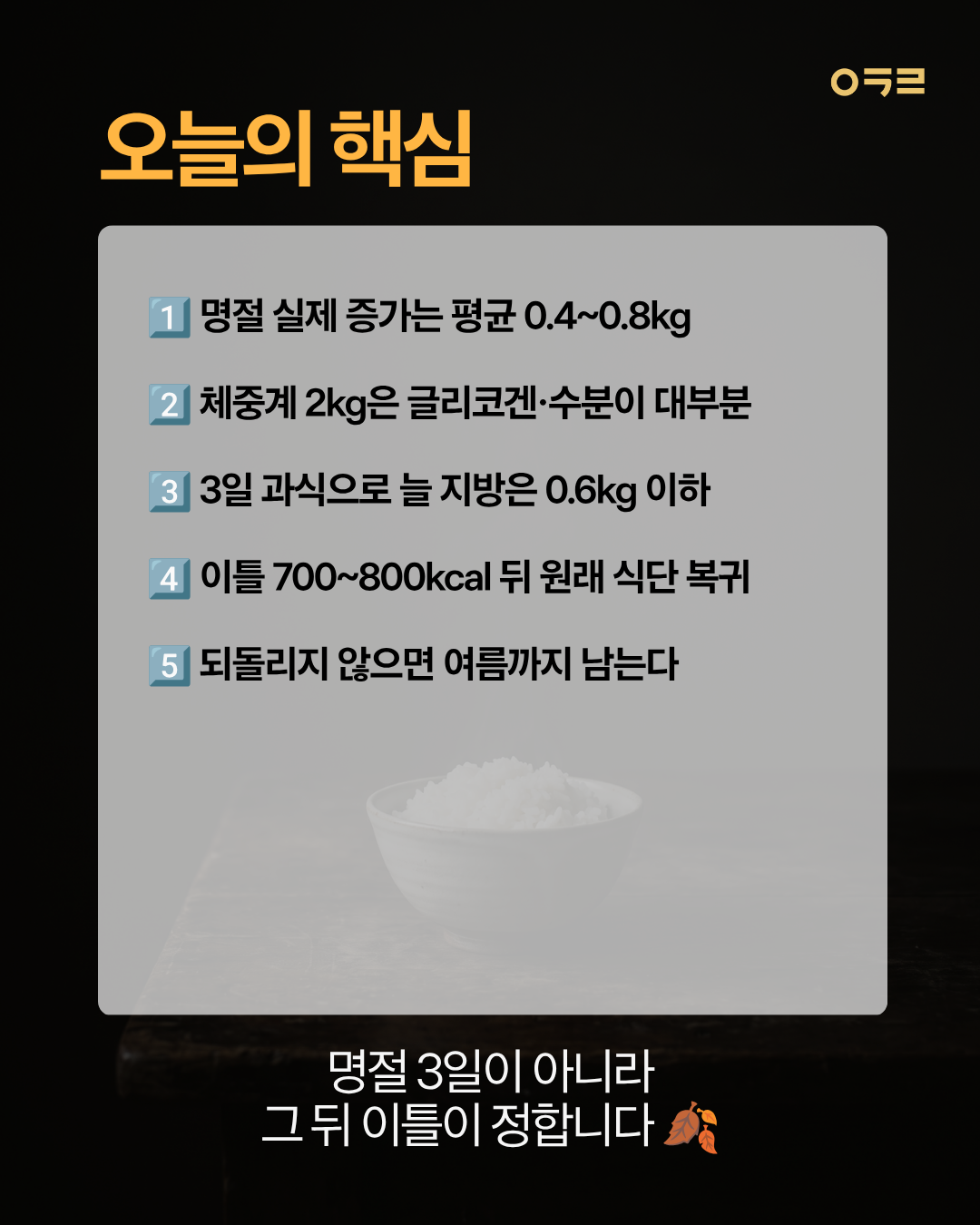
Most of the number on the scale right after Chuseok is glycogen and water, not fat, and it fits the measured studies to see the actual fat gain as 0.5 kg or less. What you need the day after the holiday is not anxiety but a two-day plan. For two days, clear out the glycogen and water first at 700-800 kcal, then return to your pre-holiday diet on day 3. It is not the 2 kg gained at Chuseok that creates the burden, but the flow in which the 0.4 kg that was not reversed piles up year after year.
※ References: Yanovski, NEJM 2000;342:861 / Helander, NEJM 2016;375:1200 / Kreitzman, AJCN 1992;56:292S / Acheson, AJCN 1988;48:240.
KakaoTalk consultation: search “acrohani” / Website: https://acrohani.com/en / 480 Gangnam-daero, 2F, Sinnonhyeon Station Exit 3, 1-minute walk
Reviewed by: Dr. Park Ji-seon · Director, ACRO Korean Medicine Clinic · Last reviewed 2026-09-26
This article is intended to provide general information, and results may vary depending on individual eating habits and constitution. Please confirm the right direction for your diet and weight management through consultation with a specialist.