

Hello. This is Dr. Park Ji-seon of ACRO Korean Medicine Clinic.
A few days after ONDA Lifting, you may sometimes feel a firm lump in the treated area, or feel pain when pressing on it.
When such a lump appears later on, even though everything was fine right after treatment,
“Has the fat clumped together?”
“Did something go wrong with the treatment?”
“Will it stay like this?”
many people start to worry like this.
A nodule is one of the side effects that can occur after ONDA Lifting,
so today I’ll start by explaining exactly what these nodules are and what problems they can cause in the body.
What Is a “Nodule” After ONDA Lifting?
A nodule is a localized tissue change in the subcutaneous tissue that feels like a lump firmer than the surrounding area.
Whereas a lipoma is a benign tumor formed by the proliferation of mature fat cells,
nodules that occur after ONDA treatment are thought to arise in connection with treatment-induced changes in fat tissue and the inflammatory process.
The recommendations of the ONDA Coolwaves International Advisory Board, published in Bioengineering in 2024,
also address nodules as one of the adverse reactions that can occur after ONDA treatment,
and suggest that they may form when fat necrosis tissue produced during fat breakdown gathers locally.
When a nodule forms, the area may feel firm and there may be pain or discomfort when pressed,
and it can last longer than ordinary swelling or bruising.
However, a nodule does not necessarily mean that the treatment went wrong or that it will remain permanently.
Most are managed while observing their progress,
but if it doesn’t shrink over time, or actually grows and is accompanied by pain, warmth, or skin changes, it should be checked for other problems.
Why Do Nodules Form After ONDA Lifting?
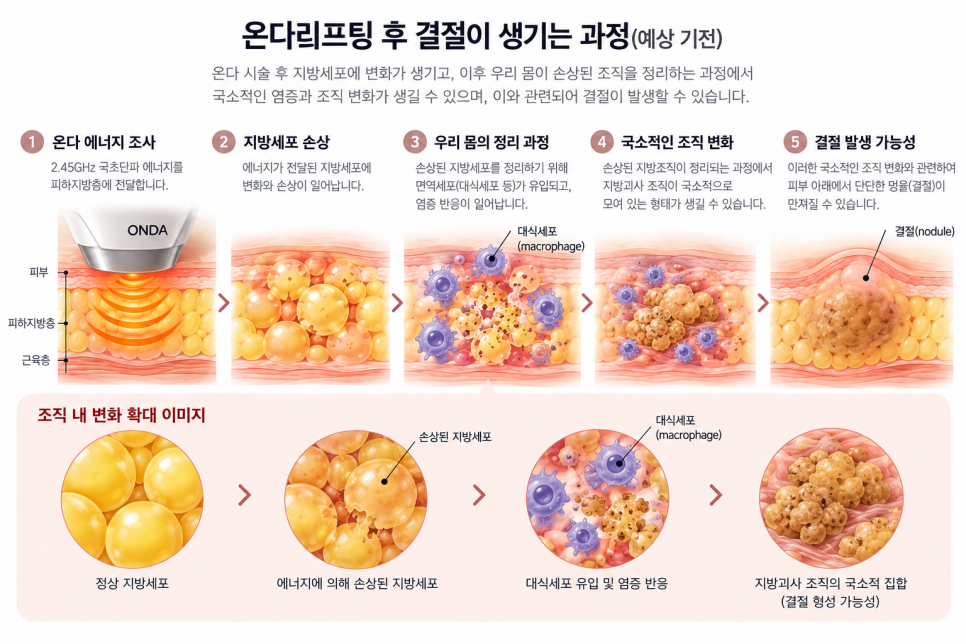
ONDA Lifting is a treatment that uses 2.45GHz microwave energy to deliver heat energy to the subcutaneous fat layer.
When enough energy is delivered to fat cells, the fat cells are damaged,
and the body then goes through a process of clearing away the damaged tissue.
In fact, in a histological study published in Cosmetics in 2025,
researchers performed ONDA on patients scheduled for abdominoplasty 5 days before surgery, then collected and examined the actual fat tissue.
As a result, damage to fat cell membranes and loss of Perilipin-1 expression were confirmed in the ONDA-treated areas,
and CD68-positive macrophages were also observed to have moved in around the damaged fat cells.
Put simply, after ONDA causes changes in fat cells, the body goes on to clear away the damaged fat tissue.
So is this also why nodules form?
The exact process by which nodules form has not been fully clarified.
However, the ONDA International Advisory Board explains that nodules may occur in connection with the fat lysis process,
and also suggests that they may be a localized collection of fat necrosis tissue.
Therefore, rather than simply seeing a nodule after ONDA as “clumped fat,”
it is more appropriate to understand it as a side effect related to localized inflammation and tissue changes that occur after fat cell damage.
Why Do They Appear a Few Days Later Rather Than Right After Treatment?
“It was fine during the treatment, so why did a lump appear a few days later?”
ONDA energy is delivered to the fat layer at the moment of treatment,
but the body’s process of dealing with the damaged fat tissue continues for some time after treatment.
In the histological study mentioned above, tissue collected 5 days after ONDA treatment also showed
fat cell damage along with the influx of macrophages.
So there may be nothing unusual on the day of treatment, but firmness or tenderness may be felt a few days later.
However, not every lump that appears after treatment should be dismissed as a simple, normal recovery process.
Because nodules are also a possible side effect after ONDA, it is important to keep an eye on how their size, pain, and the skin’s condition change afterward.
How Long Do Nodules Last?
When a nodule forms, the biggest worry is usually, “Will this stay forever?”
Nodules can last longer than ordinary swelling or bruising.
The ONDA International Advisory Board recommendations
explain that nodules occurring after fat reduction treatments have been reported to disappear within 78 days on average.
Of course, the recovery period can vary depending on individual tissue condition and the size of the nodule.
What matters is not to regard it as an abnormal course right away just because it doesn’t disappear within a few days,
but to check whether the nodule’s size, firmness, and tenderness when pressed are gradually decreasing over time.
Conversely, if the pain gets worse or the nodule grows over time,
or if it is accompanied by skin changes such as redness or warmth, its condition should be checked again.
※ The 78 days is not a figure calculated only for ONDA treatment; it is an average period presented by the International Advisory Board, citing existing studies on nodules after fat reduction treatments.
What If the Nodule Doesn’t Go Away or Becomes More Painful?
The most important thing when looking at a nodule is whether it is heading in the direction of improvement over time.
If there is no obvious redness or warmth of the skin,
and the nodule is gradually getting smaller and softer with less tenderness, it can be managed while observing its progress.
On the other hand, if you notice the following changes, it’s better to have it checked again rather than simply waiting.
· The nodule actually grows over time
· The pain gets progressively worse
· The skin becomes red or warm
· Blisters, oozing, or a distinct change in skin color appear
· The size or firmness does not decrease even after a considerable amount of time
In particular, if redness, warmth, and worsening pain appear together, beyond a simple change in fat tissue,
it is necessary to check whether an inflammatory reaction due to fat necrosis is continuing
or whether a secondary infection or inflammation of surrounding tissue is present.
Also, if there is a change in skin color, blisters, or skin damage, whether there is thermal damage to the skin and subcutaneous tissue should also be examined,
and for a lump that persists for a long time, it may be necessary to distinguish whether it is actually a nodule
or another lesion, such as a pre-existing lipoma or fibrotic tissue.
Therefore, when the course is not typical, it is important to check the condition through examination and, if necessary, ultrasound,
and then decide on the treatment approach according to the cause.
In other words, it is important to check changes in the nodule’s size and pain, the skin’s condition, and whether there is inflammation or infection, and then manage it accordingly.
How Is a Nodule Managed?
First, the priority is to check whether the lump you feel is actually a nodule, or temporary swelling or induration.
If necessary, ultrasound can also be used to check the condition of the subcutaneous fat layer.
The ONDA International Advisory Board presents lymphatic massage after fat reduction treatment as one way to reduce the risk of nodules.
When a nodule has already formed, it recommends lymphatic massage 2–3 times a week for at least 3 weeks to help relieve it.
However, the lymphatic massage referred to here is different from massage that forcibly kneads out a firm lump by pressing hard with the fingers.
Rather than repeatedly pressing or rubbing the painful area hard,
it’s better to care for it gently while observing how the nodule’s size and tenderness change.
Also, we do not immediately repeat ONDA on an area where a nodule remains.
The International Advisory Board also recommends that, when a nodule has formed, the next treatment be performed after the nodule has disappeared.
Does a Nodule Mean the Treatment Was Done Wrong?
A nodule does not necessarily mean that the treatment was done wrong.
The ONDA International Advisory Board also addresses nodules as one of the side effects that can occur after treatment,
and suggests that they may form when fat necrosis tissue produced during fat breakdown gathers locally.
That said, because ONDA is a treatment that delivers energy to the fat layer,
appropriate energy settings and treatment technique are important in reducing the risk of side effects.
The thickness and condition of the fat layer differ by treatment area and by individual.
Therefore, the thickness and condition of the fat should be checked before treatment,
and the energy adjusted accordingly, while also monitoring the warmth and pain felt during treatment.
It is important to deliver enough energy to the target fat layer
while adjusting appropriately so that no unnecessary damage occurs to the skin and surrounding tissue.
To Sum Up
Nodules that can be felt after ONDA Lifting are one of the side effects that can actually occur.
Although the exact mechanism by which nodules develop has not been fully clarified,
research to date has confirmed a tissue reaction after ONDA treatment involving fat cell damage and the influx of macrophages around them.
The International Advisory Board explains that nodules may occur in connection with this fat lysis process.
Nodules can last longer than ordinary swelling or bruising.
So rather than concluding there is a problem just because it hasn’t gone away within a few days,
it is important to watch whether its size, firmness, and tenderness decrease over time.
Conversely, if the nodule grows, the pain worsens, or skin changes such as redness, warmth, or blisters appear, its condition should be checked again.
Also, while a nodule remains, it’s best to postpone further treatment of the same area
and decide on the next session only after confirming that it has fully recovered.
ONDA is an energy-based treatment that produces real changes in the fat layer,
so it is important to adjust the energy to the individual’s fat thickness and treatment area, and to follow the course after treatment as well.
Nodules are a side effect that can occur, but what matters more than whether one occurs is how it progresses afterward.
It is necessary to watch whether the size and pain gradually decrease, and if there are unexpected changes, to have the condition checked and managed accordingly.
About ACRO Korean Medicine Clinic
📍 Location: 1 min walk from Sinnonhyeon Station Exit 3 (2F Boratial Bldg., 480 Gangnam-daero, Gangnam-gu, Seoul)
📞 Consultations: search “acrohani” on KakaoTalk
🌐 Website: https://acrohani.com/en
📝 Naver reviews 1,000+ (9.5★) | Gangnam Unni reviews 500+ (9.6★)
Hours: Weekdays 10:30–20:30 (lunch 13:00–14:00) / Weekends & public holidays 10:00–15:30 (no lunch break)
This post is intended to provide medical information and does not replace the diagnosis or treatment of individual patients.
If you have any unusual symptoms after treatment, please do not judge them yourself — see a medical professional.
References
Hoffmann K, Zappia E, Bonan P, et al. Microwave-Energy-Based Device for the Treatment of Cellulite and Localized Adiposity: Recommendations of the “Onda Coolwaves” International Advisory Board. Bioengineering. 2024;11(12):1249.
Zappia E, Bennardo S, Fasano G, et al. Efficacy of a New Non-Invasive System Delivering Microwave Energy for the Treatment of Abdominal Adipose Tissue: Results of an Immunohistochemical Study. Cosmetics. 2025;12(2):42.
#ONDALiftingSideEffects #ONDALiftingLumps #ONDALiftingNodules #ONDANodules #ONDALiftingAftercare #MicrowaveFatReduction #FatNecrosisNodule #ONDALiftingProgress #ONDALiftingRecoveryTime #LumpsAfterTreatment #ArmFatReduction #CalfFatReduction #BodyContouring #LymphaticMassage #ACROKoreanMedicineClinic #GangnamDietKoreanMedicineClinic #SinnonhyeonDiet #DietKoreanMedicineClinic #HowLongDoONDALumpsLast #NoduleFeltAfterTreatment