


Hello. This is Dr. Han Ji-young of ACRO Korean Medicine Clinic.
After ONDA Lifting, redness in the treated area sometimes lingers longer than expected, or small blisters appear within a day or two.
Even if you expected some warmth right after treatment, when blisters appear,
“Did I get burned?”
“Can I pop the blister?”
“Will it leave a scar or a mark?”
many people start to worry like this.
Burns and blisters are among the side effects that can occur after ONDA Lifting,
and the recommendations of the ONDA Coolwaves International Advisory Board, published in Bioengineering in 2024, also mention burns and blisters, along with redness, swelling, bruising, and nodules, as side effects that can appear in the treated area.
However, a blister does not necessarily mean a deep burn or that a scar will remain.
What matters is the depth and extent of the damage, and the care that follows.
Today, based on research, I’ll explain why blisters and burns can occur after ONDA Lifting, how they differ from ordinary treatment reactions, and what to do if they occur.
Why Do Burns Occur After ONDA Lifting?
ONDA Lifting is a treatment that delivers 2.45GHz microwave energy to the subcutaneous fat layer to generate heat.
The target is the fat layer beneath the skin, but because the skin lies in the path the energy travels through, a mechanism is needed to protect the skin surface from overheating.
That’s why the ONDA handpiece has a built-in cooling function.
The ONDA International Advisory Board recommendations also explain that the handpiece’s cooling function is designed to protect the epidermis and prevent excessive heating of the skin surface, and they recommend setting the skin cooling temperature to 5℃.
The problem arises when this cooling doesn’t reach the skin evenly, or when heat builds up excessively in one area.
A typical example the recommendations cite is the area around the navel.
They explain that because the navel is a recessed structure, the handpiece surface cannot make proper contact with the skin, making adequate cooling difficult, and the resulting heat accumulation can create a risk of burns.
The recommendations also advise not passing over the same area twice in a single session and moving the handpiece in a consistent pattern so that energy is delivered evenly across the entire treatment surface. When energy overlaps in the same spot, the heat burden on the skin increases accordingly.
Put simply, a burn after ONDA is a side effect that can occur when heat that should be delivered to the fat layer stays excessively on the skin side.
How Are Redness and Warmth Different from a Burn?
“It’s red and burning after the treatment — is this a burn too?”
This is a question we get a lot.
Because ONDA is a treatment that uses heat, redness and warmth right after treatment are a common reaction.
The International Advisory Board recommendations also explain that reactions such as itching, reduced sensation, firmness, warmth, tenderness, redness, and swelling are usually temporary and mostly improve within a few days after treatment.
A blister, on the other hand, means something a little different.
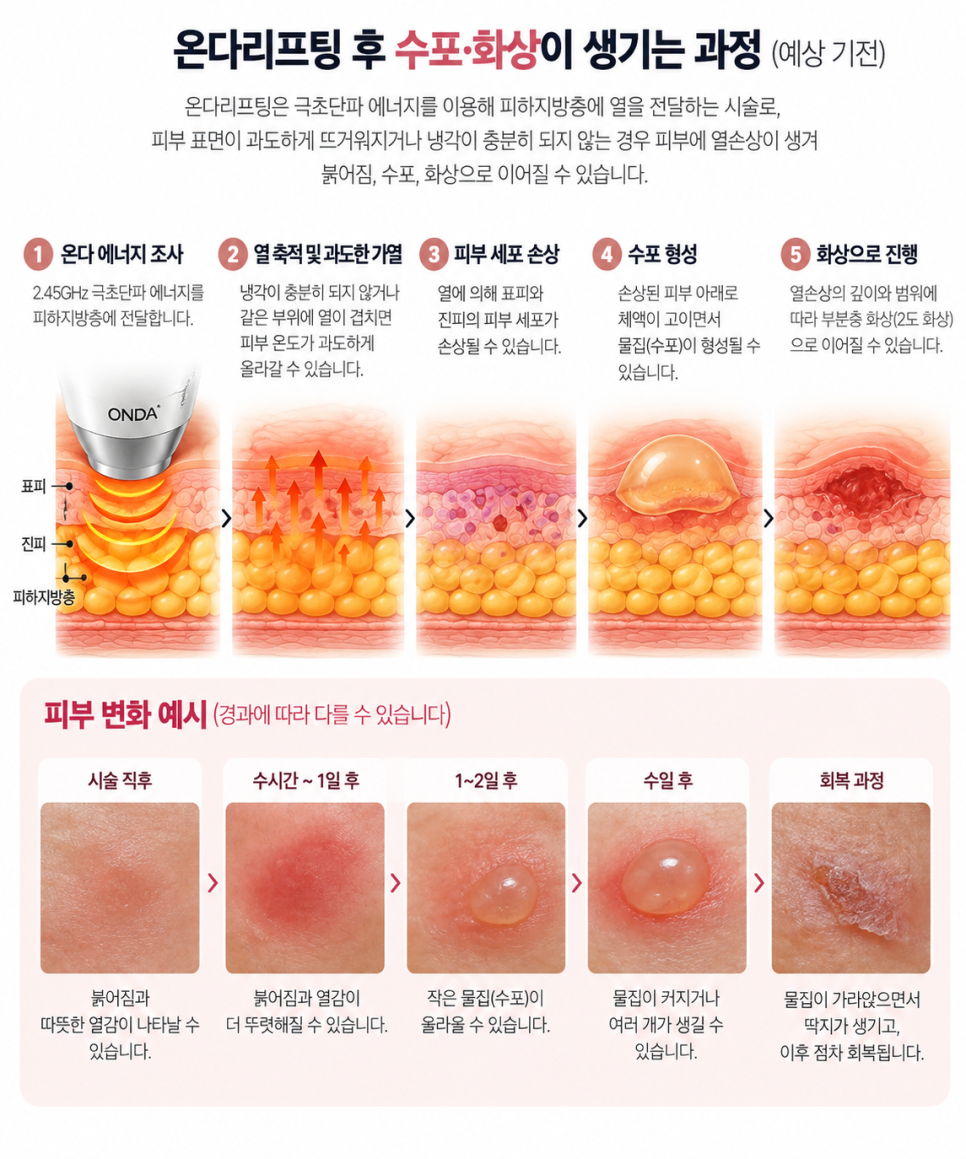
A blister is a state in which the surface layer of the skin has been damaged by heat and fluid has collected beneath it; in terms of burn classification, it is characteristic of a partial-thickness burn (second-degree burn), where the effect goes beyond the epidermis into part of the dermis.
The recommendations explain that burns and blisters are also usually temporary, but the recovery period can vary depending on the depth of the damage.
Also, a burn can deepen during the first 48 hours, so its condition sometimes becomes clearer a day or two after treatment rather than on the day itself.
So if it’s simply red and warm, you can watch how it progresses, but if blisters form or there is an area where the skin has turned white and become hard like leather, it should be regarded as thermal damage to the skin rather than an ordinary treatment reaction, and it’s best to have it checked.
What Should I Do If a Blister Forms?
- Don’t pop or peel off the blister
- Keep the area from rubbing against clothing or underwear lines
- If it feels like it’s burning, cool it with clean, cool water or a cold towel, but don’t apply ice directly to the skin
- Contact the clinic where you were treated before applying any ointment or home remedy on your own
- Take photos and keep track of changes in the blister’s size and any oozing
Will It Leave a Scar or Pigmentation?
When a blister forms, the biggest worry is usually, “Will it leave a mark?”
This depends on the depth of the damage.
Superficial second-degree burns that form blisters mostly heal within 3 weeks.
Deeper second-degree burns, on the other hand, take more than 3 weeks to heal and can lead to scarring.
Another thing to watch out for is pigmentation.
As the skin recovers from inflammation, post-inflammatory hyperpigmentation can occur, leaving the spot brown for a while, and it is relatively common in people with comparatively darker skin tones, such as Asians. It mostly fades over time, but it can take several months or more.
The International Advisory Board recommends avoiding direct sunlight for two days after treatment, and for areas with blisters or burns, it’s best to protect them from UV for longer, until they have healed.
Be Sure to Have It Checked in These Cases
- If blisters have formed, especially if they are large or numerous
- If a blister has burst and keeps oozing fluid
- If the treated area turns white or becomes hard like leather and, instead of hurting more, feels numb
- If the red area keeps spreading and the warmth, swelling, or pain gets worse
- If there is yellow pus, an odor, or fever
Does a Burn Mean the Treatment Was Done Wrong?
The ONDA International Advisory Board also addresses burns and blisters as one of the side effects that can occur after treatment.
However, unlike nodules, which are a tissue reaction occurring within the fat layer, burns are a side effect closely related to how much heat builds up on the skin surface.
That’s why cooling and contact, handpiece movement, and energy settings are important in reducing the risk.
The recommendations advise stopping the use of moisturizing creams or gels from one day before treatment, and applying a thin layer of pure Vaseline oil during treatment so that the handpiece makes proper contact with the skin. They also recommend setting the energy for each area based on the patient’s pain response.
They also recommend stopping the treatment if strong redness, warmth, blisters, or deep pain appear during the procedure.
So if you feel that it’s “too hot” or that it “hurts like stabbing” during treatment, it’s important not to put up with it but to tell us right away.
The warmth and pain you feel are an important guide for adjusting the energy.
Also, for an area that has developed a burn or blister, it’s best to postpone further treatment of that area and decide on the next session only after confirming that the skin has fully recovered.
To Sum Up
Blisters and burns after ONDA Lifting are among the side effects that can actually occur.
ONDA is a treatment that delivers heat energy to the fat layer, and while the handpiece’s cooling function protects the skin, thermal damage to the skin can occur in areas the cooling doesn’t adequately reach, such as around the navel, or where heat overlaps in one spot.
Redness and warmth right after treatment are a temporary reaction that usually subsides within a few days.
A blister, on the other hand, is a sign that the surface layer of the skin has been damaged, so rather than popping or peeling it at home, it’s best to have it checked.
Superficial second-degree burns that form blisters mostly heal within 3 weeks, but pigmentation can develop during recovery, so UV protection is needed.
If the skin turns white or becomes hard like leather and loses sensation, or if pus or fever is present, more active examination and treatment are needed.
Because ONDA is an energy-based treatment that produces real changes in the fat layer, it’s important to adjust the energy while checking warmth and pain during treatment, and to follow the skin’s progress after treatment as well.
Blisters and burns are side effects that can occur, but how they’re handled afterward determines recovery.
Don’t pop blisters at home; the depth of the damage needs to be checked and managed accordingly.
About ACRO Korean Medicine Clinic
📍 Location: 1 min walk from Sinnonhyeon Station Exit 3 (2F Boratial Bldg., 480 Gangnam-daero, Gangnam-gu, Seoul)
📞 Consultations: search “acrohani” on KakaoTalk
🌐 Website: https://acrohani.com/en
📝 Naver reviews 1,000+ (9.5★) | Gangnam Unni reviews 500+ (9.6★)
Hours: Weekdays 10:30–20:30 (lunch 13:00–14:00) / Weekends & public holidays 10:00–15:30 (no lunch break)
This post is intended to provide medical information and does not replace the diagnosis or treatment of individual patients.
If you have any unusual symptoms after treatment, please do not judge them yourself — see a medical professional.
References
Hoffmann K, Zappia E, Bonan P, et al. Microwave-Energy-Based Device for the Treatment of Cellulite and Localized Adiposity: Recommendations of the “Onda Coolwaves” International Advisory Board. Bioengineering. 2024;11(12):1249.
Lanham JS, Nelson NK, Hendren B, Jordan TS. Outpatient Burn Care: Prevention and Treatment. American Family Physician. 2020;101(8):463-470.
Ahmed MZ, McEwan W, Maqsood S. Management of Burn Blisters in Urgent Care. Journal of Urgent Care Medicine. 2022;16(10):13-18.
Davis EC, Callender VD. Postinflammatory Hyperpigmentation: A Review of the Epidemiology, Clinical Features, and Treatment Options in Skin of Color. Journal of Clinical and Aesthetic Dermatology. 2010;3(7):20-31.