
Hello, this is Dr. Han Ji-young of ACRO Korean Medicine Clinic.
“I’m slim overall, but my belly looks saggy.”
In abdominal consultations, quite a few people tell me exactly this.
Their arms and legs are slim and their weight is within the normal range, yet they are bothered that the lower belly seems to stick out or that the volume at the flanks rests over the top of their pants.
Most of them wonder whether they need to diet even more.
But in someone who is already slim, losing weight often doesn’t change the abdominal contour much.
That’s because the cause of the sagging and volume is not fat but the elasticity of the skin and connective tissue.
Today I’ll introduce the ONDA Lifting cases of two patients who came in with concerns about abdominal sagging and volume despite being slim.
One was concerned about the lower belly and flank line, the other about loose skin left after liposuction.
Slim Abdomen: Why Lifting Instead of a Fat Treatment?
- The thickness of the subcutaneous fat layer (the fat just beneath the skin)
- The elasticity of the dermis (the skin layer where collagen is distributed) and connective tissue
Case 1. Refining the Lower Belly and Love Handle Line (Woman in Her 40s)
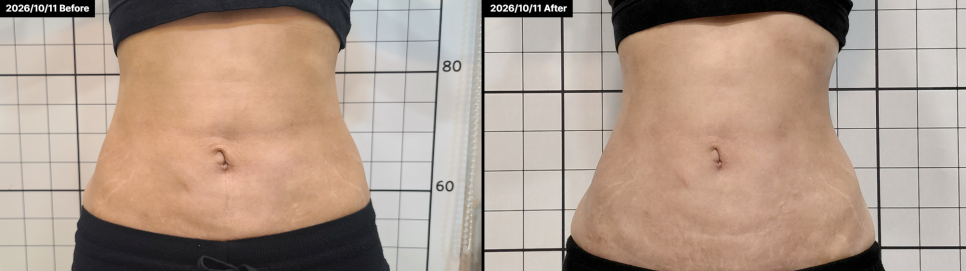
- Waistline relatively straight, without a clearly defined curve
- Lower belly resting slightly over the waistband of her pants
- Fat layer at the flanks not thick, but the skin sagging downward to form love handles
- 26/10/11 ONDA Lifting
- Area: lower belly + both flanks (love handle) line
- Energy: 150,000J
Case 2. Loss of Elasticity After Liposuction (Woman in Her 30s)
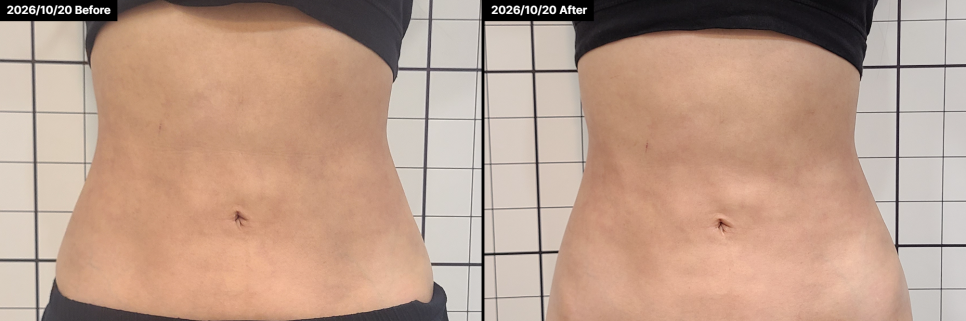
- A slim abdomen with almost no palpable body fat
- The skin had not contracted as much as the fat removed, so the surface was somewhat loose and uneven in texture
- A flat waist curve, giving the overall impression of being merely flat
- 26/10/20 ONDA Lifting
- Area: entire abdomen (upper to lower belly, waistline on both sides)
- Energy: 150,000J
Key Points from These Two Cases
First, a slim abdomen should be assessed by “tissue condition,” not “amount of fat.”
Neither patient had much fat to reduce. In such cases, an approach focused on fat breakdown does not change the contour as much as expected.
We first check the thickness of the fat layer by palpation and see how much the skin is sagging.
If the fat layer is thin and loss of elasticity is the main cause, lifting alone is the more efficient choice.
Second, loss of elasticity after liposuction is also a good indication for lifting.
Liposuction removes fat, but it doesn’t tighten the skin.
Microwave energy delivers heat to the fat layer and dermis to stimulate collagen regeneration, which makes it well suited to refining skin left behind after fat has been removed.
However, if there is a history of liposuction, we first check the tissue condition and sensation in the treatment area before proceeding.
Third, the immediate change is just the beginning — the real results appear weeks later.
The tightening seen right after treatment is a response caused by collagen contraction.
Fat reduction and collagen regeneration begin from 2–6 weeks and peak at around 3 months.
So rather than judging by the immediate post-treatment photos alone, it is more accurate to look at progress over 1–3 months.
Summary
The answer to the question “Does treatment make sense if I don’t have much fat?” depends on what is causing your concern.
On a slim abdomen, the contour usually blurs because of elasticity, not fat.
In this case, lifting that tightens collagen may be a better-suited direction than a treatment that removes fat.
Of course, tissue condition and response differ from person to person, so results also vary individually.
The starting point is to find out whether your abdomen’s issue is fat or elasticity.
We will design a treatment strategy suited to your body type and tissue condition together during your consultation.
* All photos were uploaded with the consent of the individuals concerned, in accordance with Articles 23 and 56 of the Medical Service Act.
* This post is a medical advertisement of ACRO Korean Medicine Clinic and was written in compliance with Article 56(1) of the Korean medical advertising rules (Medical Service Act).
* Side effects may occur after treatment depending on individual differences, so please be sure to have a thorough consultation with our medical staff.