


Hello, this is Dr. Park Ji-seon of ACRO Korean Medicine Clinic.
When the cheeks beside the corners of the mouth look like they’re sagging, many people assume, “Do I need to lose face fat?”
But just because a face looks saggy doesn’t mean reducing volume across the whole face is the answer.
Where to take volume away and where to preserve it depends on where the volume has gathered and which areas should not be reduced.
Today I’ll show you the before-and-after case of a woman in her 20s
who was concerned about both sagging deep cheek fat and left–right jaw asymmetry, after one session of ONDA Lifting.
What Was Her Concern?
This patient’s main concern was that her deep cheek fat area looked like it was sagging downward.
In the pre-treatment photo, volume has gathered in the area running from beside the corners of the mouth down to the jawline,
so the lower part of the face looks spread out to the sides.
On top of this, there was left–right asymmetry at the jaw joint, so the patient’s left lower face (the right side in the photo) looked wider than the right.
Another area I paid close attention to was below the cheekbones.
Below the cheekbones is an area where the cheeks can easily look hollow if fat is reduced.
If the treatment area is set too broadly in an effort to tidy up sagging cheeks, volume can be reduced here too, which may actually create hollow cheeks.
So we set three goals for this treatment:
refine the volume of the deep cheek fat and jawline that had gathered low, preserve the area below the cheekbones,
and allocate a little more energy to the left side, which looked wider.
Even with the Same 65,000 J, Where You Put It Decides the Result
In ONDA consultations, I’m often asked, “How many joules do I need?”
But on the face, where and at what depth the energy is allocated determines the result more than the total energy does.
In this case, we used two handpieces with different depths.
The 7mm handpiece acts on the deep fat layer and is used to reduce volume,
while the 3mm handpiece acts on the shallow layer and is used to reinforce skin elasticity.
Of the total 65,000 J, 50,000 J was assigned to the 7mm handpiece because the core of this concern was volume that had gathered low.
How Was This ONDA Lifting Session Performed?
This treatment was performed as follows.
| Item | Details |
|---|---|
| Treatment date | October 26, 2026 |
| Session | Session 1 |
| Power | 80–90W |
| Total energy | 65,000J |
| 7mm handpiece | 50,000J |
| 3mm handpiece | 15,000J |
| Treatment area | Double chin, jawline, deep cheek fat (front of the cheeks only very lightly) |
| Excluded area | Below the cheekbones (to prevent hollow cheeks) |
| Left–right allocation | A little more energy on the left, where the lower face was wider |
Right After One ONDA Lifting Session: How Did the Front View Change?
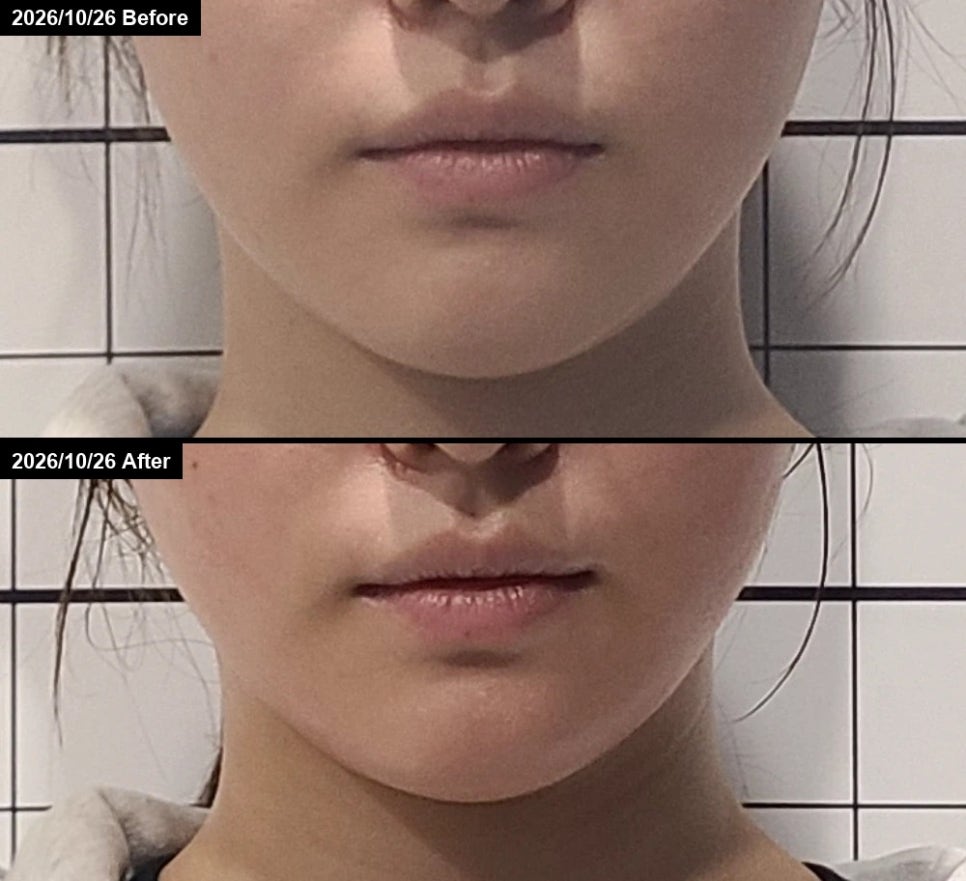
Front view immediately after 1 ONDA session
Face ONDA, immediately after 1 session: the photos above were taken on the same day, before treatment and right after the first session.
The first things to compare are the line running from beside the corners of the mouth to the tip of the chin, and the width of the lower face on each side.
Before treatment, the volume in the lower part of the deep cheek fat made the lower face look spread out to the sides, and the left lower face was wider.
Right after treatment, this line is tidied toward the tip of the chin, making the lower face look much lighter,
and the width of the wider left lower face has decreased, so the left–right difference is less noticeable.
The redness on the cheeks is temporary warmth right after treatment.
From the Side, How Did the Jawline Change?
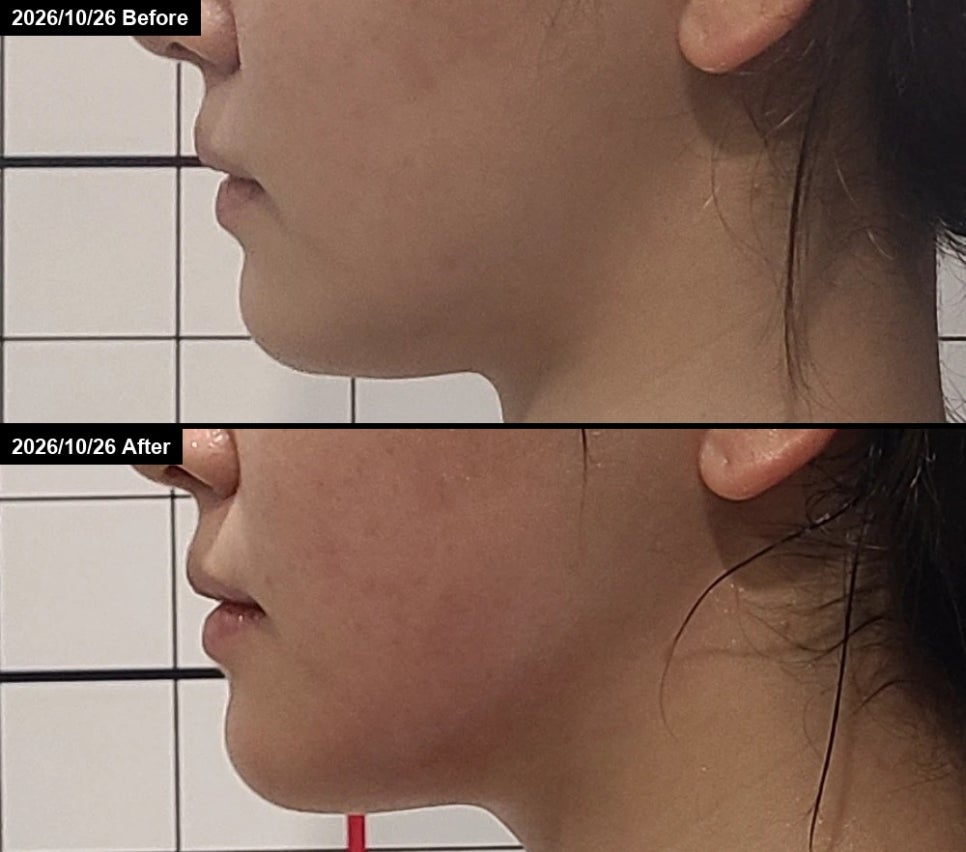
In the side view immediately after 1 face ONDA session, compare the line running from the tip of the chin to the neck.
Before treatment, the volume below the jawline flowed gently into the neck.
Right after treatment, the area under the chin is more refined, so the angle between the jaw and neck looks more defined than before.
Can ONDA Also Correct Jaw Asymmetry?
It depends on the cause of the asymmetry.
Asymmetry that comes from the jaw joint or bone structure is difficult to change with ONDA Lifting,
but if the volume sitting on top is making the wider side look even wider,
simply allocating more energy to the wider side to refine that volume
can make the left–right difference look less noticeable.
That’s why, for a face with asymmetry, rather than putting the same amount on both sides, we assess each side separately and decide the allocation.
Clinical Points from This Case
First, for cheeks that look saggy, start by looking at where the volume has gathered.
In this patient, volume had gathered in the lower deep cheek fat and the jawline.
So we reduced the lower area with the 7mm handpiece and excluded the area below the cheekbones, which is prone to hollowing, from the treatment area.
Second, a face that differs left and right needs a different allocation too.
The jaw joint asymmetry itself doesn’t change, but when we put a little more energy on the wider-looking left side to refine the volume on top, the left–right difference looked smaller even in the immediate post-treatment photos.
Frequently Asked Questions
Q. Can just one ONDA session change the deep cheek fat line?
As in this case, a change in the line can be visible even right after one session.
However, the immediate photos also include some temporary swelling,
so at our clinic we recommend 3 sessions at 3–4 week intervals and judge the result by how things look after the sessions are complete.
Q. Won’t reducing face fat make my cheeks hollow?
It can if the treatment area is set too broadly.
That’s why we exclude hollow-prone areas such as below the cheekbones from the deep-layer treatment area and refine only where the volume has gathered.
In Closing
If sagging deep cheek fat and a wide-looking lower face are both concerns,
it is important to first separate the areas where volume has gathered from the areas that need preserving, rather than reducing the whole face.
This patient had one session at 7mm 50,000J and 3mm 15,000J,
and line changes were confirmed in both the front and side views right after treatment.
If the cheeks beside the corners of your mouth look saggy, or a left–right difference in your jaw bothers you,
it’s a good idea to first check where your volume has gathered and how the two sides differ.
At ACRO Korean Medicine Clinic, we look at where volume has gathered, which areas need preserving (such as those prone to hollow cheeks),
and the left–right difference together to decide the treatment area and allocation for each handpiece.
About ACRO Korean Medicine Clinic
📍 Location: 1 min walk from Sinnonhyeon Station Exit 3 (2F Boratial Bldg., 480 Gangnam-daero, Gangnam-gu, Seoul)
📞 Consultations: search “acrohani” on KakaoTalk
🌐 Website: https://acrohani.com/en
📝 Naver reviews 1,000+ (9.5★) | Gangnam Unni reviews 500+ (9.6★)
🕒 Hours: Weekdays 10:30–20:30 (lunch 13:00–14:00) / Weekends & public holidays 10:00–15:30 (no lunch break)
* All photos were uploaded with the consent of the individuals concerned, in accordance with Articles 23 and 56 of the Medical Service Act.
* This post is a medical advertisement of ACRO Korean Medicine Clinic and was written in compliance with Article 56(1) of the Korean medical advertising rules (Medical Service Act).
* Side effects may occur after treatment depending on individual differences, so please be sure to have a thorough consultation with our medical staff.
#DeepCheekFat #SaggingCheeks #ONDALifting #ONDA #JawlineLifting #JawAsymmetry #LiftingInYour20s #MicrowaveLifting #SinnonhyeonKoreanMedicineClinic #GangnamKoreanMedicineClinic #ACROKoreanMedicineClinic