



Hello, this is Dr. Park Ji-seon of ACRO Korean Medicine Clinic.
As the end of the year approaches, consultations about weight loss increase noticeably.
That’s because it’s the time when results come in from health checkups that people put off until year’s end.
Many people tell us they had meant to lose weight for a while, and only booked an appointment after seeing about three lines marked “borderline” on their results.
Fasting blood glucose 105, triglycerides 170, blood pressure 135, and so on —
they were told they don’t need medication yet, so they wonder how many kilograms they need to lose for that word to disappear.
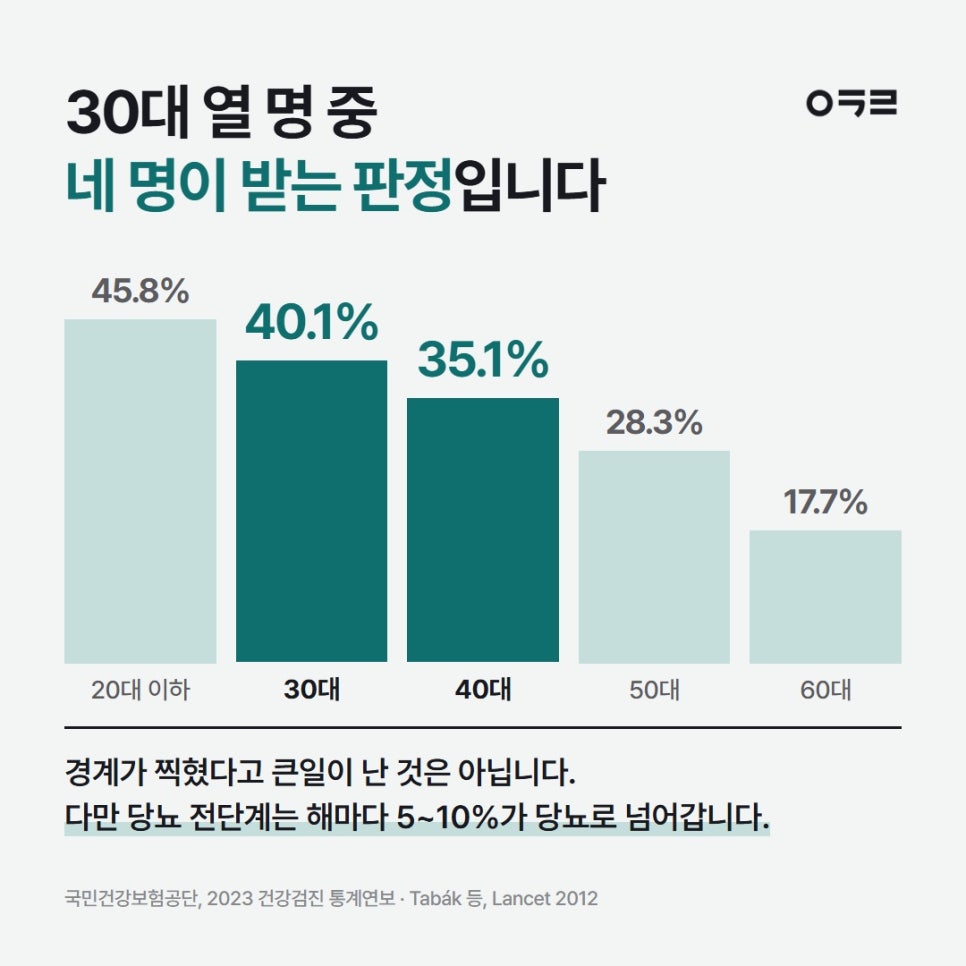
Of the 17.46 million people who had a general health checkup in 2023, 29.5% received this “Normal B (borderline)” result, and among people in their 30s alone it was 40.1%.
It’s a result four out of ten people in their 30s receive, so a borderline mark on your results doesn’t mean something terrible has happened.
However, if borderline results are left as they are, some people move toward disease every year,
and conversely, there is evidence that losing just around 5% of body weight moved blood sugar, blood pressure, and triglycerides together.
How many kilograms you should lose is better decided by how far your checkup numbers come back than by the number on the scale.
So today, using research data, I’d like to look at how common borderline results are, where they head if left alone,
and which items move, and by how much, when you lose 5% of your body weight.
How Many People Get a Borderline Result?
Three out of ten adults who have a checkup are borderline, and the younger the age group, the higher the proportion.
According to the 2023 health checkup statistics released by the National Health Insurance Service (NHIS) at the end of 2024,
the overall results of the general health checkup were Normal A 10.6%, Normal B (borderline) 29.5%, suspected disease 32.2%, and existing disease 27.6%.
| 2023 General health checkup | Normal A | Normal B (borderline) | Suspected disease | Existing disease |
|---|---|---|---|---|
| 20s and under | 26.3% | 45.8% | 26.9% | 1.0% |
| 30s | 19.7% | 40.1% | 36.1% | 4.1% |
| 40s | 10.5% | 35.1% | 39.8% | 14.7% |
| 50s | 7.3% | 28.3% | 33.1% | 31.3% |
| 60s | 3.1% | 17.7% | 28.2% | 51.0% |
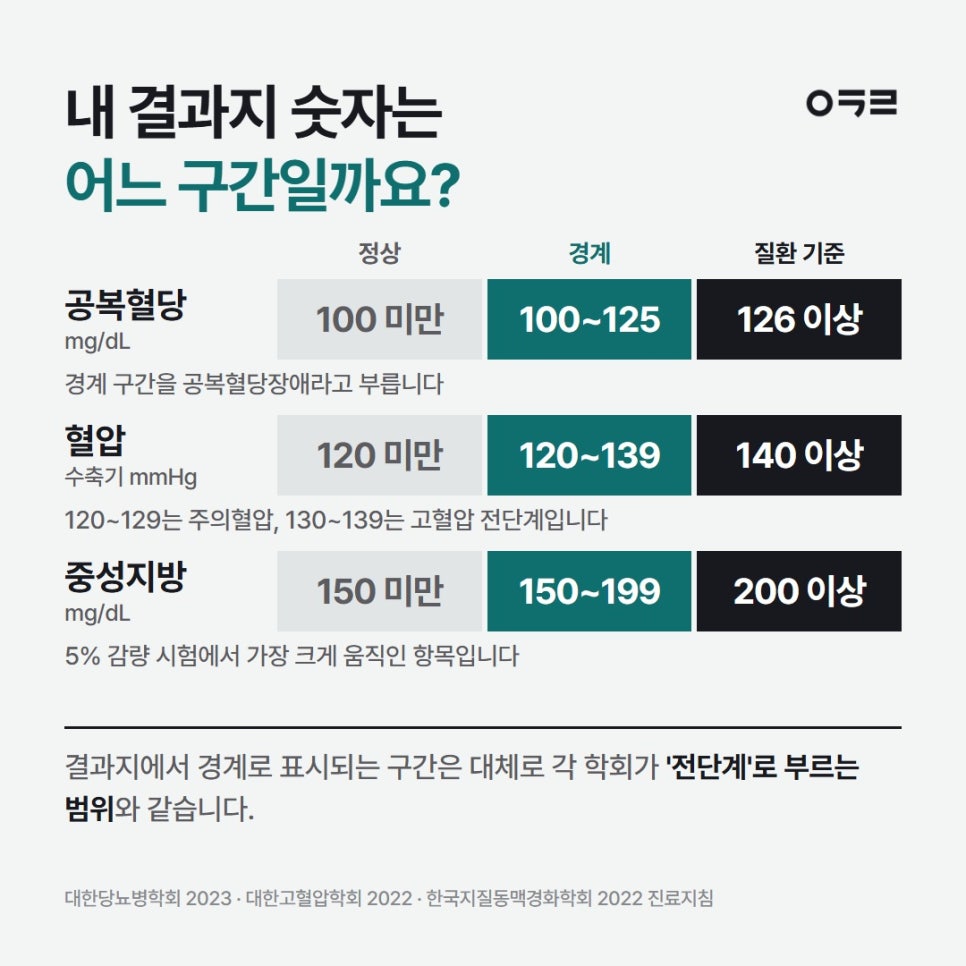
The ranges marked as borderline on your results generally match what the respective medical societies call the “pre-” stage.
| Item | Normal | Borderline (pre-stage) | Disease threshold |
|---|---|---|---|
| Fasting blood glucose | Under 100mg/dL | 100–125mg/dL (impaired fasting glucose) | 126 or higher |
| Blood pressure | Under 120/80 | Elevated blood pressure 120–129/under 80, prehypertension 130–139 or 80–89 | 140/90 or higher |
| Triglycerides | Under 150mg/dL | 150–199mg/dL | 200 or higher |
What Happens If Borderline Results Are Left Alone?
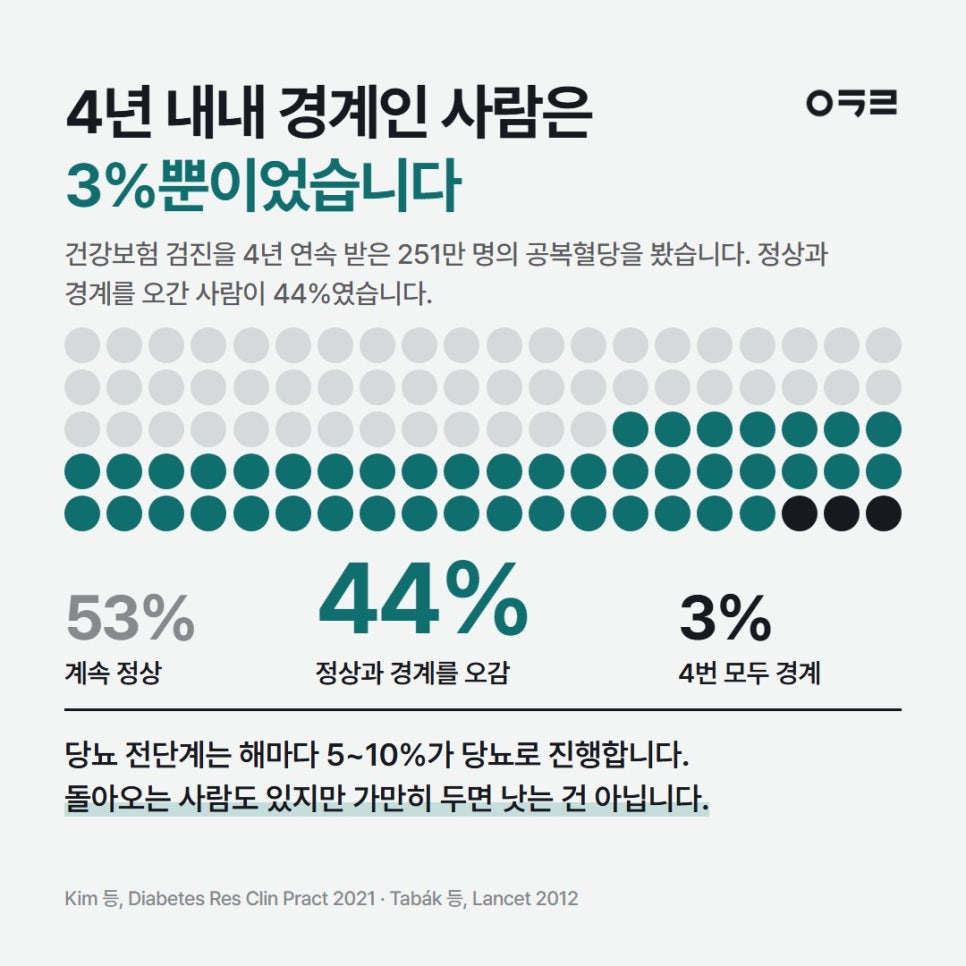
Every year, some people progress to disease, some return to normal, and many go back and forth in between.
A 2012 review in the Lancet and a 2023 review in JAMA
summarized that among people with prediabetes, 5–10% progress to diabetes each year, and a similar proportion return to normal.
Please don’t read “some people return to normal” to mean that it will get better if you leave it alone.
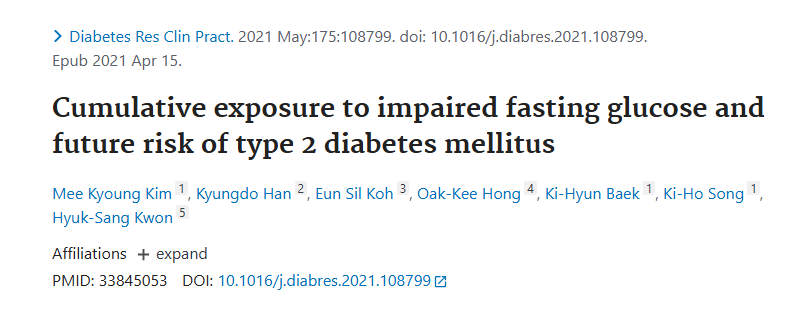
Kim et al., Diabetes Research and Clinical Practice 2021. A study that followed 2.51 million people who had national health insurance checkups for 4 consecutive years
Korean data illustrate this back-and-forth well.
It’s a 2021 study that followed 2,513,127 people who had national health insurance checkups for 4 consecutive years, through 2016.
Over the 4 years, 53% had normal fasting blood glucose throughout, only 3% were borderline (100–125) all 4 times, and 44% went back and forth between normal and borderline.
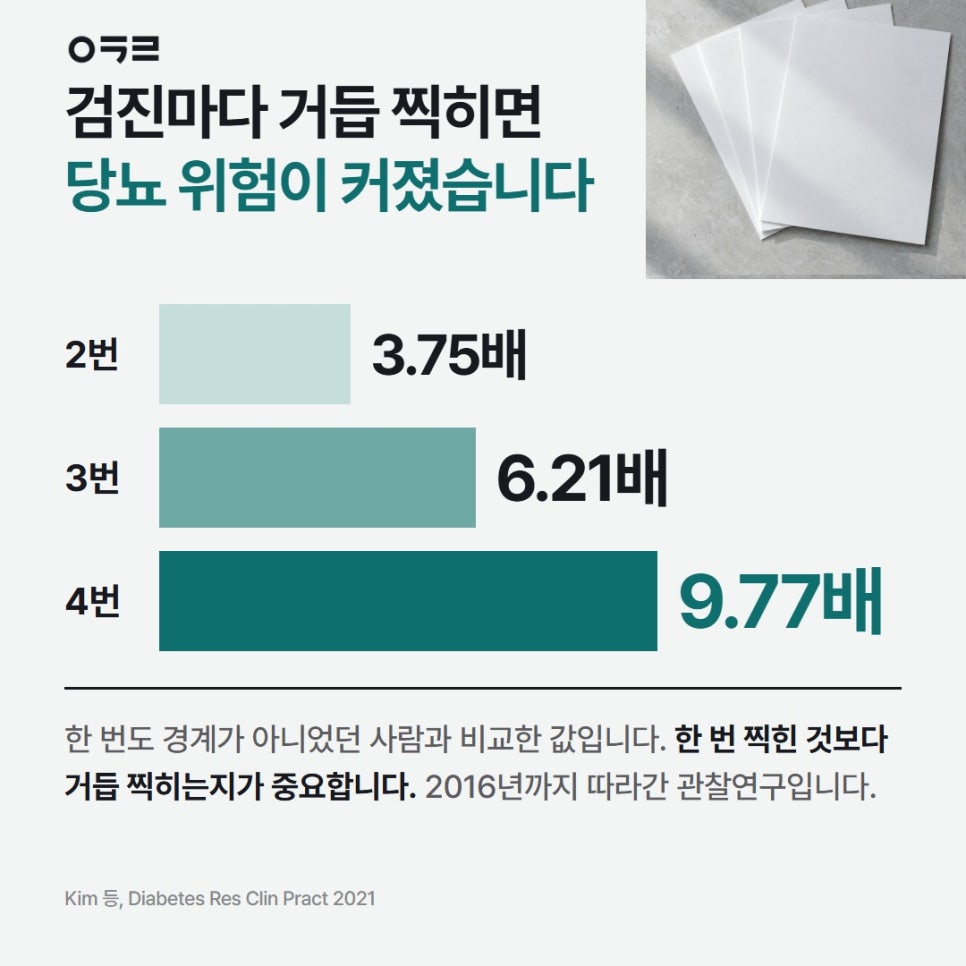
Compared with people who were never borderline, the risk of developing diabetes was observed to be 3.75 times higher for those borderline 2 times, 6.21 times for 3 times, and 9.77 times for 4 times.
The finding is that what matters is not a single borderline mark, but whether it shows up again at every checkup.
In a 2024 Korean checkup cohort that looked at what happens when weight increases further in a borderline state,
men with prehypertension who gained weight during follow-up had 1.15 times more cardiovascular events, and men with prediabetes had 1.19 times more.
These are all observational studies, so what they can tell us is that people who were borderline developed more disease.
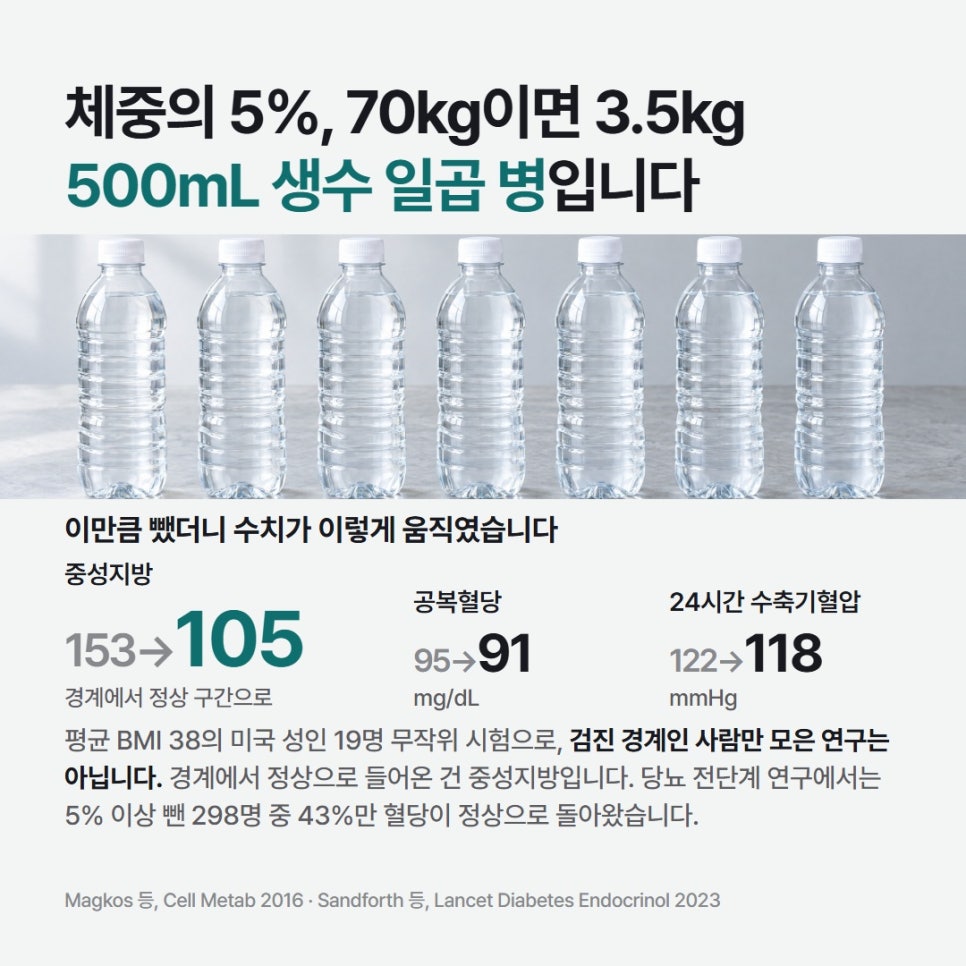
What Changes with 5% of Body Weight?
When people lost 5% of their body weight — 3.5kg for someone weighing 70kg — blood sugar, blood pressure, triglycerides, and liver enzymes went down together.
This is a randomized trial published in Cell Metabolism in 2016,
which compared adults with obesity divided into a 5% weight-loss group of 19 people and a weight-maintenance group of 14.
The weight-loss group lost 5.4kg, from an average of 106.2kg to 100.8kg, and in that time the values corresponding to checkup items moved like this.
| Item | Before weight loss | After 5% weight loss |
|---|---|---|
| Fasting blood glucose | 95mg/dL | 91mg/dL |
| Fasting insulin | 16.7mU/L | 15.0mU/L |
| 24-hour systolic blood pressure | 122mmHg | 118mmHg |
| Triglycerides | 153mg/dL | 105mg/dL |
| Liver enzyme (ALT) | 18U/L | 15U/L |
| HDL and LDL cholesterol | No significant change | No significant change |
What patients find most surprising here is triglycerides.
While blood sugar and blood pressure moved by a few units,
triglycerides fell from 153 to 105 — enough to move from the borderline range into the normal range.
In the same study, 9 people went on to lose even more, up to 11% and 16%,
and fasting insulin (18.3→9.5mU/L) and triglycerides (153→97mg/dL) kept falling the more they lost, while fasting blood glucose did not fall further.
Keep in mind that the number of participants was small, from 9 to 19, that they were American adults with obesity with an average BMI of 38,
and that the study did not specifically recruit people with borderline checkup results.
Does Losing More Make It Better?
For blood sugar and triglycerides, the more weight people lost, the more the likelihood of reaching improvement rose substantially;
for blood pressure it rose gently, and LDL cholesterol was unrelated to the amount of weight lost.
| Improvement criterion (odds ratio, weight-stable group = 1) | 2–5% weight loss | 5–10% weight loss | 10–15% weight loss | 15% or more weight loss |
|---|---|---|---|---|
| Fasting blood glucose down 20mg/dL | 1.75× | 3.24× | 4.07× | 7.92× |
| HbA1c down 0.5%p | 1.80× | 3.52× | 5.44× | 10.02× |
| Triglycerides down 40mg/dL | 1.46× | 2.20× | 3.99× | 7.18× |
| Systolic blood pressure down 5mmHg | 1.24× | 1.56× | 2.29× | 2.65× |
| Diastolic blood pressure down 5mmHg | Not significant | 1.48× | 1.60× | 2.39× |
| LDL down 10mg/dL | Not significant | 1.34× | Not significant | 1.34× |
This is a 2011 analysis from the US Look AHEAD study, in which 5,145 adults with overweight or obesity and type 2 diabetes (average 100.7kg)
were grouped according to their weight change after 1 year.
It is an observational analysis based on actual weight loss, looking at the odds ratio of reaching a “meaningful improvement” in each item compared with people whose weight stayed the same.
The 5–10% weight-loss group consists of people who lost an average of 7.25kg.
Because these data come from people who already have diabetes, rather than expecting the same multiples if you are at the borderline stage,
you can read them as a way to see “which items are sensitive to body weight.”
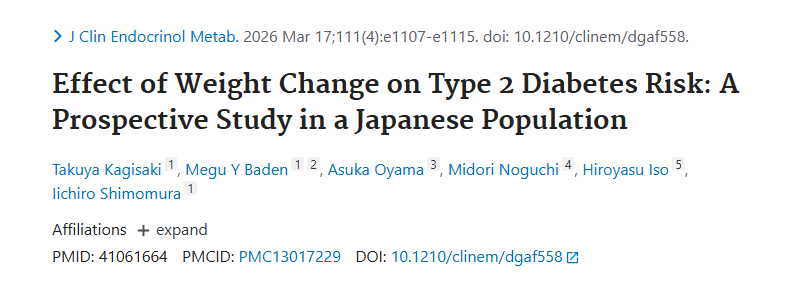
Kagisaki et al., Journal of Clinical Endocrinology & Metabolism 2026.
A study that followed 1-year weight change and diabetes incidence in 41,539 Japanese checkup participants for 5.7 years)
There are also data from ordinary checkup participants without diabetes.
It’s a study from Kochi Prefecture, Japan, published in the Journal of Clinical Endocrinology & Metabolism in 2026.
Following 41,539 checkup participants for 5.7 years, people who reduced their weight by 3–4.9% over 1 year
developed diabetes 25% less often than those whose weight stayed the same, and those who reduced it by 5% or more, 26% less often;
conversely, a gain of 3–4.9% meant 35% more, and a gain of 5% or more meant 51% more.
This association was clear at a BMI of 25 or higher, while in people with a BMI under 22 there was no association between weight change and diabetes.
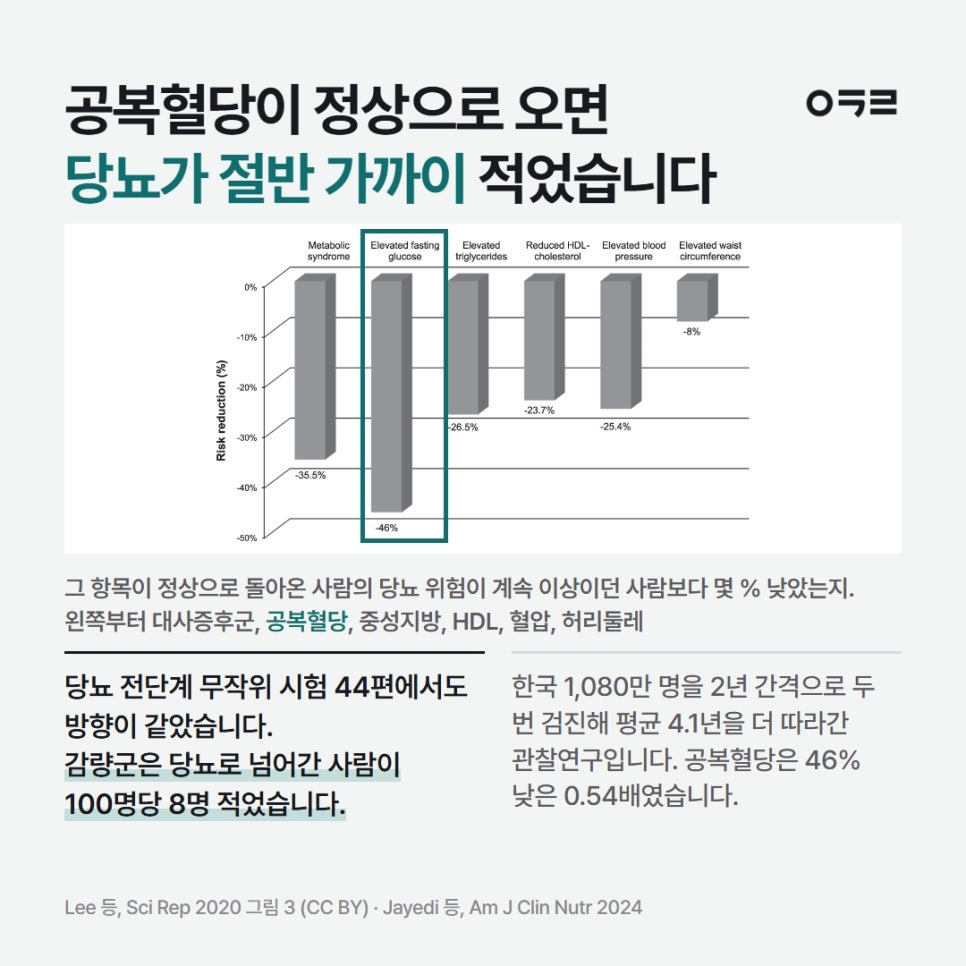
If a Borderline Result Returns to Normal, Does the Risk Return to Normal Too?
In Korean data on 10.8 million people, those whose fasting blood glucose returned from borderline to normal
developed diabetes nearly half as often as those who remained borderline.
This is a study published in Scientific Reports in 2020.
10,806,716 people aged 20 and over had two checkups 2 years apart
and were followed for an average of 4.1 more years, during which 848,859 developed diabetes.
Compared with people who were abnormal at both checkups, the diabetes risk of those whose item returned to normal at the second checkup was
0.54 times for fasting blood glucose, 0.735 times for triglycerides, 0.746 times for blood pressure, and 0.763 times for HDL.
Because these are observational data, those who returned to normal may have been different to begin with,
but results from randomized trials point in the same direction.
| Study | Participants | Results |
|---|---|---|
| Jayedi 2024 meta-analysis | 44 randomized trials in prediabetes 14,742 people, median 2 years | In the lifestyle weight-loss groups, 11 more people per 100 returned to normal blood glucose than in the control groups, and 8 fewer per 100 progressed to diabetes. Proportional to the amount lost within the 1–9% weight-loss range |
| Knowler 2002, US Diabetes Prevention Program, 3,234 people | Goal of 7% weight loss + 150 minutes of exercise per week, 2.8 years | Diabetes incidence 4.8 per 100 per year vs. 11.0 in the control group (58% lower) |
| Hamman 2006, 1,079 people in the lifestyle group of the same study | Comparison of weight actually lost and incidence | 16% reduction in diabetes incidence for every 1kg lost |
| Vazquez Arreola 2026, 2,402 of the same participants followed for 20 years | The 11.5% whose blood glucose returned to normal after 1 year vs. the rest | Cardiovascular death or hospitalization for heart failure 1.74 vs. 4.17 per 1,000 per year (adjusted hazard ratio 0.41). China Da Qing study 0.49 |
However, even with the same 5% weight loss, only some people see their blood glucose return to normal.
In a 2023 German study, only 43% of 298 people who lost 5% or more returned to normal blood glucose;
those who returned lost the same amount of weight but reduced more visceral fat, and had 73% less diabetes over the following 2 years.
This is where the idea comes from that you should look at whether your numbers returned, rather than how many kilograms you lost.
For blood pressure, a meta-analysis of 25 randomized trials found that systolic pressure fell by around 1mmHg per 1kg lost.
And evidence that such lifestyle programs reduce death itself was not confirmed in a 2022 meta-analysis of 11 studies,
so improving your numbers and living longer are, for now, still separate matters.
If You Got a Borderline Result, Pay Special Attention to These
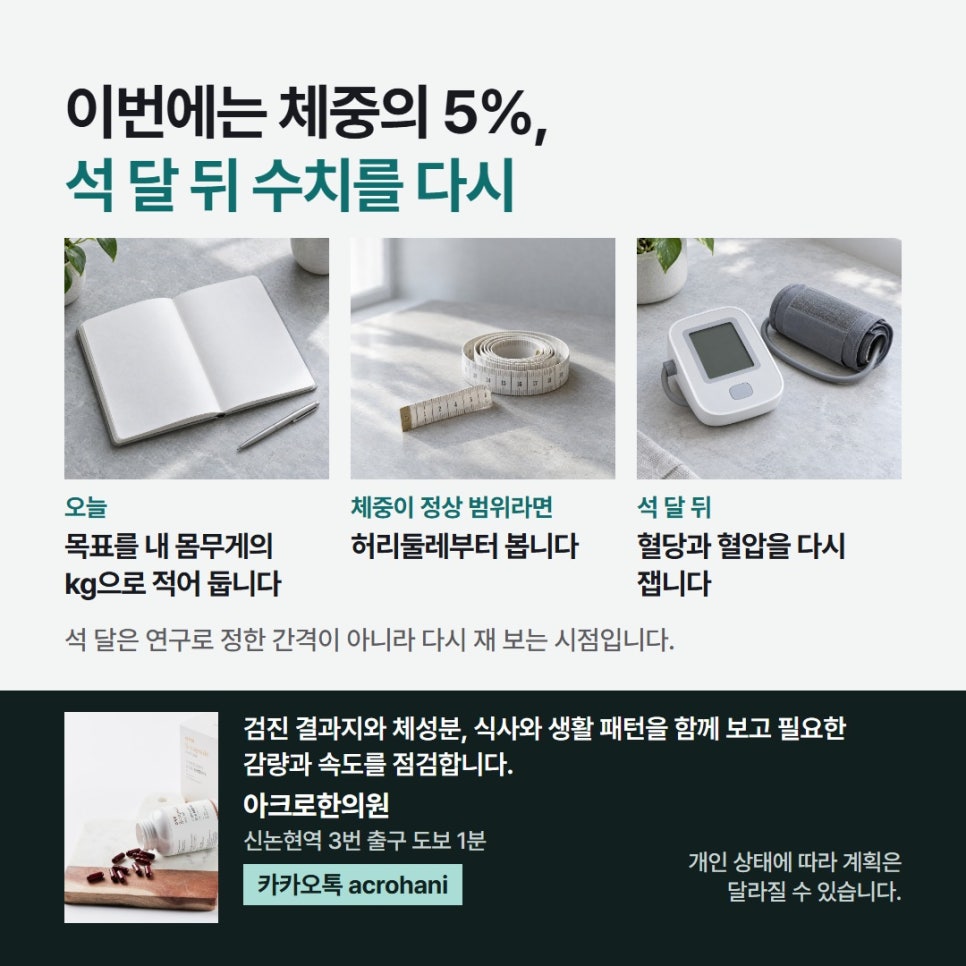
1. 3.5kg if you weigh 70kg — write your goal down in kilograms of your own body weight
Converted into numbers, 5% of body weight is 3.5kg at 70kg and 4kg at 80kg.
This is roughly the range at which triglycerides, blood sugar, and blood pressure moved together in the 5% weight-loss trial, and in the Diabetes Prevention Program, risk fell by 16% for every 1kg.
Before setting a 10kg goal, reaching and maintaining this number first is closer to the direction the data point to.
2. Triglycerides move a lot; blood pressure moves a little
In the 5% weight-loss trial, triglycerides fell from 153 to 105, whereas
systolic blood pressure moved 4mmHg, from 122 to 118, and in the data on 5,145 people as well, the odds ratio for blood pressure rose only gently as the amount of weight lost increased.
Even if the blood pressure box is still the same when you’re re-measured, it doesn’t mean you’ve failed — look at the triglyceride and blood sugar boxes first.
3. If your weight is in the normal range, look at your waist circumference first
If your BMI is normal but three lines are borderline, it’s better to check your waist circumference and visceral fat first rather than trying to shift your overall weight.
If you have a lot of visceral fat, a few kilograms of weight loss can be considered; if a specific area such as the abdomen or upper arms is your concern, local treatments such as lipolytic pharmacopuncture (ACRO Cut) or ONDA Lifting can be considered.
4. Re-measure your blood sugar and blood pressure in three months
In the data on 2.51 million people, only 3% were borderline all 4 times; most went back and forth.
It’s not an interval backed by research, but rather than waiting until your checkup 2 years later, we recommend re-measuring at a nearby clinic or public health center in about 3 months to see which way things are moving.
To Sum Up
1. 29.5% of people who had a general health checkup in 2023 received a borderline result: 40.1% of those in their 30s and 35.1% of those in their 40s
2. Each year, 5–10% of people with prediabetes progress to diabetes, and in Korean data on 2.51 million people, being borderline at all 4 of 4 checkups was associated with a 9.77-fold risk of diabetes
3. In a 5% weight-loss randomized trial, triglycerides fell from 153 to 105mg/dL, fasting blood glucose from 95 to 91, and systolic blood pressure from 122 to 118
4. Among 41,539 Japanese checkup participants, those who reduced their weight by 3–5% in 1 year developed diabetes 25–26% less often, and those who gained that much developed it 35–51% more often
5. In Korean data on 10.8 million people, those whose fasting blood glucose returned to normal had 0.54 times the diabetes rate of those who remained borderline
6. In a meta-analysis of 44 randomized trials in prediabetes, lifestyle weight loss prevented diabetes in 8 per 100 people, and those whose blood glucose returned to normal had less than half the cardiovascular deaths and heart failure hospitalizations 20 years later
A borderline result is not a disease; it’s a common result that four out of ten people in their 30s receive.
However, if borderline keeps showing up in the same box at every checkup, that in itself is a signal,
so this time, try setting a goal of around 5% of your body weight and re-checking your numbers in three months.
At ACRO Korean Medicine Clinic, we look at your checkup results, body composition, and eating and lifestyle patterns together to assess how much weight loss is needed and at what pace.
About ACRO Korean Medicine Clinic
📍 Location: 1 min walk from Sinnonhyeon Station Exit 3 (2F Boratial Bldg., 480 Gangnam-daero, Gangnam-gu, Seoul)
📞 Consultations: search “acrohani” on KakaoTalk
🌐 Website: https://acrohani.com/en
📝 Naver reviews 1,000+ (9.5★) | Gangnam Unni reviews 500+ (9.6★)
Hours: Weekdays 10:30–20:30 (lunch 13:00–14:00) / Weekends & public holidays 10:00–15:30 (no lunch break)
This article is intended to provide general medical information and does not replace individual diagnosis or treatment.
The research results cited are values observed in the participants of those studies.
If you have symptoms, please see a doctor at a nearby medical institution.
References
National Health Insurance Service (NHIS). Press release on the publication of the “2023 National Health Screening Statistical Yearbook.” December 31, 2024.
Korean Society of Hypertension. 2022 Hypertension Guidelines. 2022.
Korean Society of Lipid and Atherosclerosis. Dyslipidemia Guidelines, 5th Edition. 2022.
Echouffo-Tcheugui, J. B., et al. "Diagnosis and Management of Prediabetes: A Review." *JAMA*, vol. 329, no. 14, 2023, pp. 1206-1216.
Choi, J. H., et al. "2023 Clinical Practice Guidelines for Diabetes Mellitus of the Korean Diabetes Association." *Diabetes & Metabolism Journal*, vol. 47, no. 5, 2023, pp. 575-594.
Hamman, R. F., et al. "Effect of Weight Loss with Lifestyle Intervention on Risk of Diabetes." *Diabetes Care*, vol. 29, no. 9, 2006, pp. 2102-2107.
Jayedi, A., et al. "Efficacy of Lifestyle Weight Loss Interventions on Regression to Normoglycemia and Progression to Type 2 Diabetes in Individuals with Prediabetes: A Systematic Review and Pairwise and Dose-Response Meta-Analyses." *The American Journal of Clinical Nutrition*, vol. 120, no. 5, 2024, pp. 1043-1052.
Kagisaki, T., et al. "Effect of Weight Change on Type 2 Diabetes Risk: A Prospective Study in a Japanese Population." *The Journal of Clinical Endocrinology & Metabolism*, vol. 111, no. 4, 2026, pp. e1107-e1115.
Kim, M. K., et al. "Cumulative Exposure to Impaired Fasting Glucose and Future Risk of Type 2 Diabetes Mellitus." *Diabetes Research and Clinical Practice*, vol. 175, 2021, 108799.
Kim, Y., et al. "Reduced Cardiovascular Events through Dynamic Lifestyle Modification in Individuals with Prediabetes or Prehypertension in Korea: A Nationwide Cohort Study." *Ewha Medical Journal*, vol. 47, no. 4, 2024, e60.
Knowler, W. C., et al. "Reduction in the Incidence of Type 2 Diabetes with Lifestyle Intervention or Metformin." *The New England Journal of Medicine*, vol. 346, no. 6, 2002, pp. 393-403.
Lee, M. K., et al. "Changes in Metabolic Syndrome and Its Components and the Risk of Type 2 Diabetes: A Nationwide Cohort Study." *Scientific Reports*, vol. 10, no. 1, 2020, p. 2313.
Magkos, F., et al. "Effects of Moderate and Subsequent Progressive Weight Loss on Metabolic Function and Adipose Tissue Biology in Humans with Obesity." *Cell Metabolism*, vol. 23, no. 4, 2016, pp. 591-601.
Neter, J. E., et al. "Influence of Weight Reduction on Blood Pressure: A Meta-Analysis of Randomized Controlled Trials." *Hypertension*, vol. 42, no. 5, 2003, pp. 878-884.
Sandforth, A., et al. "Mechanisms of Weight Loss-Induced Remission in People with Prediabetes: A Post-Hoc Analysis of the Randomised, Controlled, Multicentre Prediabetes Lifestyle Intervention Study (PLIS)." *The Lancet Diabetes & Endocrinology*, vol. 11, no. 11, 2023, pp. 798-810.
Tabák, A. G., et al. "Prediabetes: A High-Risk State for Diabetes Development." *The Lancet*, vol. 379, no. 9833, 2012, pp. 2279-2290.
Vazquez Arreola, E., et al. "Prediabetes Remission and Cardiovascular Morbidity and Mortality: Post-Hoc Analyses from the Diabetes Prevention Program Outcome Study and the DaQing Diabetes Prevention Outcome Study." *The Lancet Diabetes & Endocrinology*, vol. 14, no. 2, 2026, pp. 137-148.
Wing, R. R., et al. "Benefits of Modest Weight Loss in Improving Cardiovascular Risk Factors in Overweight and Obese Individuals with Type 2 Diabetes." *Diabetes Care*, vol. 34, no. 7, 2011, pp. 1481-1486.
Zucatti, K. P., et al. "Long-Term Effect of Lifestyle Interventions on the Cardiovascular and All-Cause Mortality of Subjects with Prediabetes and Type 2 Diabetes: A Systematic Review and Meta-Analysis." *Diabetes Care*, vol. 45, no. 11, 2022, pp. 2787-2795.
Search tags
#HealthCheckupResults #BorderlineCheckupResult #BorderlineFastingGlucose #ImpairedFastingGlucose #Prediabetes #Prehypertension #HighTriglycerides #HowToLowerTriglycerides #HowToLowerBloodSugar #HowToReadCheckupResults #YearEndHealthCheckup #WeightLossBenefits #DietKoreanMedicineClinic #SinnonhyeonKoreanMedicineClinic #ACROKoreanMedicineClinic