
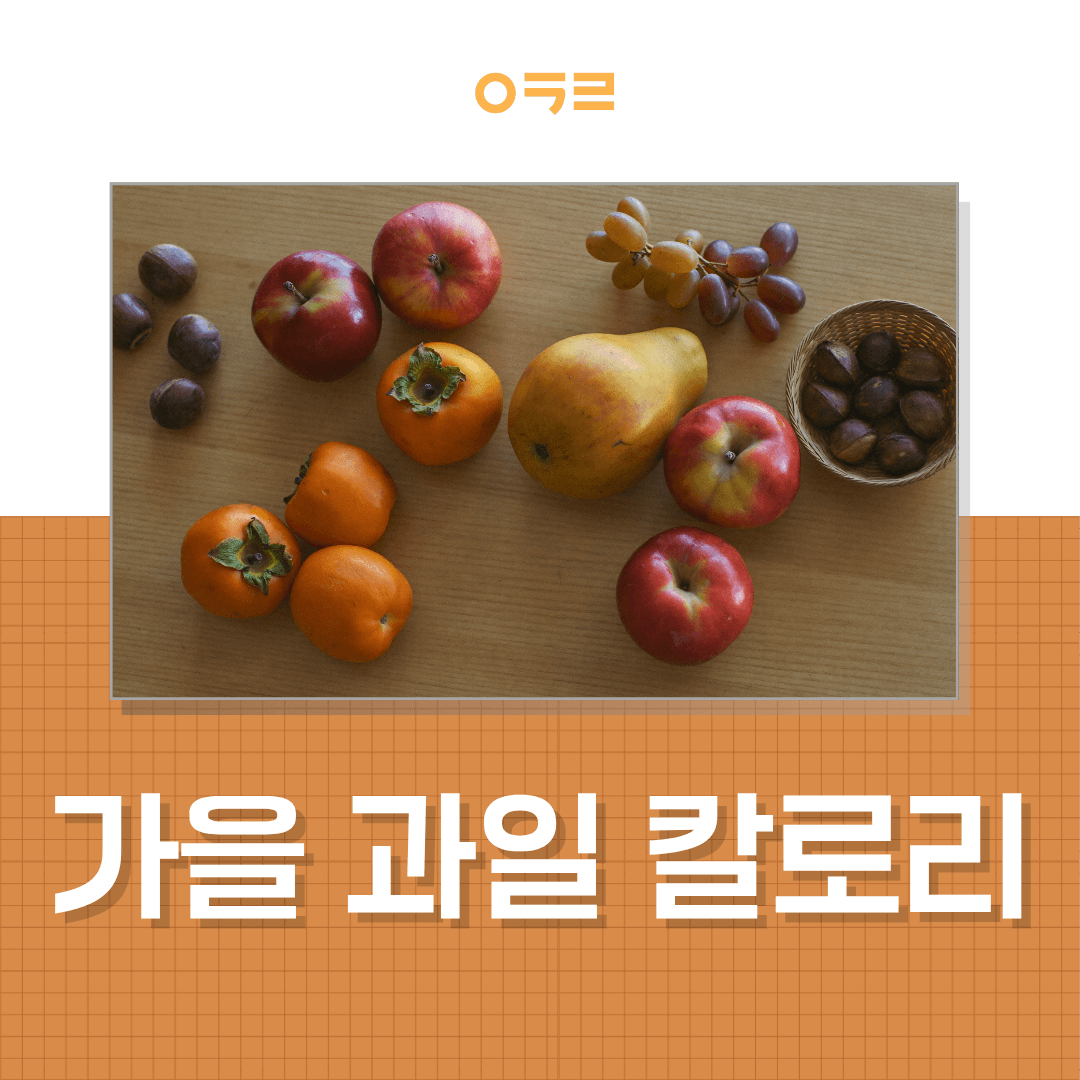
After Chuseok, fruit boxes pile up in every home. Many people might hesitate, seeing a box of dried persimmons, two bunches of Shine Muscat grapes, and pears and apples lined up, wondering, "I'm on a diet, which one should I start with?" To get straight to the point, there are no forbidden items among autumn fruits. What determines the calories is not the type of fruit, but whether it's dried and the amount consumed at once.
In this article, we've ranked autumn fruit calories per 100g, from dried fruits like dried persimmons, dried persimmon slices, and dried jujubes, to fresh fruits like Shine Muscat grapes, sweet persimmons, chestnuts, pears, and tangerines, and organized which ones to pick and how much during a diet.
Autumn Fruit Calories: Dried Fruits Take the Top Spot
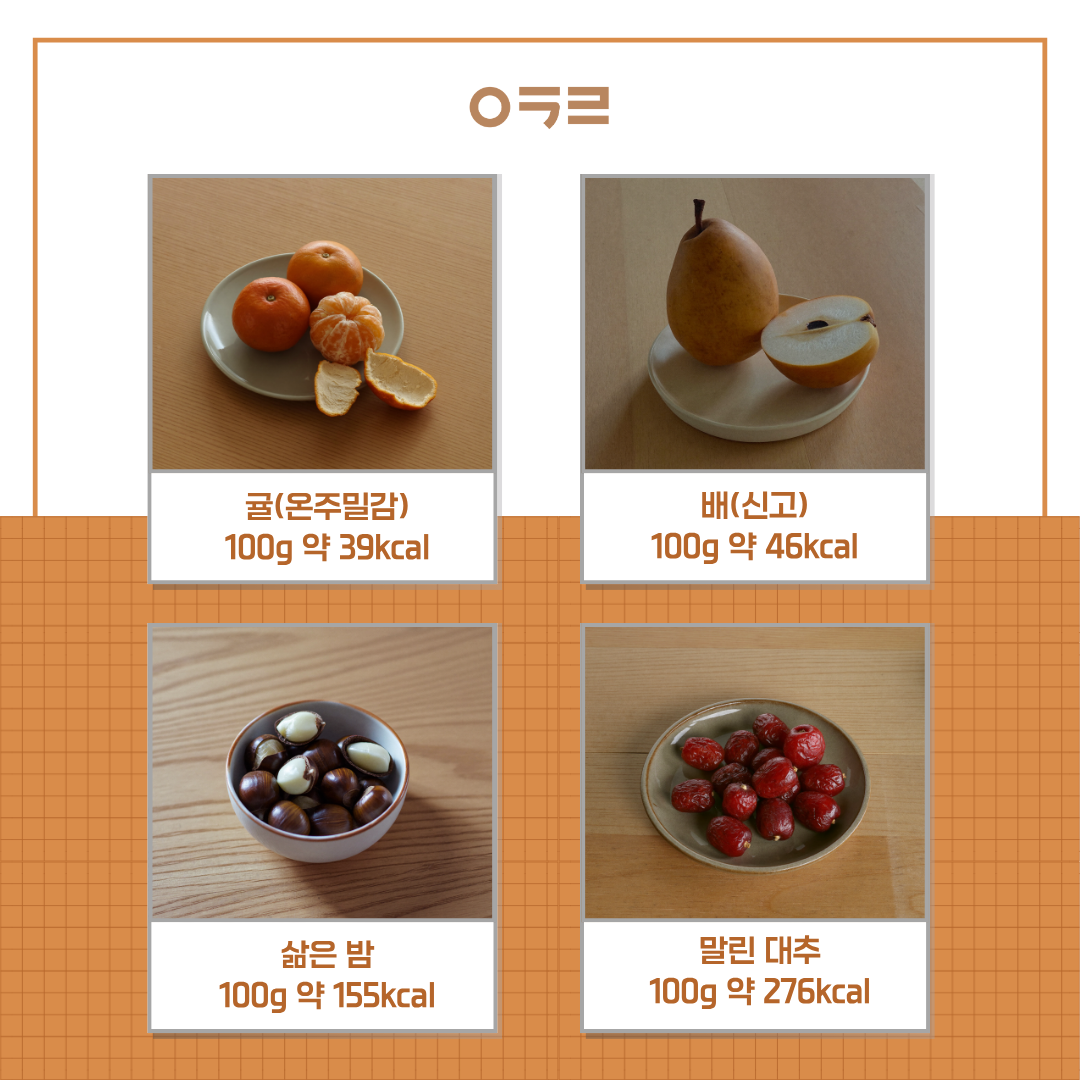
Among autumn fruits, Shine Muscat grapes might taste the sweetest, but they only contain about 66kcal per 100g. In contrast, semi-dried persimmons can go up to about 219kcal per 100g, dried persimmon slices to about 236kcal, and dried jujubes to about 276kcal. Since fresh apples are about 53kcal and pears are about 46kcal, there's nearly a five-fold difference within the same fruit basket.
The reason is simple. When fruit is dried, water evaporates, and sugar fills that space. You can think of it as the amount of water remaining, rather than how sweet it tastes, that determines the calorie content.
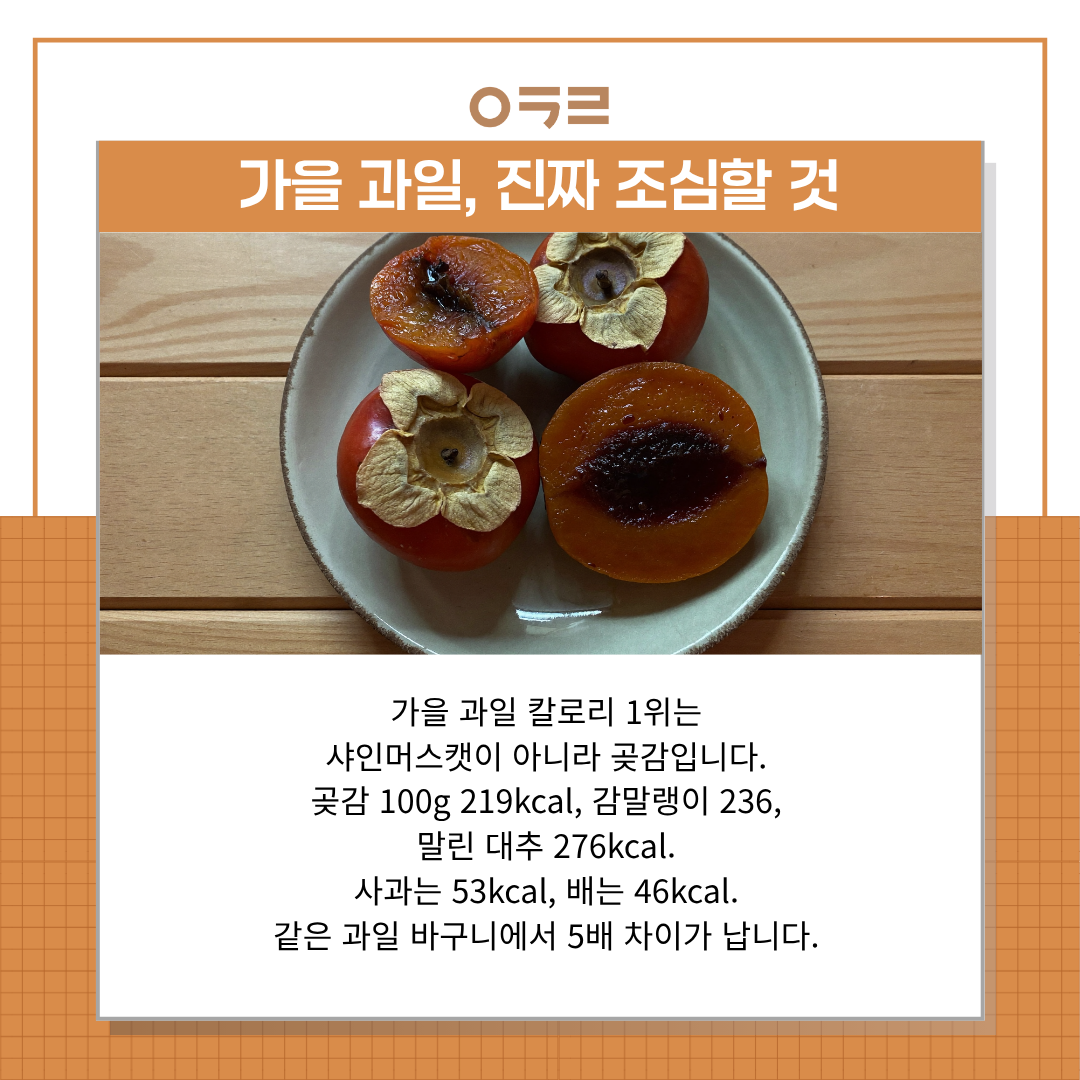
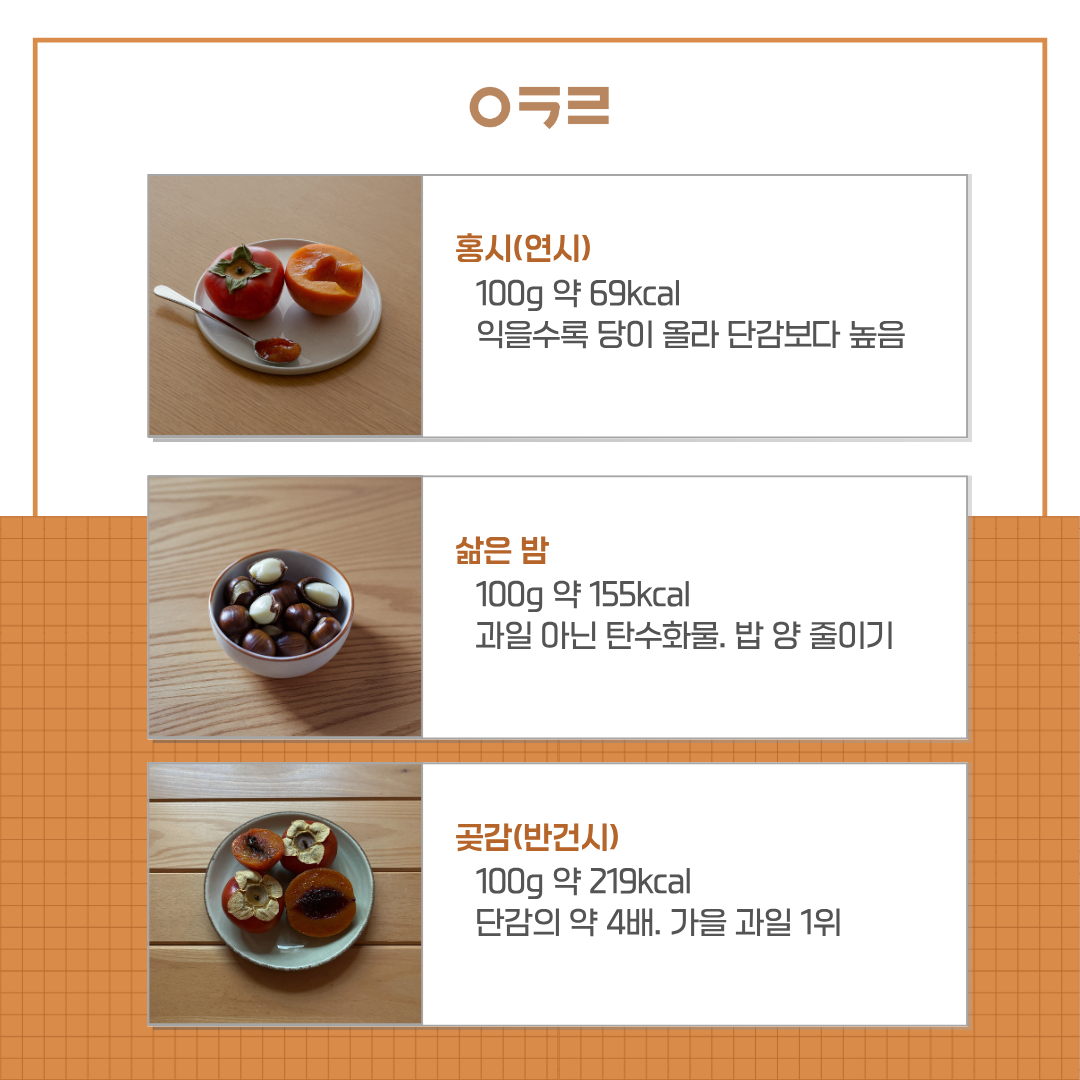
The Process of Sweet Persimmon (57kcal) Becoming Dried Persimmon (219kcal)
Fresh sweet persimmons are about 57kcal per 100g. When these persimmons are semi-dried, they become about 219kcal, and thoroughly dried persimmon slices become about 236kcal. The same applies to jujubes; fresh jujubes at about 105kcal jump to about 276kcal when dried.
Even if the weight on the scale is the same, sugar fills the space left by the evaporated water, so the amount of sugar in one bite becomes three to four times higher. Therefore, it's more accurate for diet calculations to count dried persimmons, dried persimmon slices, and dried jujubes as snacks rather than fruits. This doesn't mean you shouldn't eat them, but rather that you should count them with the same consideration as a piece of chocolate.
Shine Muscat Grapes and Campbell Grapes: Only a 9kcal Difference
Campbell grapes are about 57kcal per 100g, and Shine Muscat grapes are about 66kcal, meaning the difference between the two varieties is only 9kcal. There's little to gain by switching to Campbell grapes just because Shine Muscat grapes are expensive and sweet.
The real trap with grapes is that you can't stop eating them. One bunch is roughly 400-500g, and if you finish it all in one sitting, it's approximately 250-330kcal, an amount equivalent to one bowl of rice. The solution is not the variety, but the quantity. Dish out only a handful (about 100g) onto a plate and return the rest to the refrigerator.
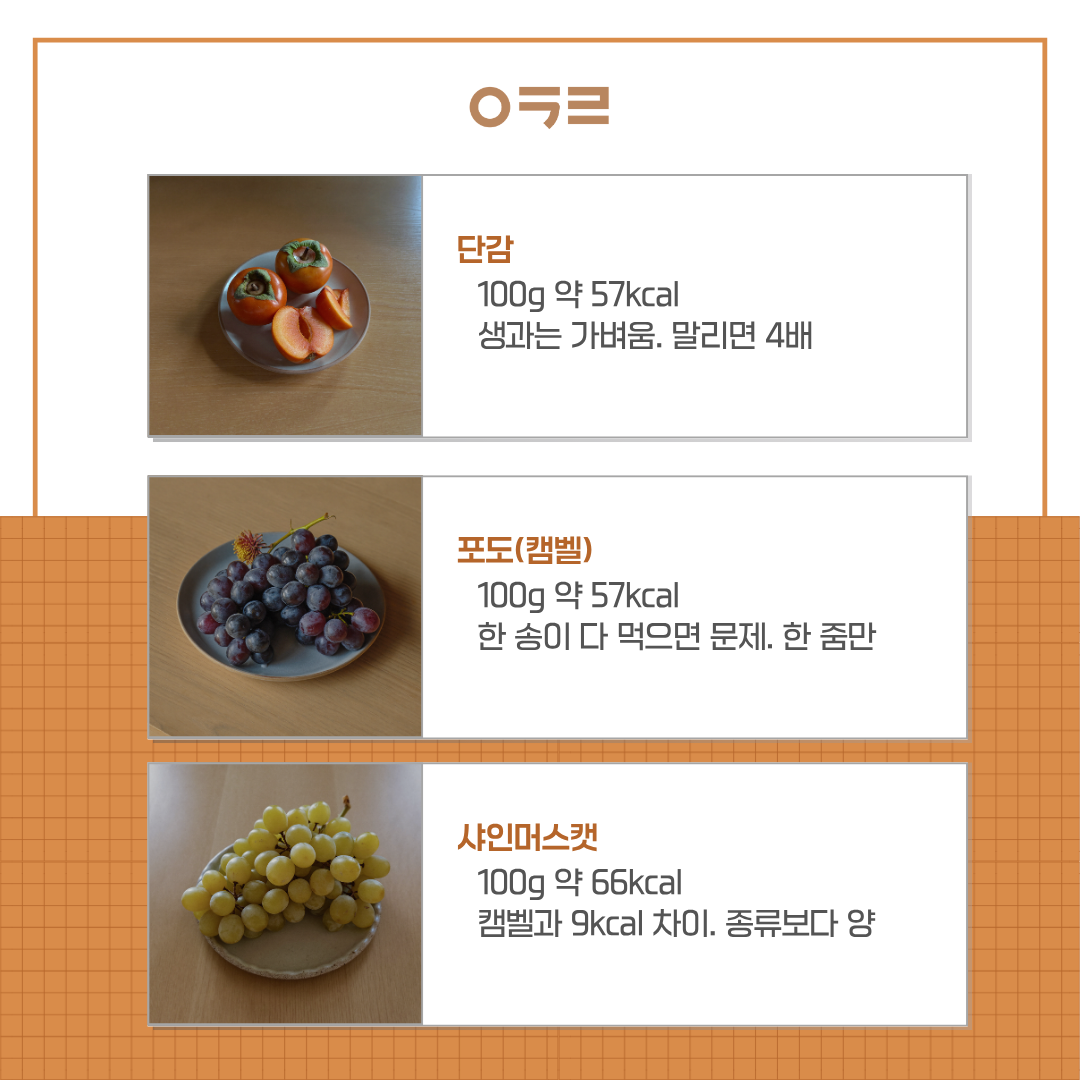
Sweet Persimmons and Soft Persimmons: Calories Increase as They Ripen
Sweet persimmons are about 57kcal per 100g, and soft persimmons (hongsi/yeonsi) are about 69kcal per 100g. As persimmons ripen and soften, starch turns into sugar, causing the calorie content to increase slightly. The numerical difference itself isn't large, but soft persimmons are easy to scoop with a spoon, making it easy to finish one and move on to a second. You can simply take out only one from the start and eat it.
Chestnuts Are Closer to Rice Than Fruit
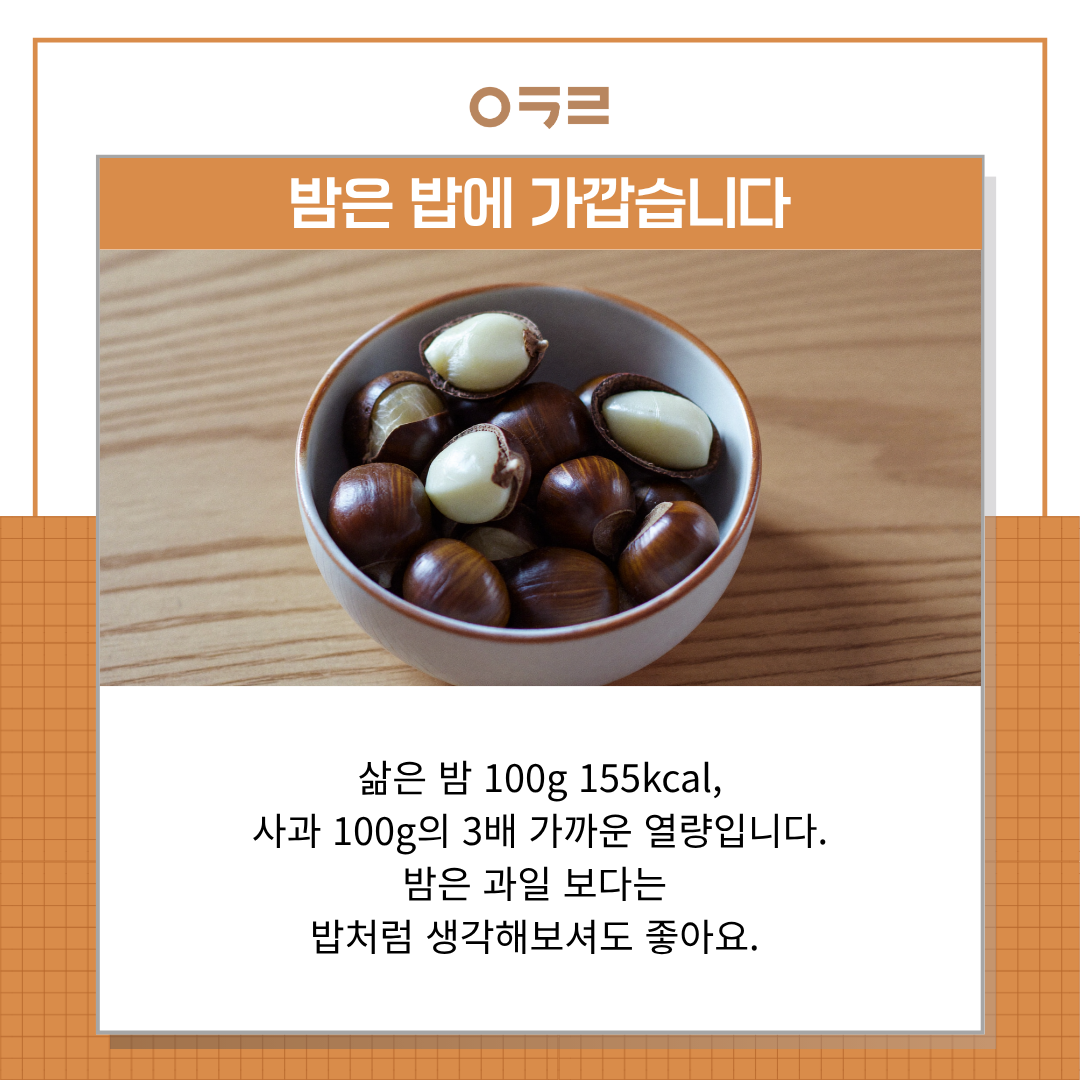
Boiled chestnuts are about 155kcal per 100g, nearly three times the calories of an apple. The main component of chestnuts is starch, not fructose, so in terms of nutritional composition, it's more appropriate to categorize them with rice or sweet potatoes than with fruits.
Therefore, on days you eat chestnuts, it's more accurate to reduce your rice intake, not your fruit intake. For example, if you ate a handful of boiled chestnuts (roughly 7-8 pieces) during Chuseok, you might reduce your dinner rice to half a bowl that evening.
Pears, Figs, and Tangerines: The Lightest Fruits in Autumn
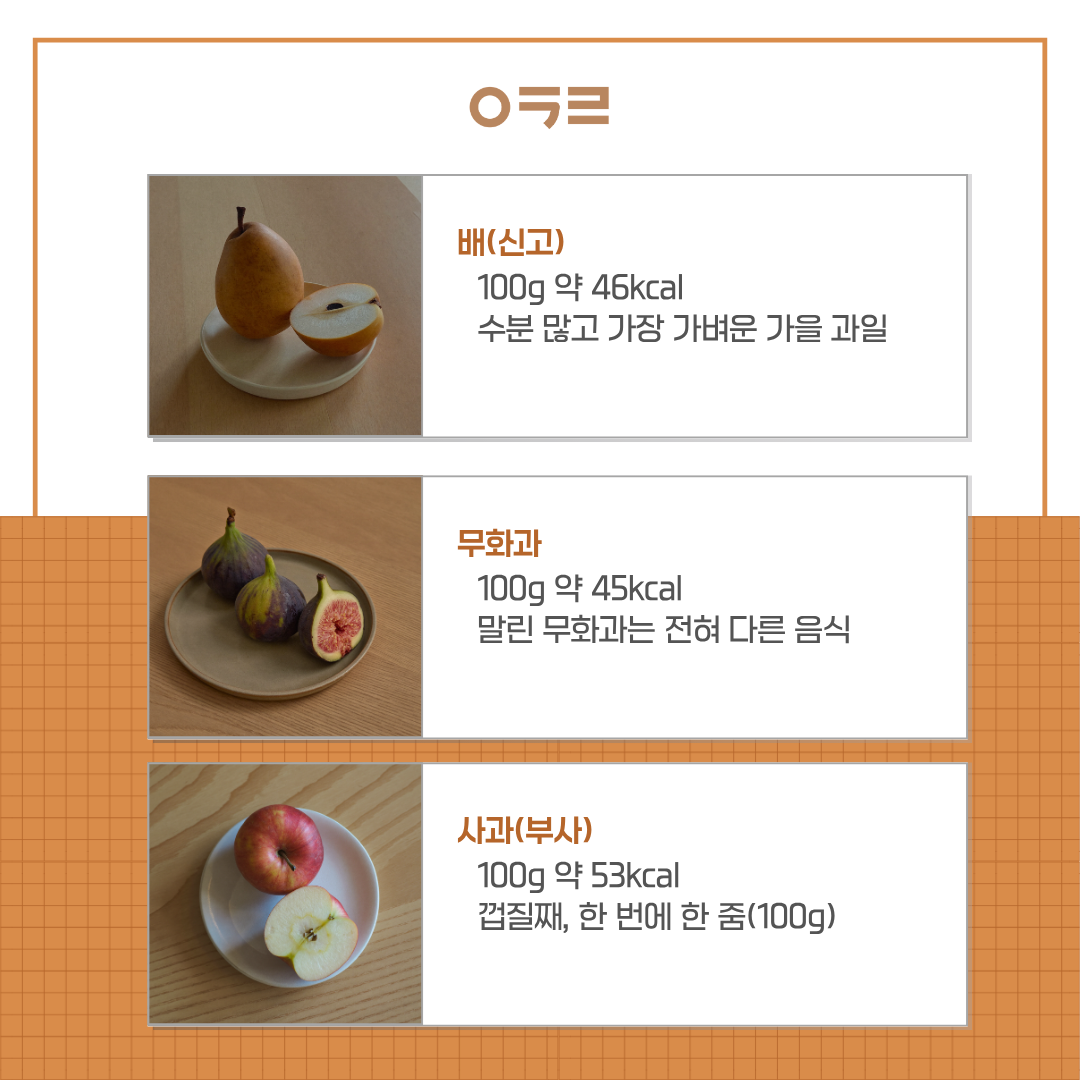
In order of lightness, tangerines (Unshu mikan) are about 39kcal, figs are about 45kcal, pears (Shingo) are about 46kcal, and apples (Fuji) are about 53kcal, all per 100g. Pears have a high water content, so their calorie count is relatively low for the feeling of fullness they provide, making them a good autumn fruit to pick first during a diet. However, this number for figs applies only to fresh figs; dried figs should be considered a completely different food, like dried persimmons.
How Much Is "A Handful" Really?
For an adult woman, a handful is approximately 100g. This is roughly half an apple, 1/3 of a pear, 1 sweet persimmon, 15-20 grapes, or 1 tangerine, and it varies slightly depending on the size. The easiest way to manage autumn fruit calories is to develop the habit of dishing out only this much onto a plate instead of eating directly from the box.
Order of Choosing Fruits While Taking Diet Herbal Medicine
At Acro Korean Medicine Clinic, we do not instruct those prescribed diet herbal medicine to completely stop eating fruit. Herbal medicine is used as the primary treatment to help control appetite and food intake, and on top of that, we guide patients to consume fruit within their total daily calorie intake. However, we always emphasize that it's easy to mistake fruit as a food that won't cause weight gain.
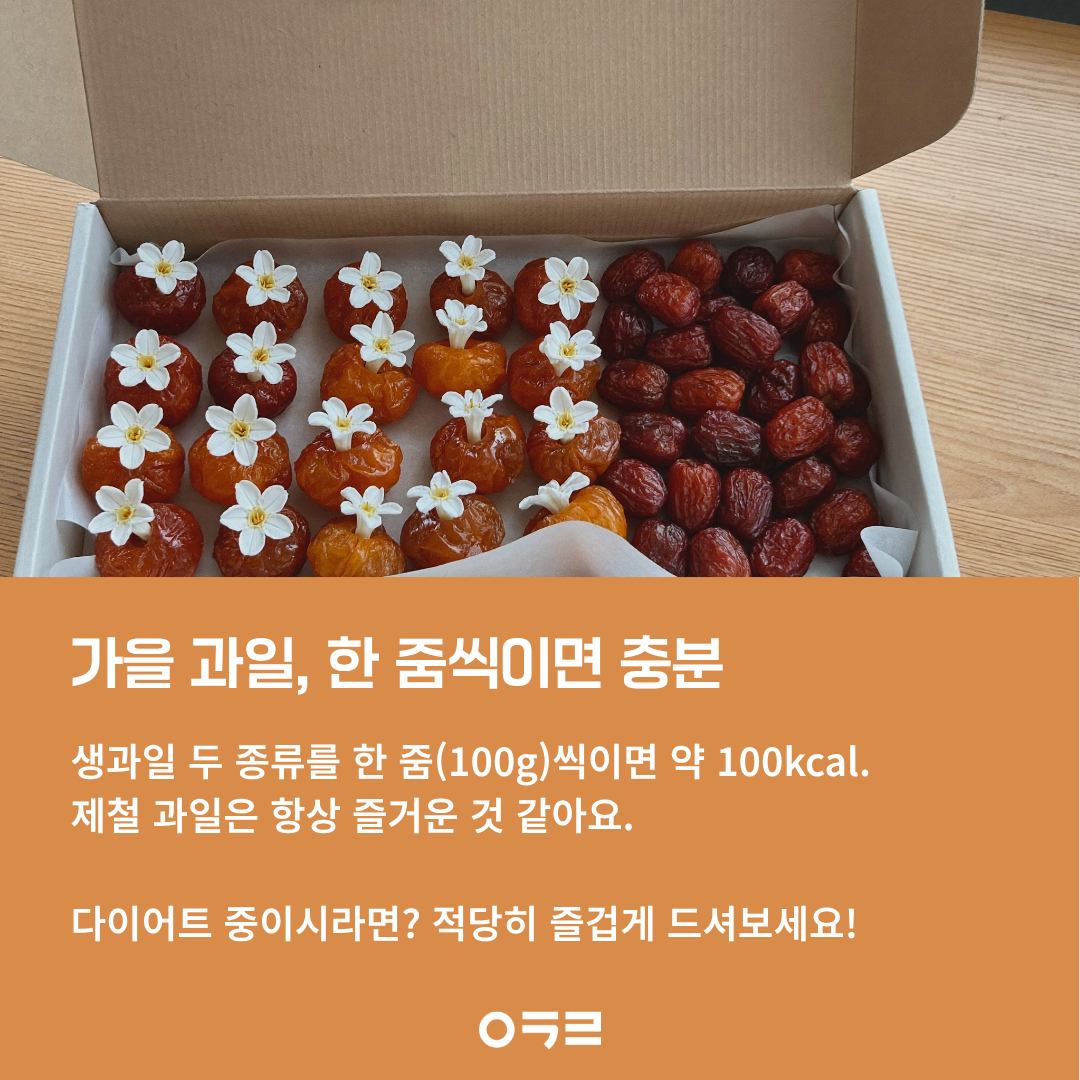
Here's the order to follow when faced with a Chuseok spread: First, choose one of pear, tangerine, or apple – the ones with high water content and lower calories. Second, a handful of sweet persimmons or grapes. Up to this point, two types, one handful each, would be about 100kcal. Avoid dried persimmons, dried jujubes, and dried persimmon slices, or count them in the snack category. If you eat chestnuts, reduce your rice intake that day. Just remember that the problem starts from the third type.
If you know the calories but still find yourself struggling at the holiday table, it's often a matter of appetite and condition. In an observational study where our clinic's medical staff participated as co-first authors, participants who combined herbal medicine with self-monitoring showed significant weight loss results (n=118, 10 weeks, average approx. -7.64kg, 94.9% lost more than 5% of initial body weight).
Acro Korean Medicine Clinic's 30-minute in-person consultation includes body composition measurement, review of eating and snacking patterns, and examination of previous diet and medication history. We also set dietary guidelines to follow before and after holidays, and an herbal medicine intake schedule, all in one session.
KakaoTalk Consultation: https://pf.kakao.com/_VcUxmC / Phone Reservation: 02-6925-1175 / Website: https://www.acrohani.com / 2nd floor, Gangnam-daero 480, 1 minute walk from Sinnonhyeon Station Exit 3
※ Citation: Jang IY, Yim JH, et al. Korean Medicine with Self-monitoring for Weight Control and Factors Associated with Weight Loss. J Korean Med. 2022;43(1):87-98. DOI 10.13048/jkm.22008 (Lim Joo-hyuk, director of this clinic, co-first author · Observational study on Korean medicine weight loss + self-monitoring). The calorie values in the text are reference values per 100g and may vary depending on variety, ripeness, and size.
Reviewed by: Lim Joo-hyuk · Director of Acro Korean Medicine Clinic Last reviewed 2026-09-14
This article is for general informational purposes only, and results may vary depending on individual dietary habits and constitution. Please consult with a specialist for accurate dietary and weight management guidance.