
Whether you're near a school or near the office, there seems to be a malatang shop on every block.
People who asked just a few years ago, “How can anyone eat that spicy red broth?” are now debating how many sticks of bunmoja (thick, chewy starch noodles) to add.
Since you fill the bowl with ingredients yourself, it's easy to assume that if you load up on vegetables, the calories will naturally stay light.
But when you're on a diet, your tongs stop over questions like, “How many kcal are in one bowl?” and “Are Tanghuo Kungfu and Chunli any different?”
As it happens, this August the Korea Consumer Agency released data from ordering malatang from 20 franchises by delivery and measuring each bowl as a whole.
I added calories by ingredient, plus rice and guobaorou (Chinese sweet and sour pork), to those numbers.
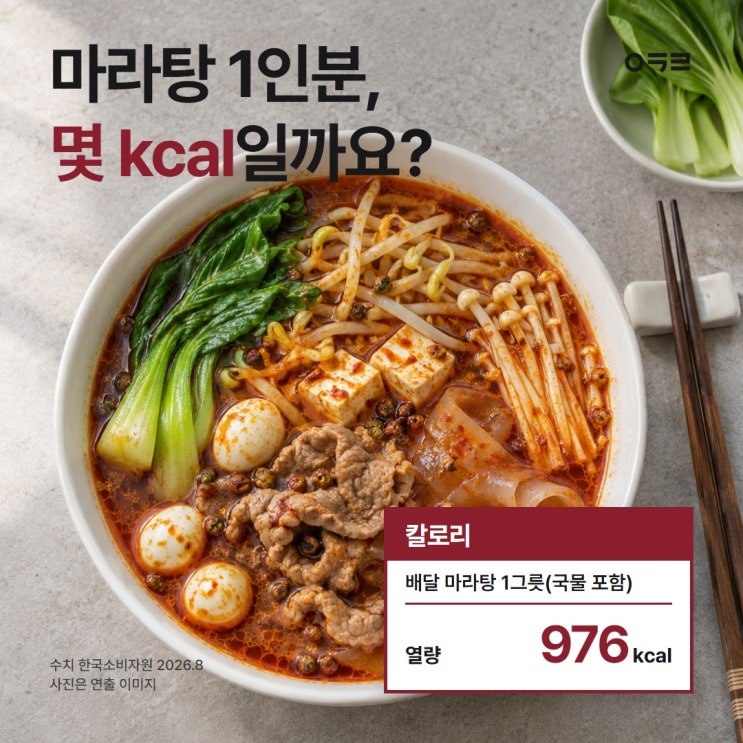
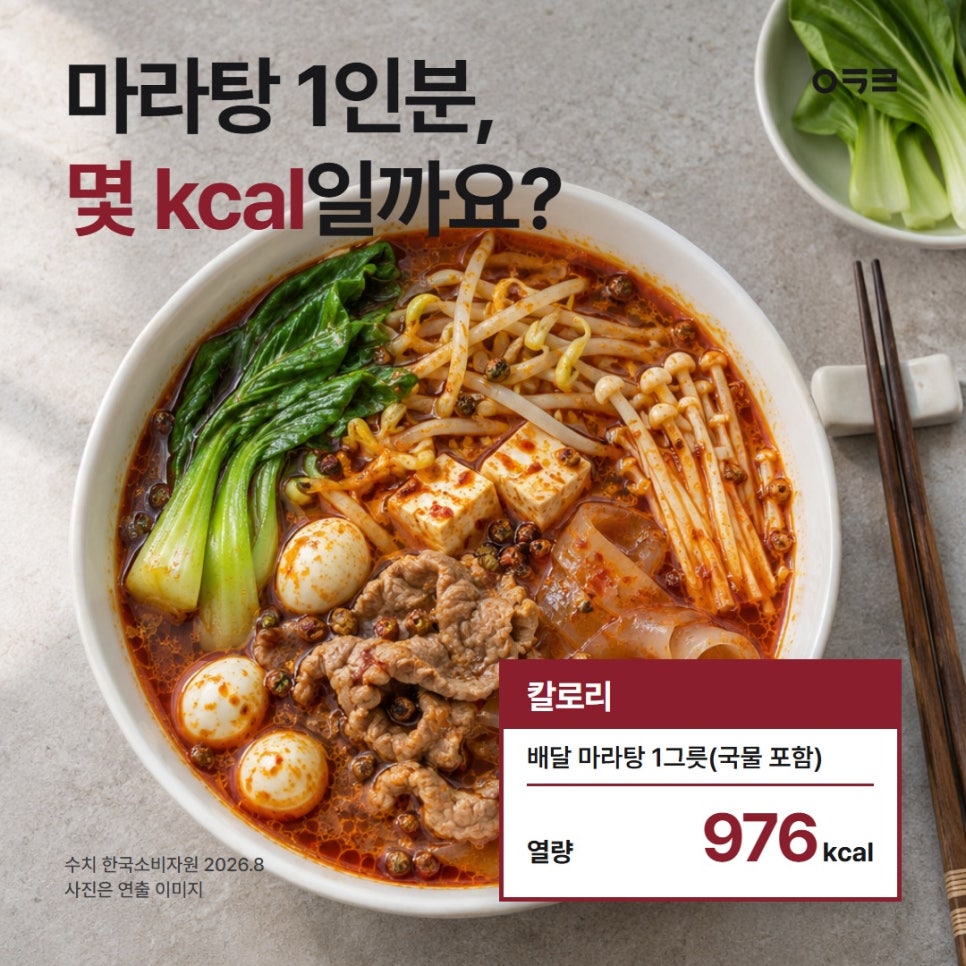
A bowl of delivery malatang, broth included, averages 976 kcal.
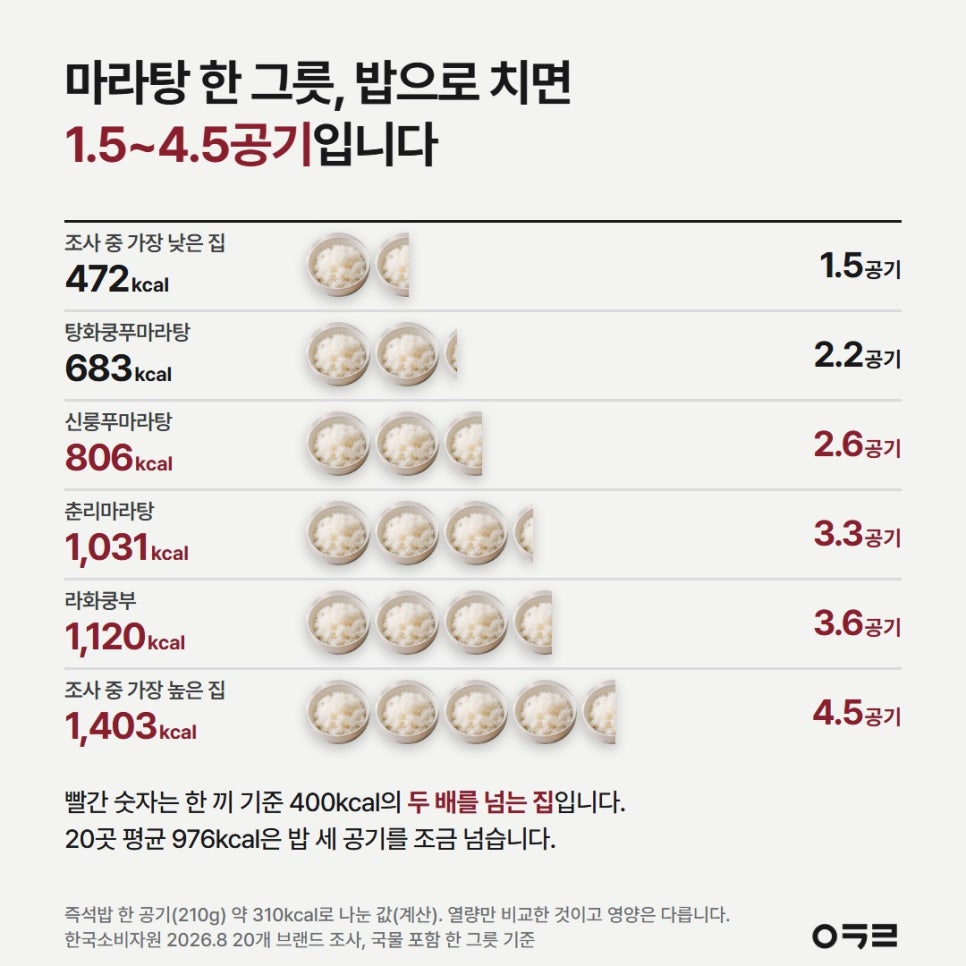
The lowest was 472 kcal and the highest 1,403 kcal, a gap of nearly three times.
One serving from Tanghuo Kungfu was 683 kcal, and one serving from Chunli was 1,031 kcal.
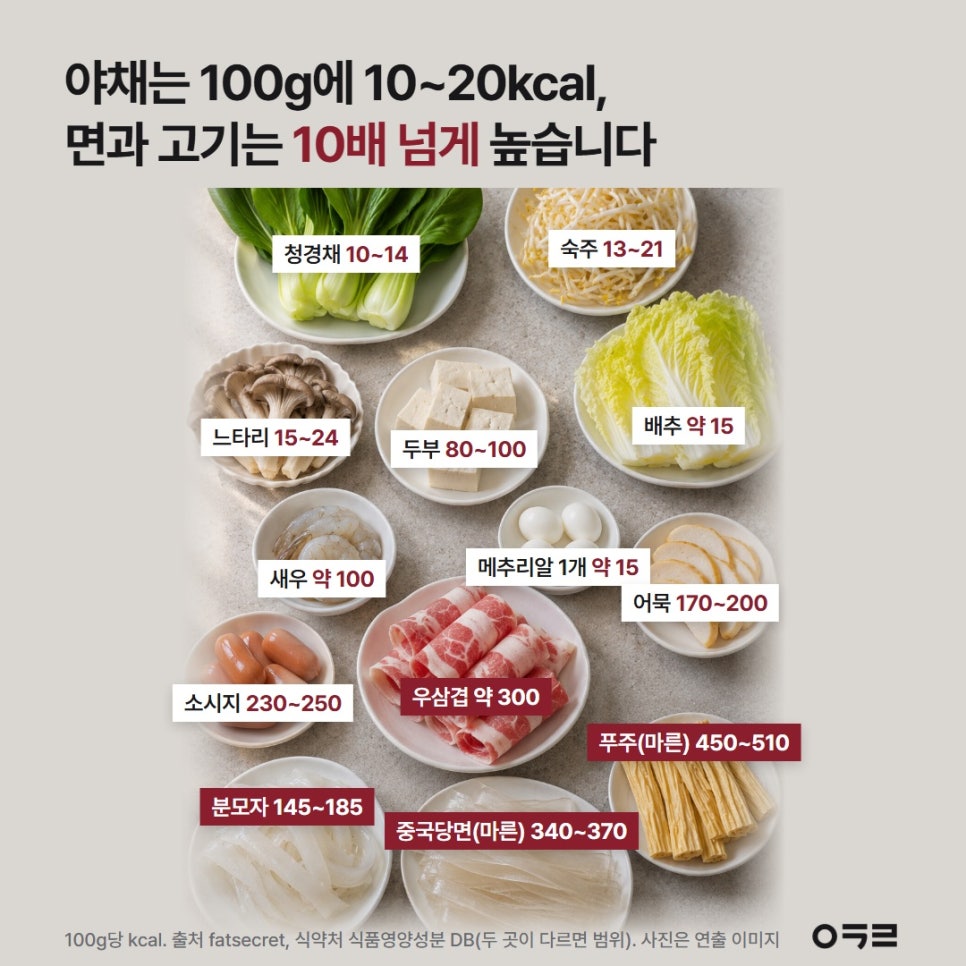
As for ingredients, 100g of bok choy has 10–14 kcal while 100g of bunmoja has 145–185 kcal, so the same weight differs by more than 10 times.
How many kcal are in one serving of malatang?
In a survey the Korea Consumer Agency released in August 2026, one serving of malatang averaged 976 kcal per bowl.
These figures come from ordering malatang for takeout through delivery apps from the 20 brands with the most franchise locations and analyzing the whole bowl, broth included.
A bowl weighed 1,333g on average (842–1,945g), and energy ranged widely from shop to shop, at 472–1,403 kcal.
That's more than twice the 400 kcal benchmark for one diet meal, and on a 1,200–1,500 kcal day, one bowl takes up two-thirds of the daily total.
The “800–1,000 kcal” that older posts estimated has now been confirmed by actual measurement:
the average was right, but the spread above and below it was much wider than expected.
| Item | Average per bowl | Range |
|---|---|---|
| Weight (with broth) | 1,333g | 842~1,945g |
| Energy | 976kcal | 472~1,403kcal |
| Sodium | 5,380mg | 3,231~10,192mg |
| Fat | 49g | 16~95g |
| Protein | 53g | 14~79g |
Source: Korea Consumer Agency, “Safety Survey of Franchise Malatang” (released August 11, 2026; 20 brands; takeout orders via delivery apps, February–June 2026).
How do Tanghuo Kungfu and Chunli malatang calories compare?
One serving of Tanghuo Kungfu Malatang (small, 530g of ingredients) was 1,089g in the bowl with 683 kcal,
and one serving of Chunli Malatang was 1,324g with 1,031 kcal.
Both are “one serving,” yet they differ by 348 kcal, more than a whole pack of instant rice (210g, about 310 kcal).
Even broken down per 100g, Tanghuo Kungfu is about 63 kcal
and Chunli about 78 kcal (calculated), so it isn't just a bigger portion: the fat content differed too, at 31g and 51g.
However, the Consumer Agency ordered each shop's basic menu or common ingredients (beef, mushrooms, vegetables),
so read these as “that's what went into the bowl that day” rather than “that shop is always higher.”
In other words, the bowl you fill is in your own hands.
| Brand (order unit) | Weight per bowl | Energy | Fat |
|---|---|---|---|
| Lowest in the survey | 842g | 472kcal | 16g |
| Tanghuo Kungfu Malatang (small, 1 serving) | 1,089g | 683kcal | 31g |
| Sinryongpu Malatang (1 serving) | 1,165g | 806kcal | 34g |
| Chunli Malatang (1 serving) | 1,324g | 1,031kcal | 51g |
| Rahwa Kungbu (1 serving, extra beef) | 1,308g | 1,120kcal | 60g |
| Highest in the survey | 1,808g | 1,403kcal | 55g |
Source: Appendix tables of the same Korea Consumer Agency survey. Per-100g values were calculated directly from the table figures.
Why is malatang so high in calories?
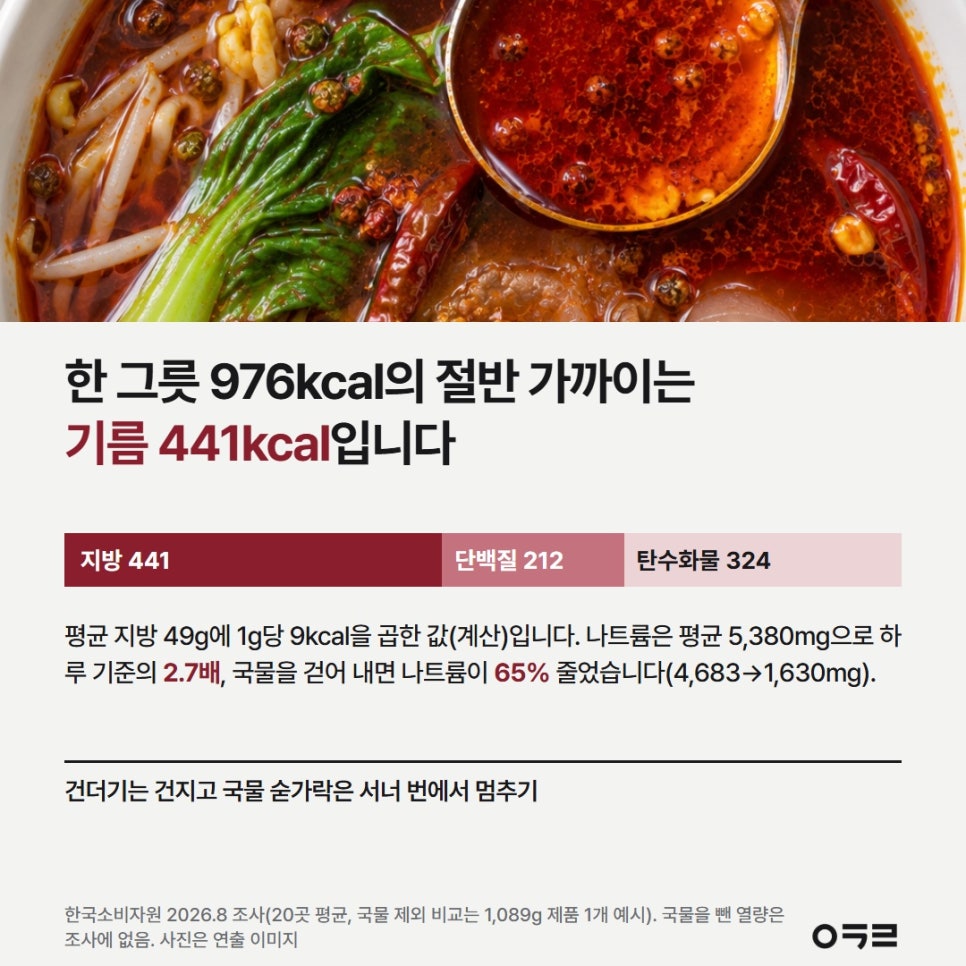
Of the 976 kcal in a bowl of malatang, fat averages 49g.
Since 1g of fat is 9 kcal, about 441 kcal (calculated) comes from fat and oil.
That means nearly half the bowl comes from chili oil, sauce and the fat from thin-sliced beef belly.
This is why the calories don't come down if the broth is red and oily, no matter how many vegetables go in.
Sodium also averaged 5,380mg, 2.7 times the daily reference of 2,000mg, and the saltiest shop reached 10,192mg.
That means some places put five days' worth of salt in a single bowl..!
The Consumer Agency advised leaving the broth and eating mainly the solid ingredients.
In fact, when the broth was removed from one product (1,089g), the weight halved to 541g
and sodium fell by 65%, from 4,683mg to 1,630mg.
This survey gave no figure for how many calories you save by leaving the broth, so I'm not listing one.
How many calories if you only add vegetables to malatang?
If you put 400g in your malatang (100g each of bok choy, bean sprouts, napa cabbage and oyster mushrooms),
the ingredients come to 50–75 kcal (calculated).
Even heaped high with the tongs, that's less than a quarter pack of instant rice.
Tofu is 80–100 kcal per 100g, shrimp about 100 kcal per 100g,
and one quail egg about 15 kcal, so the protein options are light too.
The moment you add 100g of thin-sliced beef belly (about 300 kcal) and 100g of bunmoja (145–185 kcal),
the bowl's total starts to jump, and the broth and sauce go on top at the end.
Because of the oil in the broth, I can't pin down exactly how many kcal a vegetable-only malatang has,
but it's clear that the ingredients alone start at under 100 kcal.
| Ingredient (100g) | Calories |
|---|---|
| Bok choy | 10~14kcal |
| Bean sprouts (mung bean) | 13~21kcal |
| Napa cabbage | About 15 kcal |
| Oyster mushrooms | 15~24kcal |
| Tofu | 80~100kcal |
| Shrimp | About 100 kcal |
| Steamed sweet potato | 130~160kcal |
| Bunmoja (fresh) | 145~185kcal |
| Fish cake | 170~200kcal |
| Dried tofu (tofu sheets) | 190~250kcal |
| Vienna sausage | 230~250kcal |
| Thin-sliced beef belly | About 300 kcal |
| Chinese glass noodles (dry) | 340~370kcal |
| Yuba sticks (dried bean curd sticks, dry) | 450~510kcal |
Source: fatsecret and the food composition database of the Ministry of Food and Drug Safety (values listed from the Rural Development Administration's National Standard Food Composition Table) were cross-checked; ingredients where the two disagree are shown as ranges. For bunmoja, the Mimisa product label (250g, 459 kcal) was also checked. One quail egg is about 15 kcal.
Calories in bunmoja, Chinese glass noodles and yuba sticks
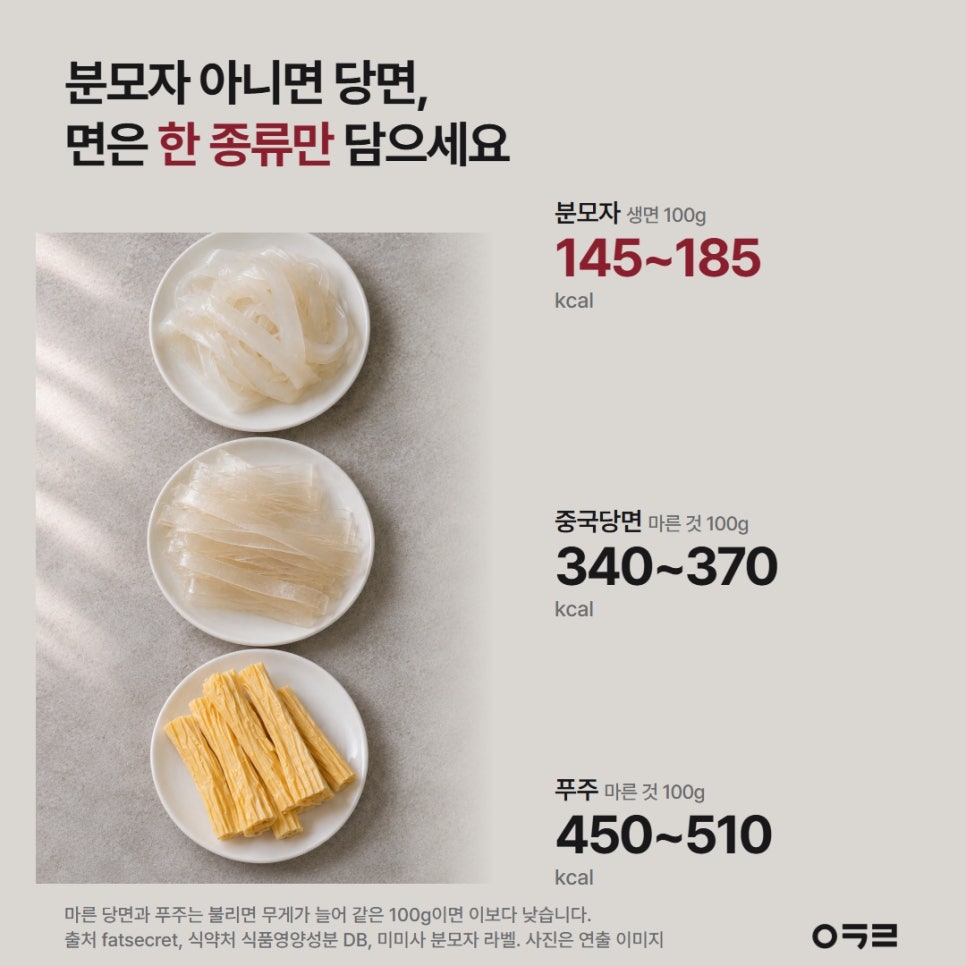
Bunmoja has 145–185 kcal per 100g fresh, Chinese glass noodles 340–370 kcal per 100g dry,
and yuba sticks 450–510 kcal per 100g dry.
These are the three ingredients people reach for most at malatang shops:
100g of bunmoja is more than 10 times 100g of bok choy, and 100g of dry Chinese glass noodles is higher than a pack of instant rice.
You might think yuba sticks are light because they're made from soybeans like tofu, but they're dried, so weight for weight they're the highest of all.
Still, glass noodles and yuba sticks gain a lot of weight when soaked,
so 100g of the soaked form in your bowl is much lower than 100g dry.
Malatang shops weigh the soaked ingredients, so simply multiplying “450 kcal per 100g” would be wrong,
but the ranking still holds: at the same weight picked up, they're about ten times higher than vegetables.
I found no reliable data on how many grams one stick of bunmoja weighs, so I didn't list it. (The chewy things are the highest..!!!)
What if you add guobaorou or mala xiang guo?
Nobody walks out after eating only malatang, right..!
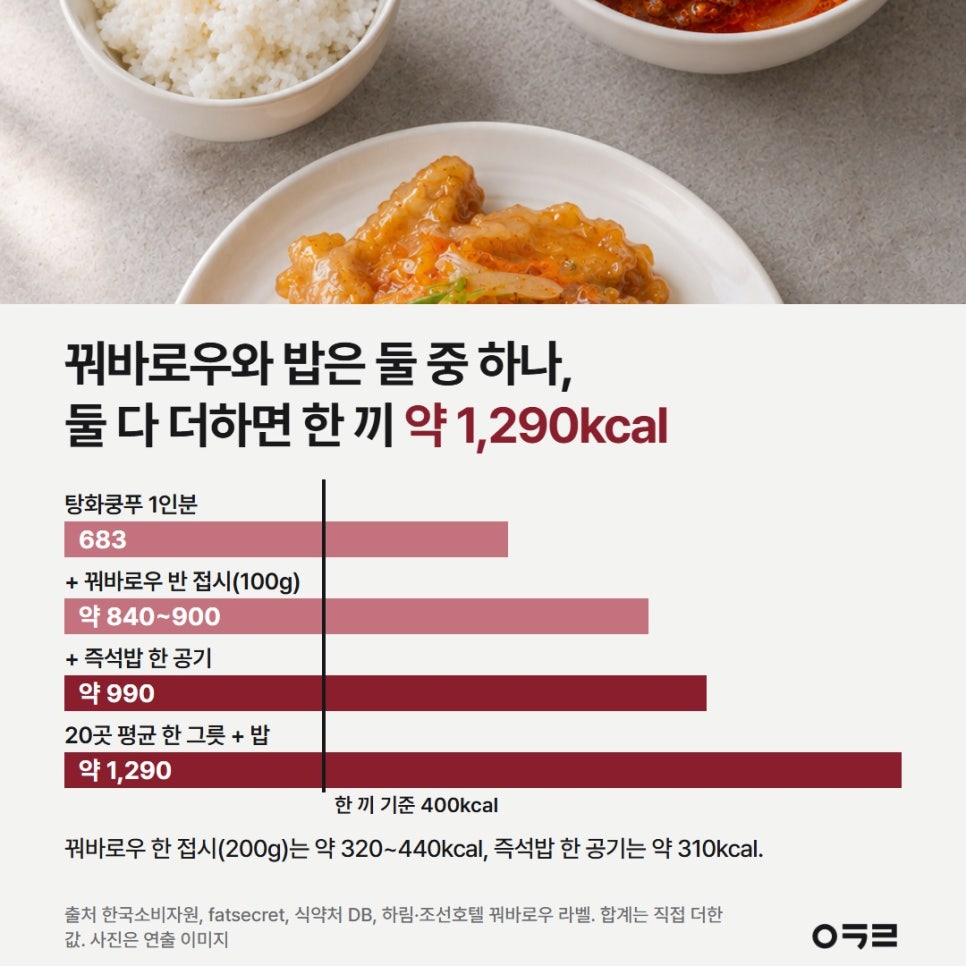
Guobaorou is 160–220 kcal per 100g, so a 200g plate is about 320–440 kcal.
Add just half a plate of guobaorou to a 683 kcal serving of Tanghuo Kungfu and you're at 840–900 kcal,
which is what two people sharing one plate would get.
Mala xiang guo is stir-fried in oil without broth, at 100–200 kcal per 100g,
so per 100g it's around twice malatang (about 66–73 kcal per 100g),
and a 250g plate is about 250–500 kcal.
Add a bowl of rice to this and the numbers look like this.
| Combination | Total |
|---|---|
| Average bowl of malatang + 1 pack of instant rice | About 1,290 kcal |
| 1 serving of Tanghuo Kungfu + 1 pack of instant rice | About 990 kcal |
| 1 serving of Tanghuo Kungfu + half a plate of guobaorou (100g) | About 840–900 kcal |
| 1 plate of guobaorou (200g) | About 320–440 kcal |
| 1 plate of mala xiang guo (250g) | About 250–500 kcal |
Source: Korea Consumer Agency survey, fatsecret, the Ministry of Food and Drug Safety food composition database, and Harim and Josun Hotel guobaorou product labels. Totals were added up directly, counting a 210g pack of instant rice as about 310 kcal.
How should you eat malatang while dieting?
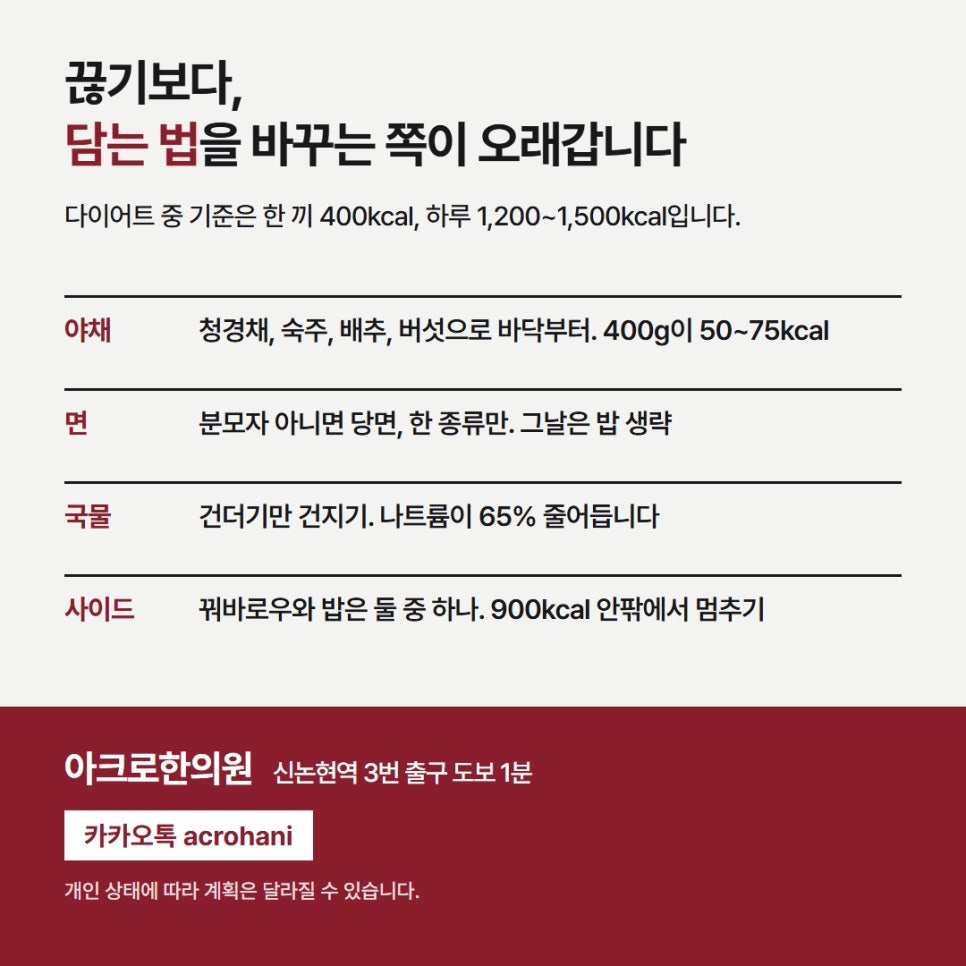
Fill the bottom of the bowl with vegetables first.
Even 400g of bok choy, bean sprouts, napa cabbage and mushrooms is only 50–75 kcal. Get your protein from tofu, shrimp and quail eggs, take just a small handful of beef belly, and pick only one of sausage or fish cake. The Consumer Agency also advised filling the bowl with mainly vegetables and tofu instead of ham and sausages.
Only one kind of noodle: bunmoja or glass noodles.
The day you add bunmoja, Chinese glass noodles and yuba sticks all together is the day your bowl's total jumps the most. Pick just one of the three, and don't order rice that day: 100g of dry Chinese glass noodles is higher than a pack of instant rice.
Leave the broth.
A good share of the 49g of fat floats in the broth, and removing the broth cut sodium by 65%. Fish out the solid ingredients and stop at three or four spoonfuls of broth. Choosing the white broth means less chili oil, but there's no measured data on its calories, so I can't give you a number.
Half a plate of guobaorou, skip the rice.
Add rice to malatang and an average bowl comes to about 1,290 kcal, using up a 1,200–1,500 kcal daily plan in one meal. On days you want guobaorou, skip the rice and have half a plate; on days you want rice, skip the guobaorou. If you take only one of the two, you'll stop at around 900 kcal based on a serving of Tanghuo Kungfu.
If you want to go even lower
On days when you only want the malatang flavor, have Ottogi Cup Noodle Malatang (44.7g each, 150 kcal) or Nongshim Noodle Fit Mala Tantan (41g, 135 kcal, a mala-flavored brothless noodle). Both are glass noodles, so they're closer to a snack than a meal, but they satisfy the craving for spice at around one-sixth of the calories of a bowl from a malatang shop.
You only need to remember two numbers, 976 kcal for an average bowl and 683 kcal for a serving of Tanghuo Kungfu, plus this: “per 100g of ingredients, vegetables are 10–20 and bunmoja 150–180.” To fit malatang into 400 kcal a meal and 1,200–1,500 kcal a day, line the bowl with vegetables, take only one noodle, leave the broth, and choose either guobaorou or rice. Changing how you fill the bowl lasts longer than giving it up.
Frequently asked questions about malatang calories
Q. How many calories do I save if I don't drink the malatang broth?
The Consumer Agency survey has no calorie figure without broth, so it's hard to give a number. What was confirmed is a 65% drop in sodium (4,683→1,630mg) and half the weight. Much of the fat floats in the broth, so calories go down too, but I can't say by how many kcal.
Q. Will eating only the vegetables in malatang help me lose weight?
400g of bok choy, bean sprouts, napa cabbage and mushrooms is 50–75 kcal. The ingredients are light, but the oil from the broth and sauce gets added, so don't think of it as “close to zero.” It only becomes a light meal if you also leave the broth.
Q. Which is lower, bunmoja or Chinese glass noodles?
Per 100g, fresh bunmoja is 145–185 kcal and dry Chinese glass noodles 340–370 kcal, but glass noodles gain weight when soaked, so the same 100g becomes much lower. Since what goes on the scale is soaked, think of the two as being in a similar range, and whichever you choose, add only one.
About ACRO Korean Medicine Clinic
📍 Location: 1 min walk from Sinnonhyeon Station Exit 3 (2F Boratial Bldg., 480 Gangnam-daero, Gangnam-gu, Seoul)
📞 Consultations: search “acrohani” on KakaoTalk
🌐 Website: https://acrohani.com/en
📝 Naver reviews 1,000+ (9.5★) | Gangnam Unni reviews 500+ (9.6★)
Hours: Weekdays 10:30–20:30 (lunch 13:00–14:00) / Weekends & public holidays 10:00–15:30 (no lunch break)