


The first question we ask in a facial ONDA Lifting consultation is whether the concern lies in ‘volume’ or in ‘elasticity’. The depth at which energy is delivered and the handpiece combination differ depending on which it is. In this clinical note, we place side by side a case in her 20s whose goal was improving left–right asymmetry and a case in her 30s with relatively little facial fat whose goal was improving elasticity, and compare the treatment design and the same-day before-and-after changes.
Facial ONDA Lifting: The Layers the 7 mm and 3 mm Handpieces Handle
In both cases, the 7 mm and 3 mm handpieces were used alternately in facial ONDA Lifting. The 7 mm handpiece sends energy down to the subcutaneous fat layer, the fat just beneath the skin, to drive volume reduction, while the 3 mm handpiece delivers energy close to the dermis, where collagen in the skin is distributed, to refine the contour and surface elasticity.
The difference lies in where the 7 mm handpiece is placed. In Case 1, the 7 mm handpiece went to the left lower face with greater volume; in Case 2, it went to the double chin, where there was fat. The reason we first check the thickness of the fat layer in each area before setting the depth is that deep energy in a place with little fat carries a risk of cheek hollowing.
Case 1 — Woman in Her 20s, Reducing Asymmetric Volume
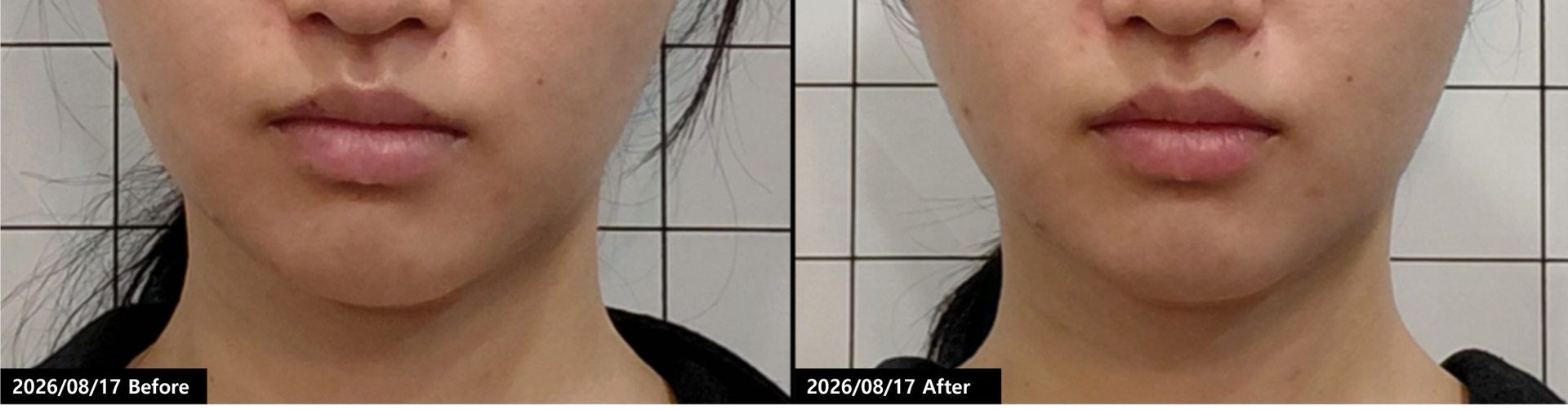
The first case is a female patient in her 20s. Her concern was an asymmetry in which the volume on the left side of her face (the right side in the photo) looked greater than on the other side; seen from the front, the volume of the left lower face stood out, so the jawlines on the left and right looked different in shape.
If the same amount of energy is delivered to the whole face, the left–right volume difference remains. So for the asymmetry case, we took a design approach that allocates more energy to the side with greater volume. In the treatment on August 17, 2026, we treated the entire face while concentrating on the left lower face, delivering 60,000 J at 80–90 W.
On the left side, where the volume was greater, energy was delivered down to the subcutaneous fat layer with the 7 mm handpiece. Areas that needed contour refinement and reinforcement of surface elasticity were finished with the 3 mm handpiece.
In the pre-treatment photo, the volume of the left lower face is greater than the right, so the height and width of the jawline look out of line from left to right. In the photo taken immediately after treatment on the same day, the left volume has decreased somewhat, and the difference between the left and right jawlines has eased considerably.
Case 2 — Woman in Her 30s, Improving Elasticity of the Double Chin and Deep Cheeks
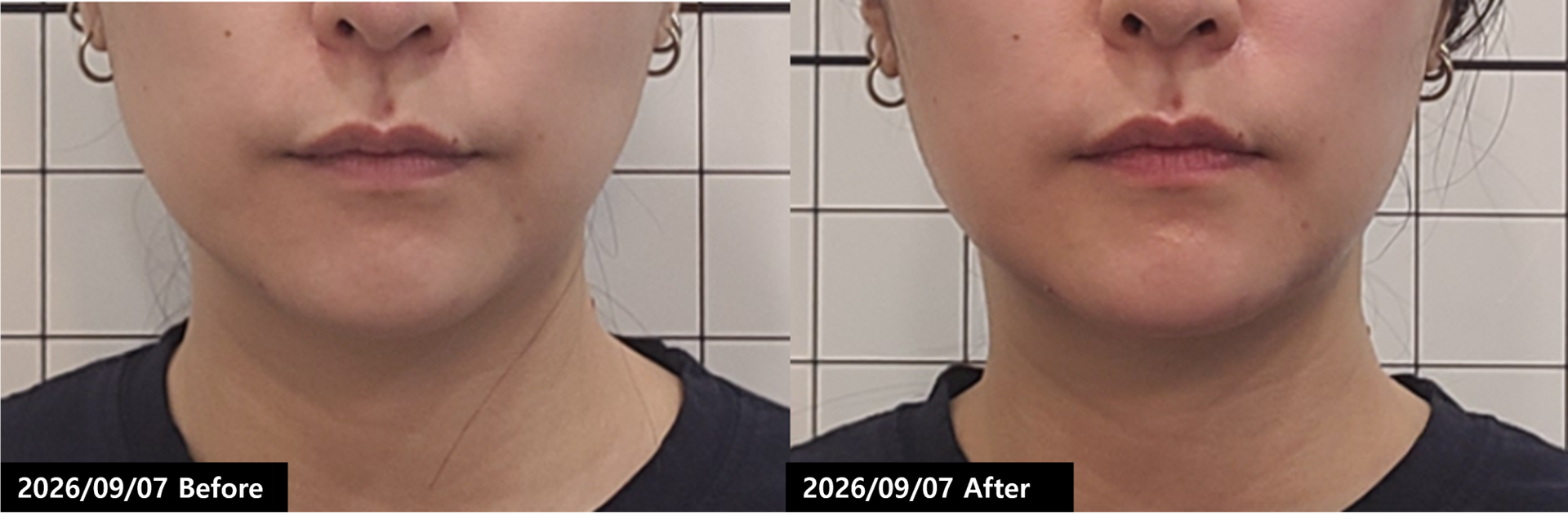
The second case is a female patient in her 30s whose concern was a double chin and loss of elasticity in the deep cheek area. The deep cheek refers to the cheek flesh that sags downward beside the corners of the mouth. On palpation, the facial fat layer was not thick, so rather than reducing volume, the goal was elasticity improvement: lifting the sagging and refining the boundary of the jawline.
The treatment on September 7, 2026 worked on the face centered on the double chin and deep cheeks, delivering 70,000 J at 80 W for 15 minutes. For the fat-rich double chin, the 7 mm handpiece delivered energy down to the subcutaneous fat layer; for overall facial elasticity improvement, the 3 mm handpiece delivered energy close to the dermis.
Because this was a case with little facial fat, too much energy in the deep layer could cause cheek hollowing. So the cheek area was treated mainly with the 3 mm handpiece, and the design avoided spots where volume could be lost.
Before treatment, the boundary under the chin flowed gently, and the distinction between the jawline and the neck was blurred. Right after treatment, the line under the chin was pulled upward, and the boundary between the jawline and the neck became clearer. The redness seen on both cheeks is temporary flushing caused by thermal energy and usually subsides within a few hours.
Comparing the Facial ONDA Lifting Design of the Two Cases
| Item | Case 1 (20s) | Case 2 (30s) |
|---|---|---|
| Concern | Asymmetry with greater volume in the left lower face | Loss of elasticity in the double chin and deep cheeks |
| Goal | Reducing asymmetric volume | Elasticity improvement that tightens sagging |
| Treatment date | August 17, 2026 | September 7, 2026 |
| Treatment area | Whole face, concentrated on the left lower face | Face centered on the double chin and deep cheeks |
| Energy and output | 60,000 J, 80–90 W | 70,000 J, 80 W, 15 minutes |
| 7 mm handpiece | Left side with greater volume | Double chin with fat |
| 3 mm handpiece | Contour refinement and surface elasticity | Overall facial elasticity; mainly 3 mm for the cheeks |
Same-Day Changes and Final Changes Are Checked at Different Times
The changes seen right after treatment in both cases are mainly due to tightening from the immediate contraction of collagen. Volume reduction, in which fat cells shrink, appears over 2–6 weeks after treatment, and the elasticity improvement from collagen regeneration progresses over 2–12 weeks, with the effect peaking at around 3 months.
So the same-day before-and-after photos should be seen not as the final result but as an indicator of whether the facial ONDA Lifting design is moving in the intended direction.
Frequently Asked Questions
Q. How is asymmetry approached with facial ONDA Lifting? A. More energy is allocated to the side with greater volume. In Case 1, we concentrated on the left lower face and delivered energy down to the subcutaneous fat layer with the 7 mm handpiece.
Q. Can I have ONDA Lifting even if I have little facial fat? A. Yes. However, because too much energy in a deep layer can cause cheek hollowing, we proceed with a shallow-layer elasticity design centered on the 3 mm handpiece and avoid areas where volume might be lost.
Q. My cheeks turned red right after treatment. Is that okay? A. It is temporary flushing caused by thermal energy and usually subsides within a few hours.
Q. When can I see volume reduction and elasticity improvement? A. Volume reduction appears over 2–6 weeks and elasticity improvement over 2–12 weeks, with the effect peaking at around 3 months.
Summary
For a face where asymmetry is the concern, we apply a design that concentrates energy on the side with greater volume; for a face with little fat where sagging is the concern, we apply an elasticity design centered on the shallow layer. Even with the same facial ONDA Lifting, the handpiece depth and energy allocation differ depending on whether the goal is volume reduction or elasticity improvement. At ACRO Korean Medicine Clinic, we first check the thickness of the facial fat layer and the state of elasticity, and then design the treatment strategy together with you through a consultation. Results may vary from person to person.
KakaoTalk consultation: search “acrohani” / Website: https://acrohani.com/en / 2F, 480 Gangnam-daero, 1-minute walk from Sinnonhyeon Station Exit 3
All photos were published with the consent of the individuals concerned, in accordance with Articles 23 and 56 of the Medical Service Act. Side effects may occur after treatment depending on individual differences, so please have a thorough consultation with our medical staff.
Reviewed by: Dr. Han Ji-young · Director, ACRO Korean Medicine Clinic. Last reviewed 2026-10-11
This article is intended to provide general information, and results may differ depending on an individual’s eating habits and constitution. Please confirm the right direction for diet and weight management through a consultation with a professional.