
Hello, this is Dr. Han Ji-young of ACRO Korean Medicine Clinic.
In lifting consultations, I hear these questions all the time.
“I’m still in my 20s. Is it okay to get lifting?”
“I heard you have to start from your 30s, right?”
“In my 40s, do I need something stronger than Shurink?”
All of these come from thinking about lifting by age,
but in the actual consultation room, the story is a little different.
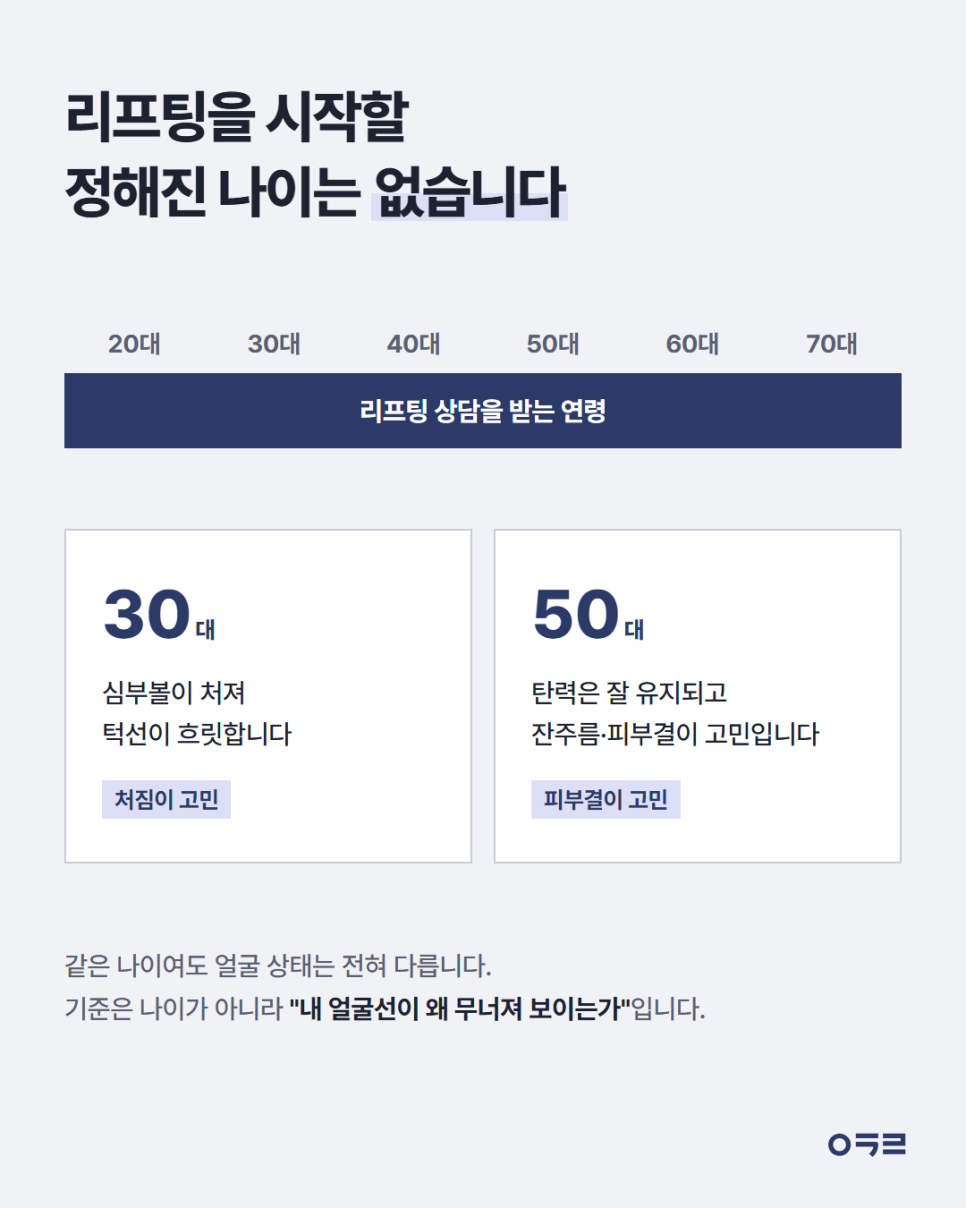
People who come in for lifting consultations range in age from their early 20s to their 70s.
And even at the same age, the condition of the face is completely different.
Some people in their 30s have sagging deep cheek fat and a blurred jawline,
while some in their 50s have kept their firmness well and are only concerned about fine lines and skin texture.
That is why there is no set age to start lifting.
The criterion is not age, but “why does my facial line look blurred?”
Whether it is excess fat, loosened skin, sagging tissue, or lost volume,
the right lifting differs in each case.
Today, starting from why the face sags, then the differences between devices,
I will go through in order which lifting suits each age group and face type.
| At a Glance 1. There is no set age to start lifting; face type and sagging pattern are the selection criteria. 2. For a face with a lot of fat we mainly consider microwave (ONDA) and InMode FX; for a face with loose skin, monopolar radiofrequency (Thermage, Oligio, Volnewmer); for sagging deep cheeks and jawline, focused ultrasound (Shurink, Ulthera). 3. For a hollow face that has lost volume, we think about restoring volume first. |
|---|
Why Does the Face Sag?
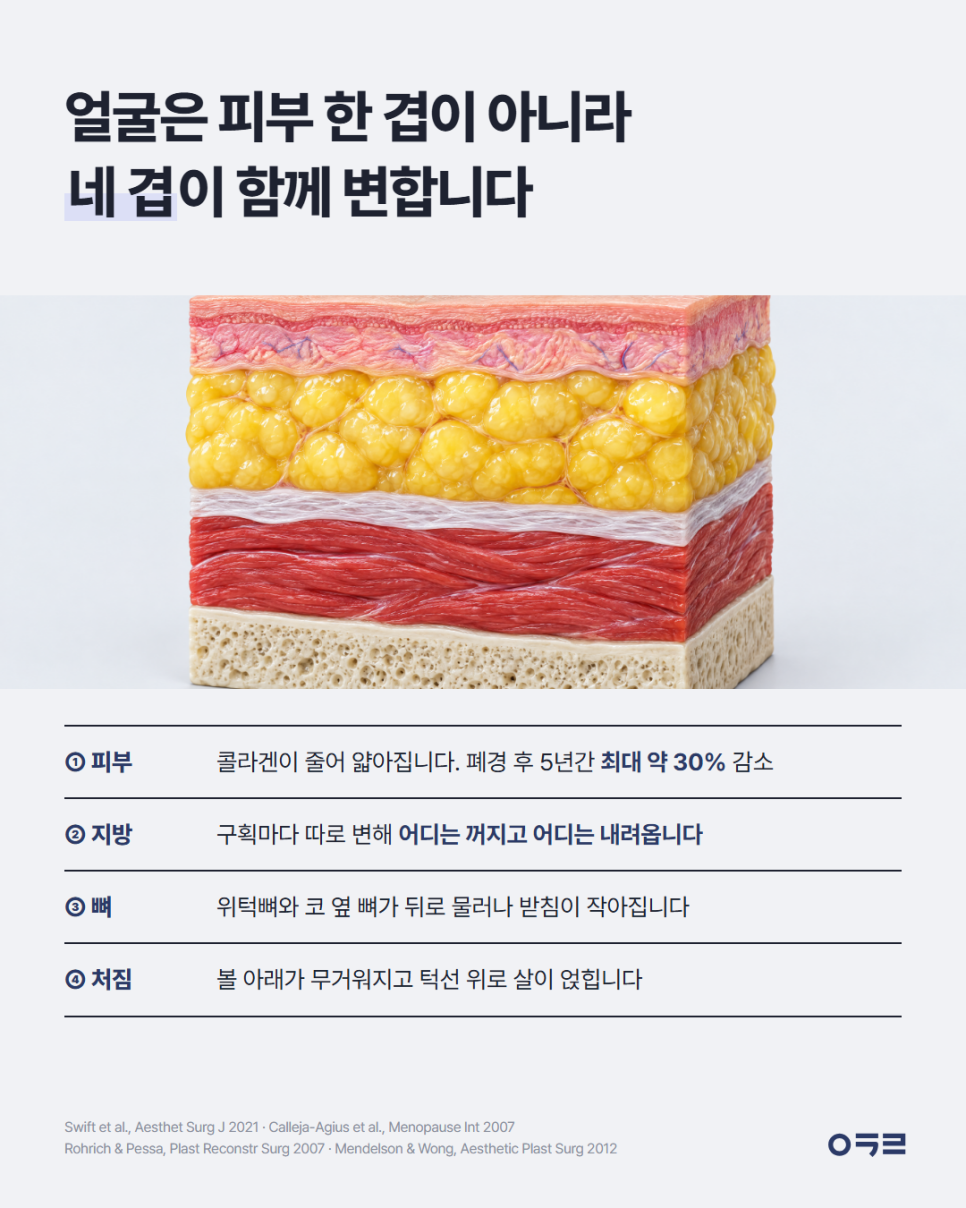
The face is not built from a single layer of skin.
Beneath the skin, the fat layer, fascia (SMAS), muscles and ligaments, and bone are connected layer upon layer.
A review by Swift et al. published in Aesthetic Surgery Journal in 2021
describes facial aging as a process that starts in the bone,
moving on to soft tissue and then skin, a three-dimensional process that works “from the inside out.”
As we age, four major changes overlap in the face.
1. Skin elasticity declines
As collagen and elastic fibers in the dermis decrease, the skin becomes thinner and loses its ability to recover.
Women are greatly affected by hormonal changes around menopause.
According to a review by Calleja-Agius et al. published in Menopause International in 2007,
up to 30% of skin collagen is lost in the first 5 years after menopause,
and over the 15 years after menopause it declines by an average of 2.1% per year.
2. Facial fat changes differently by zone
An anatomical study by Rohrich and Pessa published in Plastic and Reconstructive Surgery in 2007
showed that facial fat is divided into several independent compartments.
That is why facial fat does not shrink all at once;
some areas sink, while others remain or move downward.
This structure explains a face where the front cheek sinks while the deep cheek actually stands out more.
3. The facial bones change too
According to a review by Mendelson and Wong published in Aesthetic Plastic Surgery in 2012,
with age the maxilla recedes backward and the pyriform aperture beside the nose widens.
In effect, the foundation that supported the skin and fat becomes smaller.
4. Soft tissue descends
When these changes accumulate, the lower cheek becomes heavier,
and flesh rests on top of the jawline, making the facial line look blurred.
To sum up, facial sagging is the combined result of changes in skin, fat, and bone.
That is why people with loosened skin, people with a dull jawline from excess fat, and people with a hollow face from lost volume
each need a different lifting.
Lifting Devices: What Differs, and How?
There are many names for lifting devices,
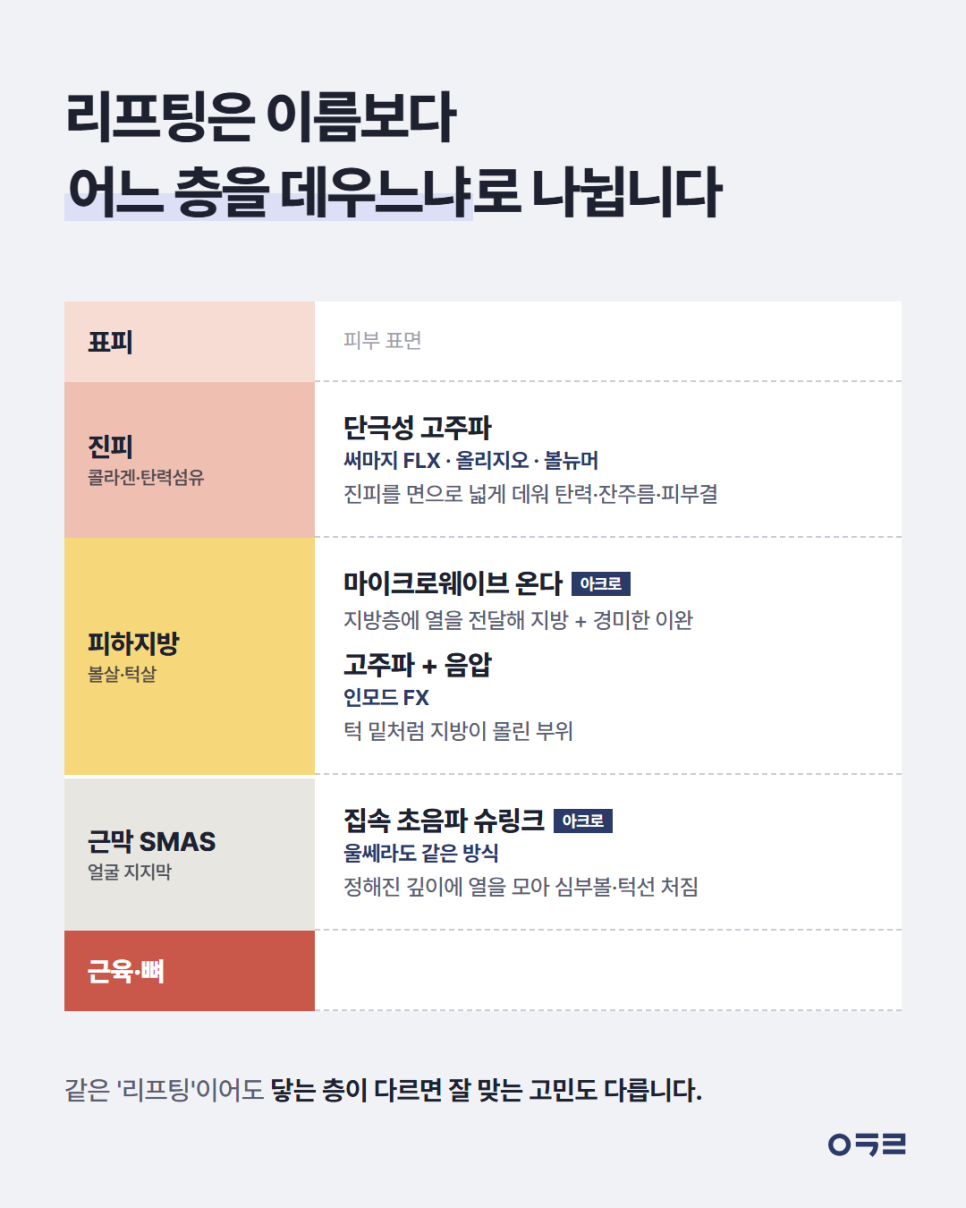
but it becomes much simpler if you sort them by “what kind of energy is delivered mainly to which layer.”
| Layer | Composition | Main devices that act on it |
|---|---|---|
| Dermis | Collagen, elastic fibers | Monopolar radiofrequency (Thermage, Oligio, Volnewmer) |
| Subcutaneous fat | Cheek fat, chin fat | Microwave (ONDA), radiofrequency + negative pressure (InMode FX) |
| Fascia (SMAS) | Supporting membrane of the face | Focused ultrasound (Shurink, Ulthera) |
1. Focused ultrasound (HIFU): Shurink, Ulthera
Like focusing sunlight with a magnifying glass, ultrasound energy is gathered at a single point at a set depth
to create tiny thermal coagulation points.
The tissue contracts, and over the following months collagen is newly produced.
Its biggest feature is that it can reach the fascia (SMAS), the layer that is pulled in surgical lifting.
A systematic review by Contini et al. published in the International Journal of Environmental Research and Public Health in 2023
pooled and analyzed 16 studies of ultrasound lifting.
At 90 days after treatment, 92% showed improvement in skin elasticity or wrinkles on clinician assessment, and the improvement continued for up to 1 year.
Because it takes time for collagen to build up, you can understand it as a treatment that improves gradually over time.
2. Monopolar radiofrequency (Monopolar RF): Thermage FLX, Oligio, Volnewmer
The principle is that a radiofrequency current meets resistance in tissue and generates heat.
If ultrasound aims deeply at a single point, radiofrequency warms the dermis broadly as a surface and tightens the skin as a whole.
Rather than lifting sagging tissue, it is stronger in improving skin elasticity, fine lines, and skin texture.
A systematic review by Rohrich et al. published in Plastic and Reconstructive Surgery in 2022
analyzed 23 radiofrequency lifting studies
and concluded that radiofrequency devices improve skin laxity of the face and body to a measurable degree.
3. Microwave: ONDA
This is a device that uses 2.45 GHz microwaves.
The handpiece sends energy toward the subcutaneous fat layer while the skin surface is protected by cooling,
it addresses a jawline blurred by fat together with mild skin laxity.
An international advisory board recommendation paper by Hoffmann et al. published in Bioengineering in 2024
summarized studies that used ONDA for localized fat, cellulite, and skin laxity,
and it also introduces a submental study in which 48 adults received 6 sessions at 2-week intervals.
When followed up to 6 months after treatment, both submental fat and submental skin laxity improved.
4. Radiofrequency + negative pressure: InMode FX
This delivers bipolar radiofrequency while the skin is gently drawn up by negative pressure,
and it is the small-area handpiece (MiniFX) of InMode devices.
We mainly consider it for refining narrow areas where fat is concentrated, such as under the chin, rather than the whole face.
Device Comparison at a Glance
| Type | Representative devices | Layer mainly reached | Concerns it suits |
|---|---|---|---|
| Focused ultrasound | Shurink, Ulthera | Dermis to fascia (SMAS) | Sagging deep cheeks and jawline |
| Monopolar radiofrequency | Thermage FLX, Oligio, Volnewmer | Dermis overall | Reduced skin elasticity, fine lines |
| Microwave | ONDA | Subcutaneous fat | Fat + mild laxity |
| Radiofrequency + negative pressure | InMode FX | Subcutaneous fat | Fat in narrow areas (under the chin) |
What Changes Appear at Each Age?
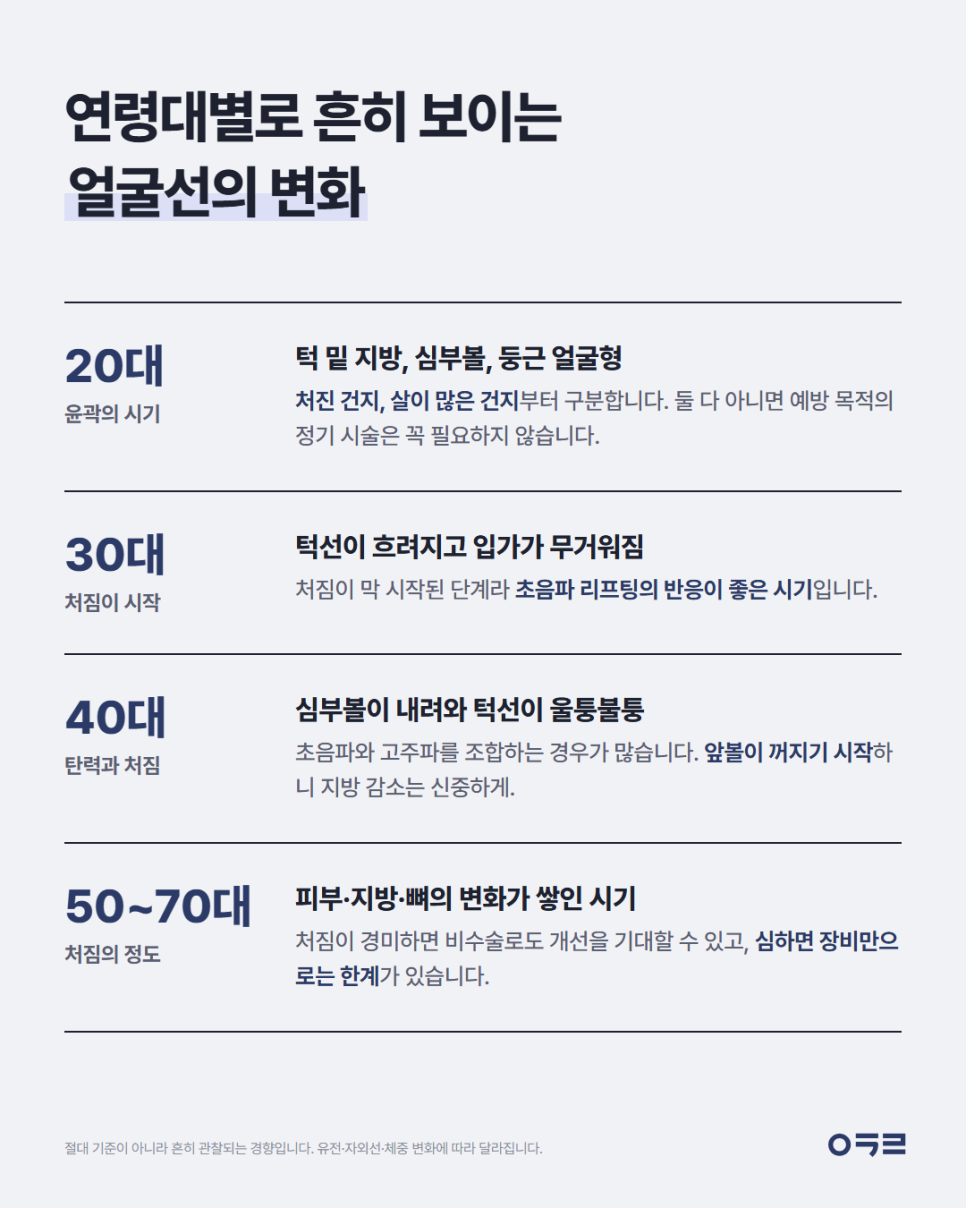
The age groups below are not absolute standards but tendencies commonly observed.
The actual pace of aging varies with genetics, UV exposure, weight changes, and lifestyle.
Your 20s: a time when contour, rather than sagging, is the concern
Skin elasticity is mostly well preserved, but instead
many people are concerned about submental fat, deep cheeks, and a round face shape.
Many also say their jawline became blurred after gaining and then losing weight.
The most important thing at this stage is telling apart whether it is sagging or simply a lot of flesh.
If fat is the cause, treatments that address the fat layer, such as ONDA or InMode FX, suit well,
and if you want a slightly crisper jawline, light ultrasound lifting can be considered together.
The basis of preventing aging at this stage is sun protection.
A study by Flament et al. published in Clinical, Cosmetic and Investigational Dermatology in 2013
analyzed 298 women and reported that about 80% of visible signs of facial aging may be related to UV exposure.
Your 30s: when sagging begins
The jawline is not as sharp as before, and the area around the mouth begins to look heavy.
The deep cheeks may also start to stand out downward.
Because sagging has only just begun, this is a good time to expect a response to ultrasound lifting.
If skin texture and elasticity have declined as well, radiofrequency can be added.
The same Flament study also found that facial sagging is affected more by age than by UV exposure,
which is why starting care in step with when sagging begins can help.
Your 40s: when elasticity and sagging are looked at together
The deep cheeks descend and the jawline looks bumpy,
the marionette lines beside the mouth deepen, and the boundary between the chin and neck becomes blurred.
At this point it is better to look at the balance of the whole face than to pull up just one area.
Often ultrasound is used for sagging and radiofrequency for skin laxity, in combination,
and the treatment range is decided by separating areas where volume should be preserved, like the front cheek, from areas to be refined.
Your 50s to 70s: a time that depends on the “degree” of sagging
This is a time when changes in skin, fat, and bone have accumulated together, but even now individual differences are large.
If elasticity is still relatively well preserved, you can reasonably expect improvement even with non-surgical lifting.
In fact, patients in their 70s are also receiving lifting for jawline and double chin concerns.
More Important Than Age Is Face Type: Which Type Is Your Face?
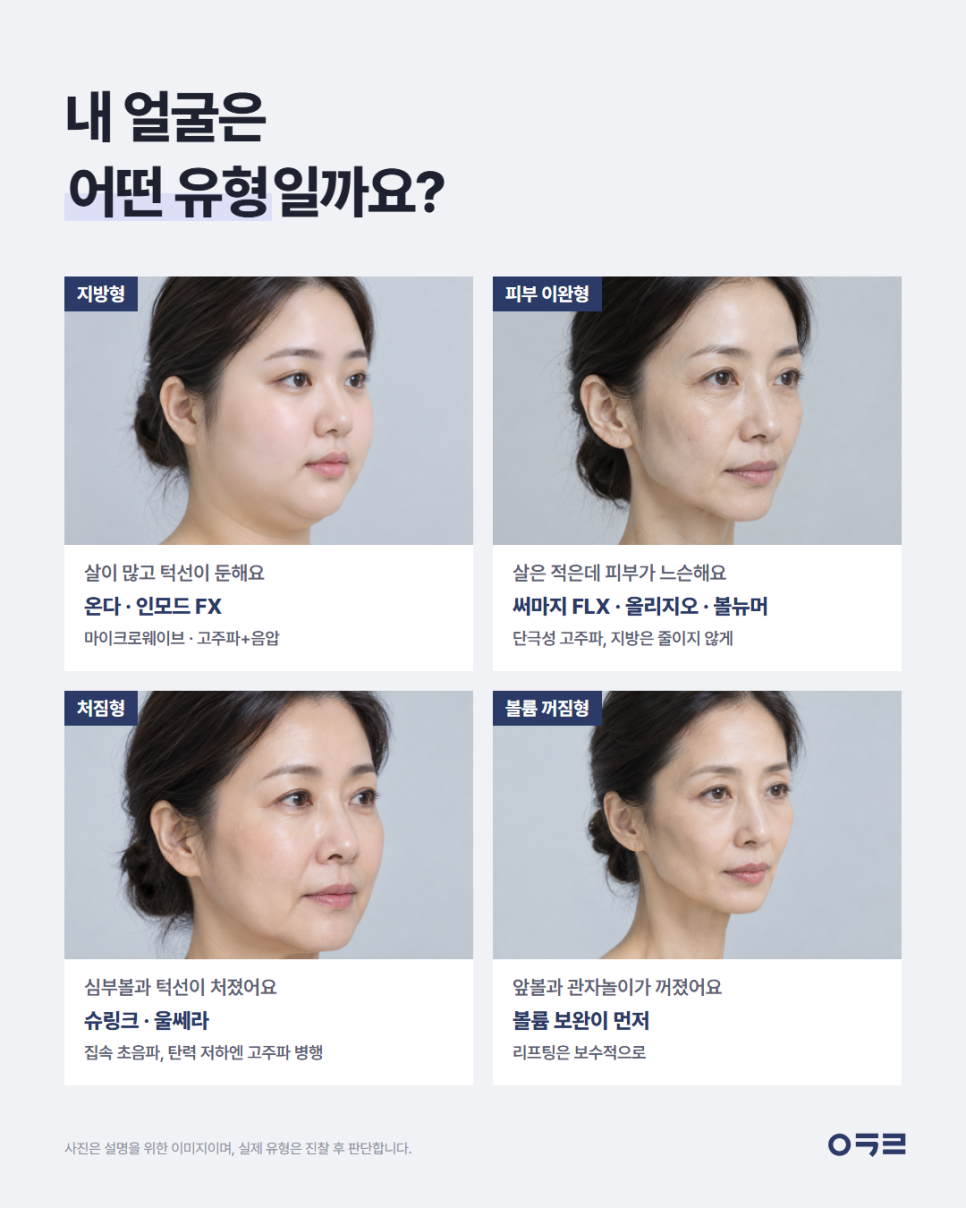
Type 1. A face with a lot of flesh and a dull jawline
→ ONDA, InMode FX
| ✔ When I gain weight, my face fills out first ✔ I have a double chin or a thick area under the chin ✔ It isn’t sagging, but my face looks round and heavy |
|---|
In this type, the amount and distribution of subcutaneous fat determine the facial line more than the skin does.
If fat and mild laxity are present together, ONDA can be considered,
and if fat is concentrated in a narrow area like under the chin, InMode FX can be considered.
The point is to separate where to reduce and where to leave, tidying up while preserving natural volume.
Type 2. A face with little flesh but loose skin
→ Thermage FLX, Oligio, Volnewmer
| ✔ I don’t have much flesh on my face and my cheeks are thin ✔ When I pinch my skin lightly and let go, it is slow to spring back ✔ After dieting, my skin doesn’t feel firm |
|---|
This type does not need to reduce fat.
What is needed is the elasticity of the skin itself.
Monopolar radiofrequency, which warms the dermis broadly, suits well,
and you can expect skin texture and fine lines to be refined as well.
Type 3. A face with sagging deep cheeks and jawline
→ Shurink, Ulthera (+ radiofrequency)
| ✔ Even when I’m not smiling, the lower cheek beside my mouth bulges ✔ The boundary running from the mouth corner to the jawline is blurred ✔ My face looks more sagged in the afternoon than in the morning |
|---|
In this type, a shift in fat position, skin laxity, and weakened supporting structures act together.
Focused ultrasound, which reaches the fascial layer, becomes the core,
and if reduced skin elasticity and fine lines are also a concern, radiofrequency can be added.
There is one distinction to make here.
A face whose deep cheeks are naturally well developed and a face whose deep cheeks have sagged from aging have different treatment goals.
For the former, fat management is central; for the latter, lifting is.
Type 4. A face that is hollow and lacks volume
→ Volume restoration first
| ✔ My front cheeks and temples look hollow ✔ The area below my cheekbones is sunken ✔ My face looks thin and tired overall |
|---|
In this type, rather than reducing fat, we first think about the direction of filling in the lost volume.
After checking where the volume has been lost, it is better to add lifting lightly, mainly to supplement elasticity.
However, that doesn’t mean lifting is unsuitable just because the face lacks volume.
If you tidy up the parts that stick out above and below the hollow area,
you can get an effect where the relatively sunken part stands out less.
This is because the facial line is seen not through one area alone but through its balance with its surroundings.
Lifting is not a treatment that always makes the face smaller,
but a treatment that corrects sagging tissue and elasticity to refine the facial line.
| My facial concern | Treatments to consider |
|---|---|
| A lot of face flesh or double chin, dull contour | ONDA, InMode FX |
| Little face flesh but loose skin, fine lines | Thermage FLX, Oligio, Volnewmer |
| Sagging deep cheeks, jawline | Shurink, Ulthera (+ combined radiofrequency) |
| Lack of volume, hollow face | Volume restoration first |
※ These are general selection criteria; actual treatment varies with fat layer thickness, skin elasticity, and facial structure.
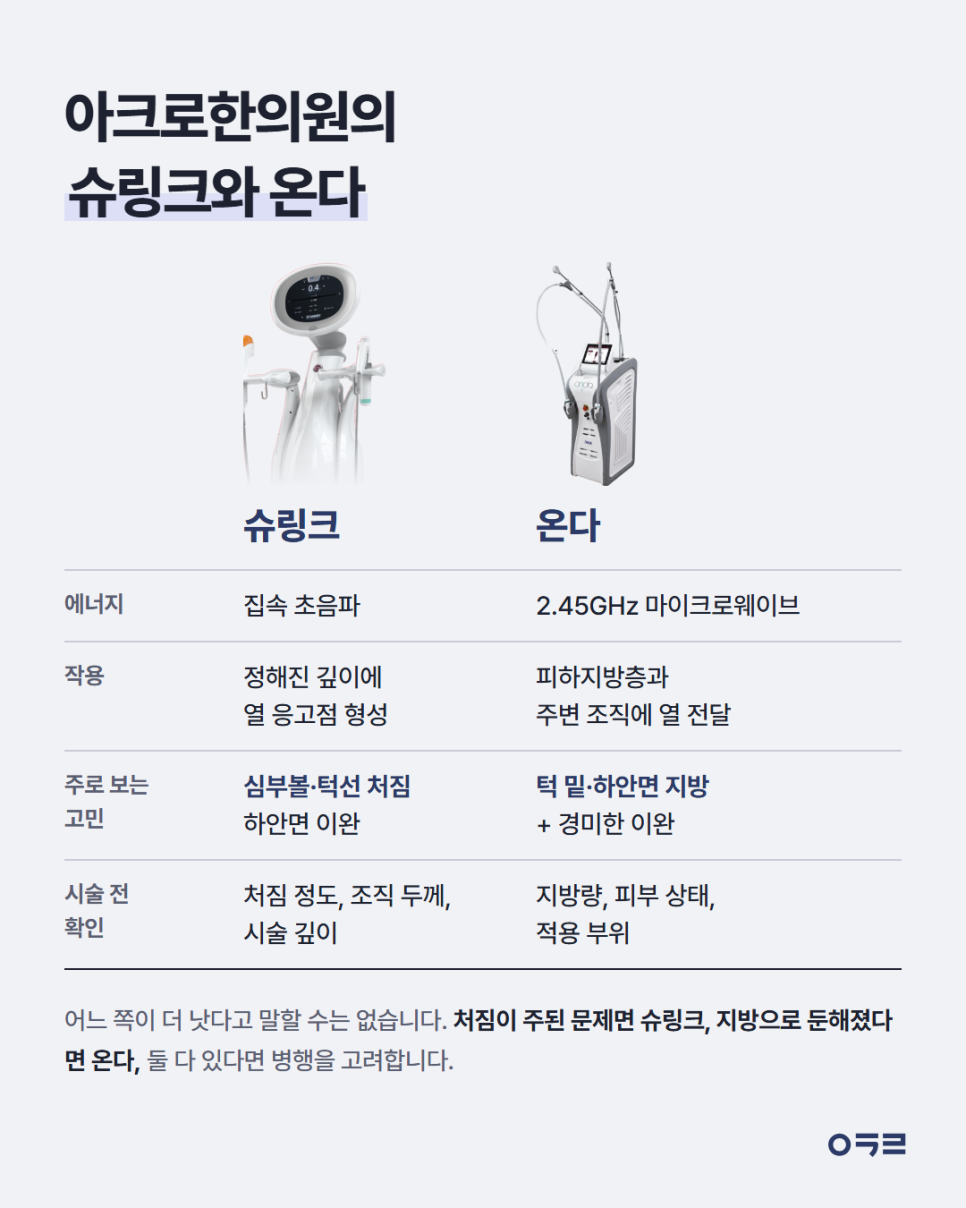
Shurink and ONDA at ACRO Korean Medicine Clinic
ACRO Korean Medicine Clinic operates two lifting devices: Shurink (focused ultrasound) and ONDA (microwave).
| Item | Shurink | ONDA |
|---|---|---|
| Energy | Focused ultrasound (HIFU) | 2.45 GHz microwave |
| How it works | Forms thermal coagulation points at a set depth | Delivers heat to the subcutaneous fat layer and surrounding tissue |
| Concerns mainly considered | Sagging deep cheeks and jawline, lower-face laxity | Fat under the chin and lower face + mild laxity |
| Pre-treatment assessment points | Degree of sagging, tissue thickness, treatment depth | Amount of fat, skin condition, area of application |
Rather than one being better than the other, the two devices suit different concerns.
If sagging is the main problem, Shurink; if fat has dulled the facial line, ONDA;
and if both are present, we consider combining them.
In practice, people in their early 20s often have fat-type concerns, so we often consult them about ONDA,
while for those in their 30s and older whose sagging has begun, we often consult mainly about Shurink.

What We Check Together First in a Consultation
1. Is it sagging, or a lot of flesh?
We first distinguish whether the facial line looks dull because of fat, elasticity, or volume.
2. Fat layer thickness and distribution
We separate fat that can be reduced from volume that should be preserved, and set the treatment range accordingly.
3. Location and degree of sagging
We choose the device and depth depending on whether the center of the problem is the deep cheeks, jawline, or under the chin.
4. The change you want and your schedule
If you have a date such as a wedding or an event, we plan around when the effect comes in.
Frequently Asked Questions
Q. At what age is it best to get lifting?
There is no set age. Even in your 20s, if you are concerned about fat under the chin or contour, treatments that address the fat layer may help, and even after your 50s, if elasticity is maintained, you can expect improvement from non-surgical lifting. The criterion is not age but face type and sagging pattern.
Q. How are Shurink and ONDA different?
Shurink uses focused ultrasound to create thermal coagulation points down to the fascial layer and improve sagging, while ONDA uses 2.45 GHz microwaves to deliver heat to the subcutaneous fat layer, addressing fat and mild laxity together. We consider Shurink first if sagging is the concern, and ONDA first if fat is the concern.
Q. My face sagged after dieting. Which lifting is good?
If facial fat has already decreased from weight loss, radiofrequency that improves skin elasticity or ultrasound that pulls up sagging often suits better than a treatment that reduces fat further.
To Sum Up
| 1. There is no set age to start lifting. What blurred the facial line (fat, elasticity, sagging, volume) is the selection criterion. 2. Facial sagging is the combined result of reduced collagen (up to 30% in the 5 years after menopause), zone-by-zone fat changes, and bone changes. 3. In a review of 16 studies, ultrasound lifting showed improvement in 92% on clinician assessment at day 90, and the effect continued for up to 1 year. 4. We mainly consider ONDA and InMode FX for the fat type, radiofrequency for the elasticity type, and Shurink and Ulthera for the sagging type. 5. For a hollow face that has lost volume, we think about restoring volume first. |
|---|
Even with the same lifting, results differ depending on face type and tissue condition.
If you have been wondering when to get lifting, rather than counting your age,
please start by checking which part of your face is changing right now.
The criteria by type introduced today are only a general direction to aid understanding, not an absolute answer.
Because treatment cannot be divided neatly, even for the same type, depending on the condition of the face and the design by the medical staff performing the treatment,
the choice of device, treatment range, and results can differ.
If you are curious about what suits your face, we recommend checking your current condition through an in-person consultation.
As much as needed, in the right way.
That is the surest way to keep a natural facial line.
About ACRO Korean Medicine Clinic
📍 Location: 1 min walk from Sinnonhyeon Station Exit 3 (2F Boratial Bldg., 480 Gangnam-daero, Gangnam-gu, Seoul)
📞 Consultations: search “acrohani” on KakaoTalk
🌐 Website: https://acrohani.com/en
🕒 Hours: Weekdays 10:30–20:30 (lunch 13:00–14:00) / Weekends & public holidays 10:00–15:30 (no lunch break)
This article is intended to provide general medical information and does not replace individual diagnosis or treatment.
The effects and suitability of treatment may differ depending on each person’s skin and tissue condition, so please have a thorough consultation with our medical staff.
References
Calleja-Agius, J., Y. Muscat-Baron, and M. P. Brincat. "Skin Ageing." Menopause International, vol. 13, no. 2, 2007, pp. 60-64.
Contini, M., et al. "A Systematic Review of the Efficacy of Microfocused Ultrasound for Facial Skin Tightening." International Journal of Environmental Research and Public Health, vol. 20, no. 2, 2023, 1522. doi:10.3390/ijerph20021522.
Flament, F., et al. "Effect of the Sun on Visible Clinical Signs of Aging in Caucasian Skin." Clinical, Cosmetic and Investigational Dermatology, vol. 6, 2013, pp. 221-232. doi:10.2147/CCID.S44686.
Hoffmann, K., et al. "Microwave-Energy-Based Device for the Treatment of Cellulite and Localized Adiposity: Recommendations of the 'Onda Coolwaves' International Advisory Board." Bioengineering, vol. 11, no. 12, 2024, 1249. doi:10.3390/bioengineering11121249.
Mendelson, B., and C.-H. Wong. "Changes in the Facial Skeleton with Aging: Implications and Clinical Applications in Facial Rejuvenation." Aesthetic Plastic Surgery, vol. 36, no. 4, 2012, pp. 753-760.
Rohrich, R. J., et al. "Minimally Invasive Approach to Skin Tightening of the Face and Body: Systematic Review of Monopolar and Bipolar Radiofrequency Devices." Plastic and Reconstructive Surgery, vol. 150, no. 4, 2022, pp. 771-780.
Rohrich, R. J., and J. E. Pessa. "The Fat Compartments of the Face: Anatomy and Clinical Implications for Cosmetic Surgery." Plastic and Reconstructive Surgery, vol. 119, no. 7, 2007, pp. 2219-2227.
Swift, A., et al. "The Facial Aging Process From the 'Inside Out'." Aesthetic Surgery Journal, vol. 41, no. 10, 2021, pp. 1107-1119.