

How Much Weight Gain Before Your Period Is Normal? Weight Changes During Menstruation and Ovulation
Weight that rises and falls with each cycle: research suggests it is mostly water
Hello, this is Dr. Park Ji-seon of ACRO Korean Medicine Clinic.
When I go over weight records with patients who are dieting,
I see many whose graph suddenly jumps once a month, at about the same point.
Their diet and exercise haven't changed, yet 1–2 kg suddenly appears,
so they walk into the consulting room saying, "This month is ruined."
When we match up the dates, it is usually a few days before the expected period.
Much of the weight gained around a period comes from water held in the body for a short while, more than from body fat.
That said, how much it goes up differs quite a bit from person to person,
and research has also confirmed that appetite rises during the same stretch,
so rather than just brushing it off, knowing about it helps your diet.
Today I'll go through why body weight changes before your period, during it and around ovulation,
how many kilograms is a common change,
and whether the idea of a "post-period golden window for dieting" holds up.
| At a Glance 1. Weight change across the menstrual cycle averages around 0.5 kg, and the gain is mainly water 2. The bloated feeling is strongest on the first day of the period and weakest after the period ends 3. Before a period, people tend to eat about 168 kcal more per day on average 4. The "post-period golden window" rests on just two small studies and is not yet established |
|---|
Why does weight go up before a period?
Premenstrual weight gain happens when fluid stays for a while in the tissues outside the blood vessels.
The time from ovulation until the period is called the luteal phase,
and during this phase, the body tends to hold a little more water than usual.
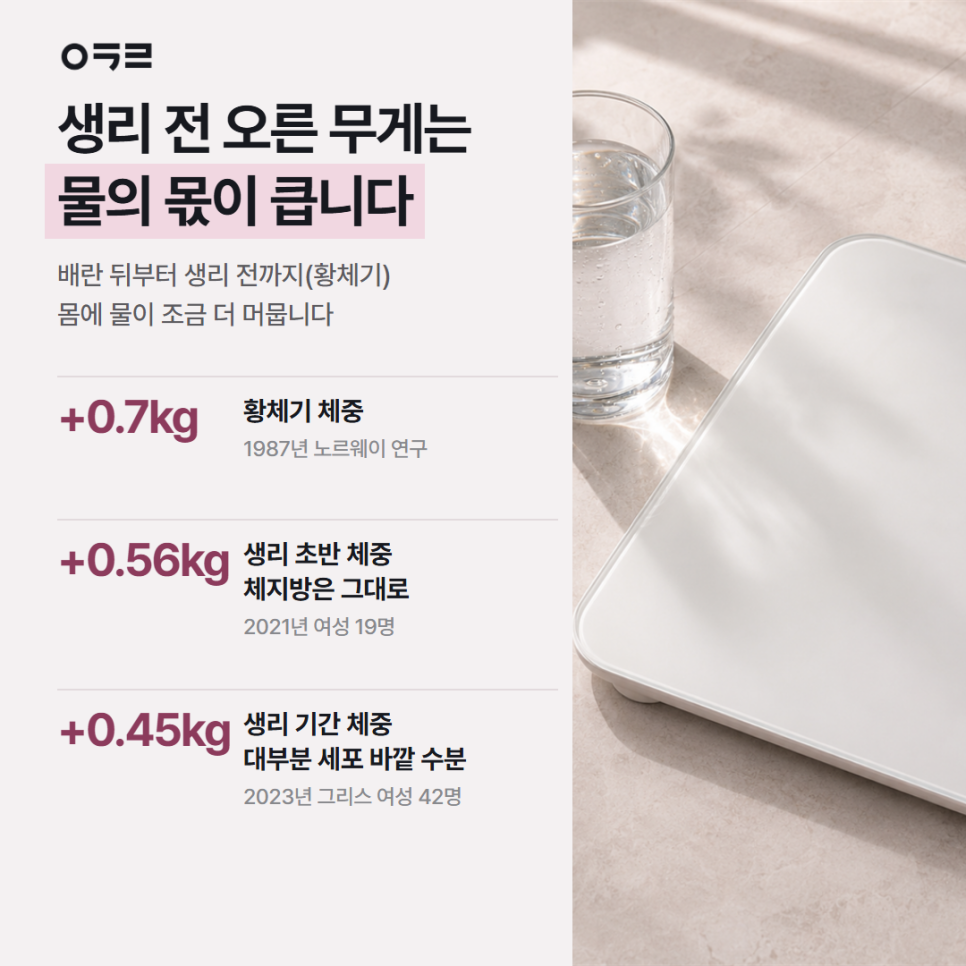
In a study published in 1987 in the
American Journal of Obstetrics and Gynecology, even women without premenstrual syndrome symptoms
gained 0.7 kg on average in the luteal phase,
and colloid osmotic pressure had dropped in both their blood and the tissue under the skin.
The researchers suggested that this may reflect a little water pooling in the tissues.
A 2007 Italian study found something similar:
when body water was measured in 38 women, total body water
and extracellular water had increased in the luteal phase.
Fat did not increase along with the added weight
A study published in 2021 in
Medicine and Science in Sports and Exercise measured 19 women twice, once early in the period
and once midway through the time after the period had ended.
Body weight was 0.56 kg higher on average early in the period,
and extracellular water was also 0.27 L higher,
but body fat did not differ between the two time points.
In a 2023 Greek study (42 women, measured twice a week),
weight during the period was also 0.45 kg higher than in the first week of the cycle,
and most of the increase was extracellular water (0.47 kg).
So there's no need to read a number that went up over a few days
as fat, is there?
How many kilograms is a common change?
The average is under 1 kg, but it varies widely from person to person.
Studies measured it in different ways, but the average figures are smaller than you might expect.
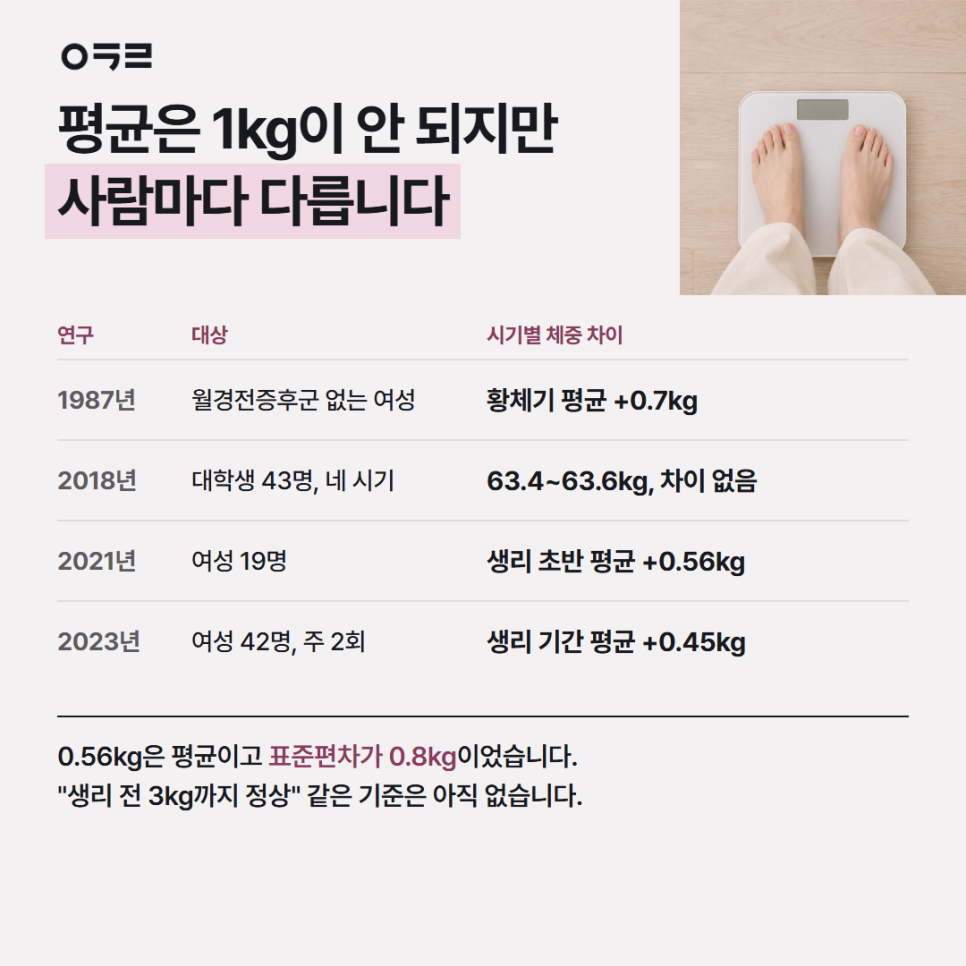
| Study | Participants | Weight difference by phase |
|---|---|---|
| American obstetrics and gynecology journal, 1987 | Norwegian women without premenstrual syndrome | Average gain of 0.7 kg in the luteal phase |
| Exercise science journal, 2018 | 43 female university students, four time points | 63.4–63.6 kg, no difference |
| Sports medicine journal, 2021 | 19 women | 0.56 kg heavier on average early in the period |
| American human biology journal, 2023 | 42 women, twice a week | 0.45 kg heavier on average during the period |
What patients find most surprising here
is this: "If the average is that small, why do I go up by as much as 2 kg?"
The 0.56 kg in the 2021 study is an average, and the standard deviation was 0.8 kg.
In other words, individual results were spread quite widely around the average.
However, how common large swings such as 2 or 3 kg are was not reported separately,
and no study has yet drawn a line such as "up to 3 kg before a period is normal."
How salty your food was that month also has an effect.
In a 1989 study in which 25 women weighed themselves daily for one cycle,
weight changes by phase moved together with the amount of sodium eaten that week,
so cutting back on salty foods such as soups and broths or ramen in the week before your period
is also worth a try.
What changes during the period and around ovulation?
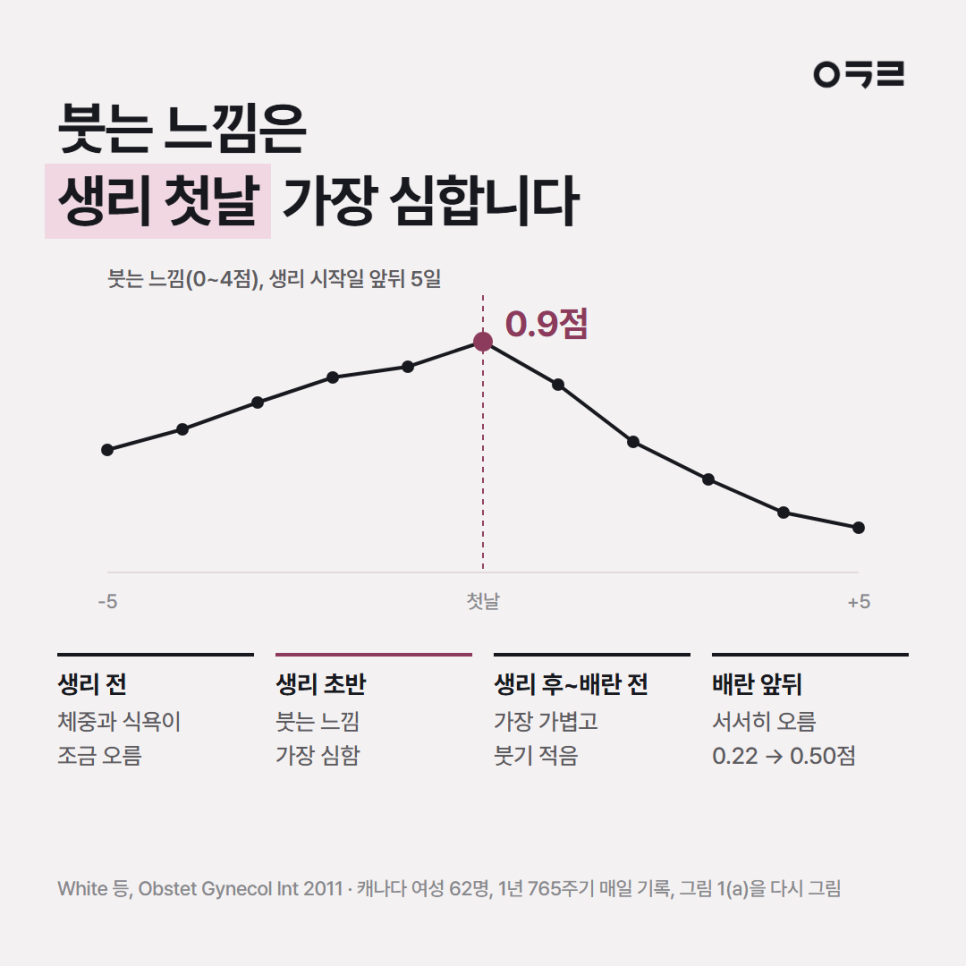
The bloated feeling is strongest on the first day of the period,
and you feel lightest in the days after the period ends.
In a 2011 Canadian study, 62 healthy women
rated their fluid retention daily from 0 to 4 over 765 cycles across one year.
Ovulation was confirmed by basal body temperature.
The fluid retention score was highest on the first day of the period, at 0.9 points,
and lowest midway through the time after the period had ended.
Around ovulation, it rose slowly over 11 days from 0.22 to 0.50 points,
and it was clearly higher around the period than around ovulation.
Interestingly, the estrogen and progesterone levels measured in the first and last cycles
showed no clear relationship with the fluid retention scores.
What about weight around ovulation?
In a 2002 Austrian study, 32 women measured their own weight,
waist and hips every morning throughout one cycle.
Weight rose slightly in the later part of the cycle,
while around ovulation the waist-to-hip ratio actually went down.
In a 2017 Tunisian study (30 women), weight was also lowest around ovulation.
It is hard to find evidence for a big gain at ovulation, as in searches like "2 kg weight gain during ovulation,"
and the bloated feeling at this time tends to be milder than before a period.
| Phase | Weight and bloating | Evidence |
|---|---|---|
| After the period ends to before ovulation | Lightest, with little bloating | 2011 records of 62 women, 2021 measurements |
| Around ovulation | Bloating slowly rises; waist-to-hip ratio may even fall | 2011 records, 2002 daily measurements of 32 women |
| Week before the period | Weight rises a little and appetite tends to increase | 1987 study, 2025 meta-analysis |
| Early in the period | Bloating is strongest and weight tends to be higher | 2011 records, 2021 measurements |
I also often hear, "I'm on my period and my weight won't go down."
Since the first day of the period is the peak of bloating,
it is common for the water not to have fully drained yet during the period.
The bloated feeling is lightest midway through the time after the period ends.
Is premenstrual appetite just in your head?
Eating more before a period is something that has shown up repeatedly across several studies.
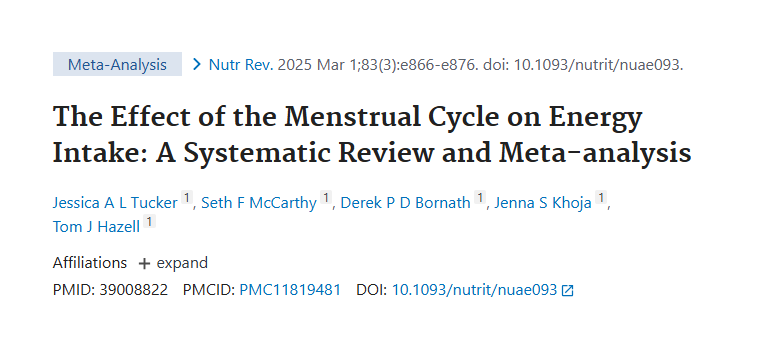
A meta-analysis published in 2025 in Nutrition Reviews
pooled data from 330 women of normal weight,
and energy intake in the luteal phase was 168 kcal per day higher on average than in the follicular phase.
That is a little over half a bowl of rice,
but results varied widely between studies, so for some people it may be more, and for others almost nothing.
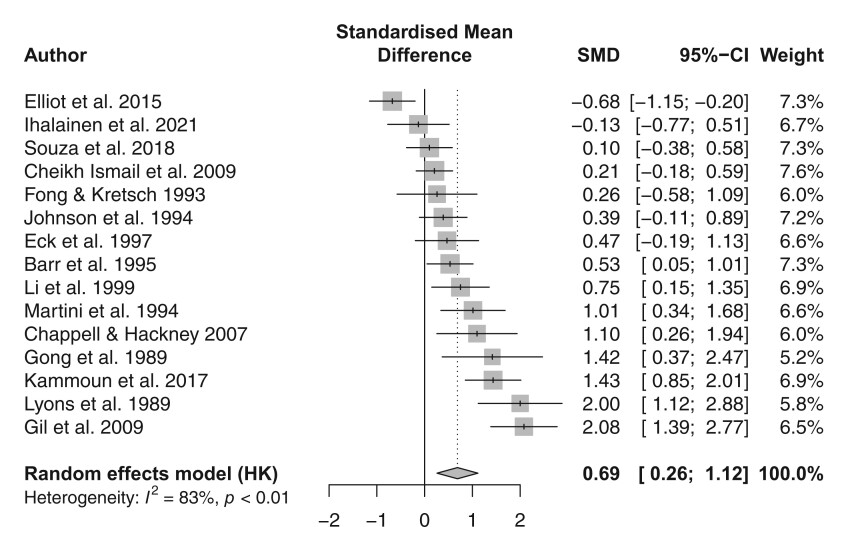
Source: Tucker et al., Nutrition Reviews 2025, Figure 2, differences in energy intake between the luteal and follicular phases by study (CC BY 4.0)
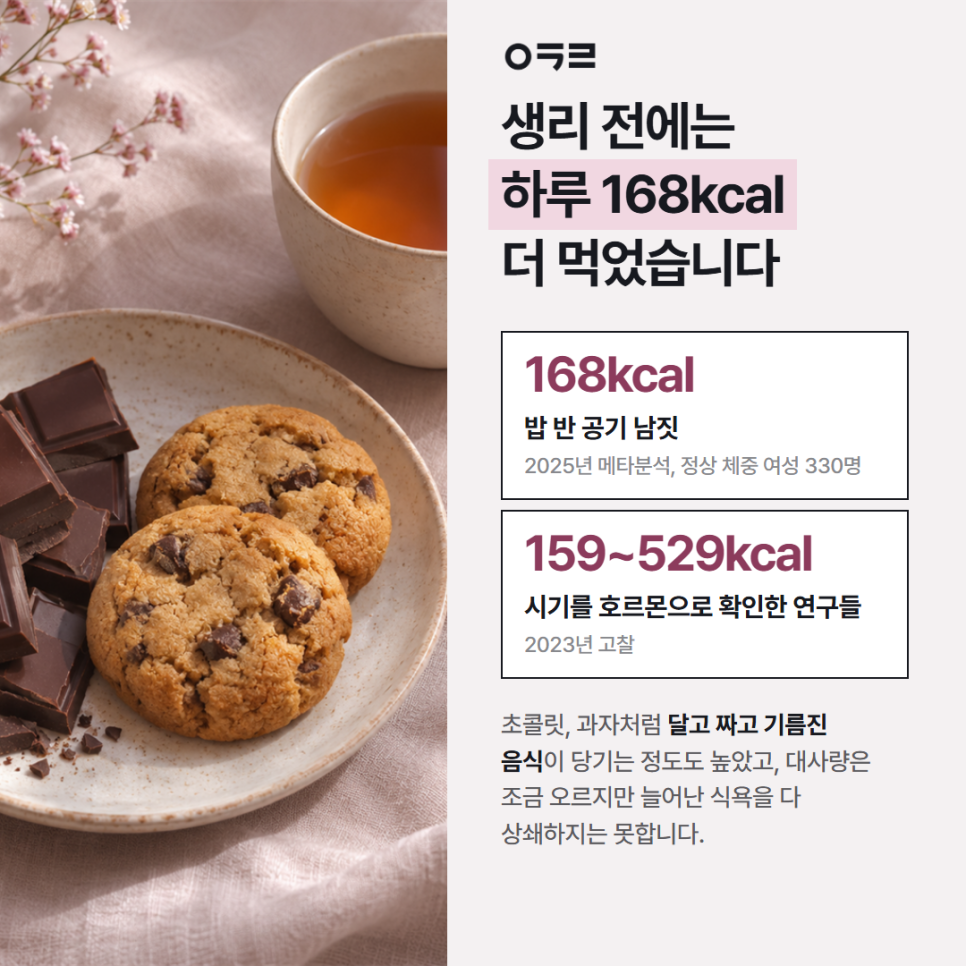
In a 2023 review in the same journal,
looking only at studies that accurately confirmed the phase with hormones,
the difference ranged from 159 to 529 kcal per day depending on the study.
Since these few days before the period come around again and again,
it's not a number to brush aside in a month-long diet plan.
The foods you want change too.
In a 2018 Brazilian study, before the period,
cravings for sweet, salty and fatty foods such as chocolate, snacks and desserts were clearly higher.
Fortunately, the calories your body burns also rise a little during this time.
A 2020 meta-analysis in PLoS One (26 studies, 318 women)
found that resting metabolic rate was slightly higher in the luteal phase,
but the effect size was small and the number of kcal per day was not calculated,
so it is hard to say it fully offsets the increased appetite.
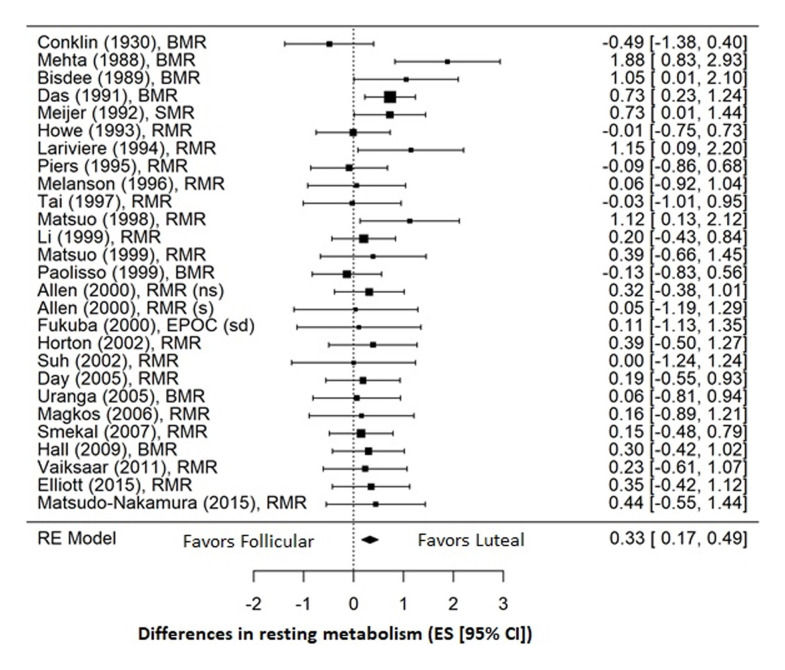
Source: Benton et al., PLoS One 2020, Figure 3, differences in resting metabolic rate across 26 studies (CC BY 4.0)
So for the week before your period, rather than a plan built on holding back,
a plan that picks one snack in advance tends to last longer.
If you decide ahead of time what to reach for when you crave something sweet,
it is less likely to spiral into "It's already ruined, so I'll eat everything today."
Is the "post-period golden window for dieting" real?
Water loss accounts for much of the sharp drop in weight after a period,
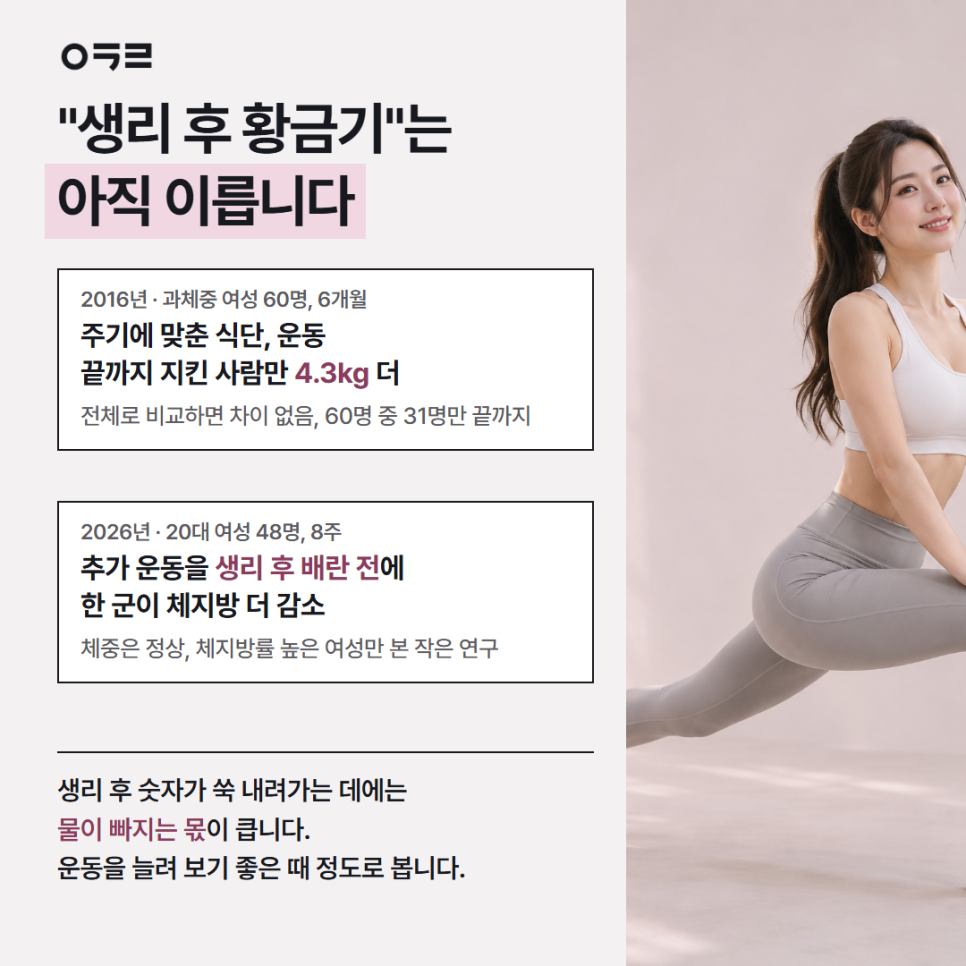
and the evidence that fat comes off more easily is still just two small studies.
Search online and you'll find many posts calling the 1–2 weeks after a period
the "golden window" when fat comes off best,
but based on the research so far, it is hard to say that for certain.
A study published in 2016 in the American Journal of Clinical Nutrition
split 60 overweight women into two groups for 6 months:
one changed diet and exercise according to the phase of the menstrual cycle,
while the other simply cut calories to the same level (1,600 kcal a day).
Comparing everyone, there was no meaningful difference in weight loss between the two groups,
but looking only at those who stuck with the program to the end, they lost 4.3 kg more.
However, only 31 of the 60 stayed to the end, so this result needs to be read with caution.
A 2026 Chinese study had 48 women in their 20s exercise for 8 weeks,
comparing a group that concentrated extra exercise in the late follicular phase (after the period, before ovulation)
with a group that concentrated it in the luteal phase.
Weight and body fat fell more in the late follicular phase group.
It was a small study that included only women with normal weight but high body fat percentage,
so it is hard to apply it more broadly as it is.
On the other hand, a 2020 study that measured the rate of fat burning during exercise by phase
found no difference in peak fat oxidation.
As we saw earlier, bloating is strongest on the first day of the period
and lightest after the period ends,
so water loss accounts for much of the sharp drop on the scale during this time.
Still, your body feels light and your appetite is lower then,
so you can think of it as a good time to exercise a bit more or to start something new.
It is not yet established enough to be called a "golden window."
On the flip side, if the number won't drop in the week before your period,
that's no reason to give up on that month's diet.
When should you weigh yourself for a fair comparison?
If you have a menstrual cycle, comparing with the same point last month means fewer swings.
If you compare your weight from the week before your period with the week after it ends,
it can look as if you gained nearly 1 kg while your fat stayed the same.
So when you look at your weight records,
For example, day 3 of this month's period against day 3 of last month's:
it's a good idea to compare the same points like this.
What about machines that measure body composition, like InBody?
In a 2018 study of 43 university students, none of four types of body composition analyzers
showed differences in body fat percentage across the phases of the menstrual cycle.
However, as in the 2021 and 2023 studies, a little more water is picked up early in the period,
so if possible, avoid the days just before and early in your period,
and measure at a similar point each time for easier comparison.
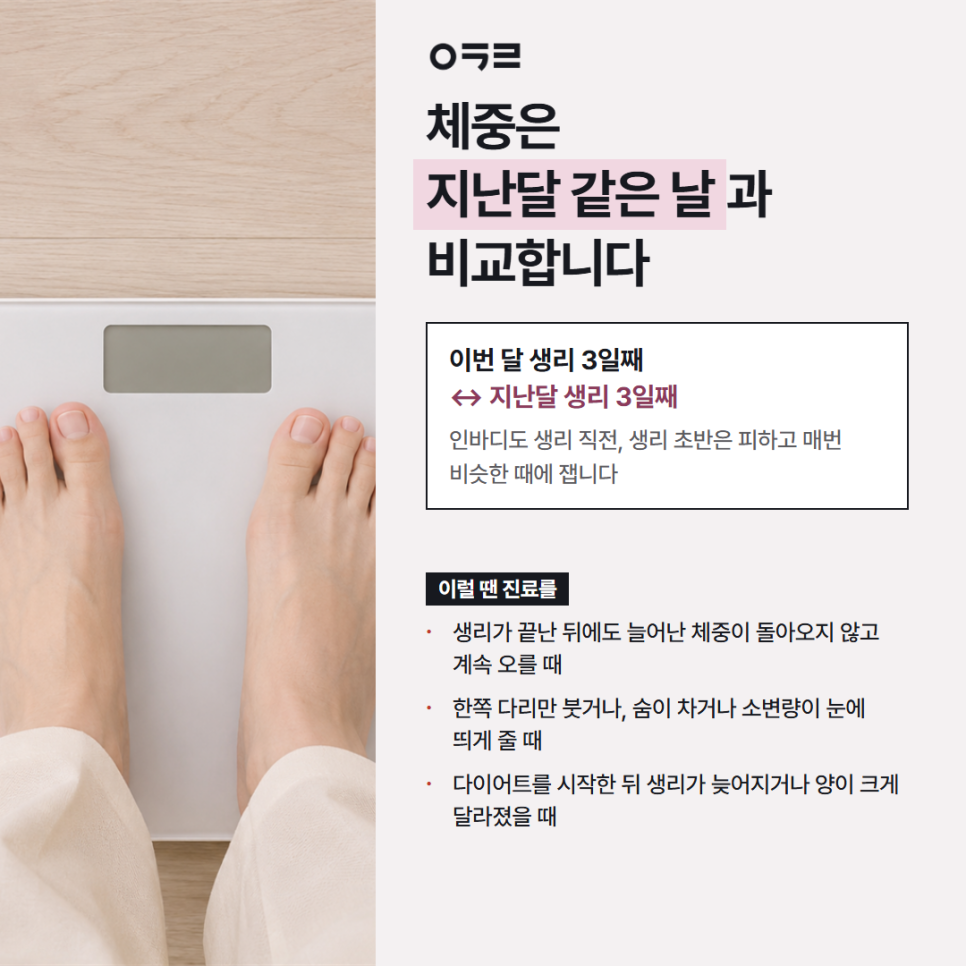
In the following cases, don't put it down to your menstrual cycle alone; it is a good idea to see a doctor.
· When the added weight doesn't come back down after your period ends and keeps rising
· When only one leg swells, or swelling comes with shortness of breath or a noticeable drop in urine output
· When your period is late or the flow changes a lot after you start dieting
Frequently Asked Questions
Q. I gained 3 kg before my period. Is it all fat?
It is hard to see all of a 3 kg rise over a few days as fat;
it is a mix that includes water and the weight of food not yet digested.
However, no study has set 3 kg as a common range,
so be sure to check whether your weight returns to where it was after your period ends.
Q. Can I take diet herbal medicine during my period?
Yes, you may take it during your period.
However, if your bleeding suddenly becomes heavier or the pain gets worse,
please get a consultation before you continue taking it.
Q. My period has been late since I started dieting.
Changes in body fat or stress during a diet can temporarily disrupt your cycle,
and in most cases it recovers once weight loss stabilizes.
If the delay goes on for a long time, it is a good idea to see a doctor.
In Summary
| 1. Weight change across the menstrual cycle averages 0.45–0.7 kg depending on the study, mainly water 2. Even within one study, the standard deviation was 0.8 kg, so people differ widely 3. The bloated feeling is strongest on the first day of the period (0.9 out of 4 points) 4. Before a period, people tend to eat about 168 kcal more per day on average 5. There is a small study in which exercise after the period did better, but it is too early to call it a "golden window" 6. Comparing your weight with the same point last month means fewer swings |
|---|
Just not letting the scale shake you in the week before your period
makes a month of dieting far less tiring.
At ACRO Korean Medicine Clinic, we also look through your weight records with you during consultations
and go over the changes that come with your menstrual cycle.
| ACRO Korean Medicine Clinic Information 📍 Location: 1 min walk from Sinnonhyeon Station Exit 3 (2F Boratial Bldg., 480 Gangnam-daero, Gangnam-gu, Seoul) 📞 Consultations: search “acrohani” on KakaoTalk 🌐 Website: https://acrohani.com/en 📝 Naver reviews 1,000+ (9.5★) | Gangnam Unni reviews 500+ (9.6★) 🕒 Hours: Weekdays 10:30–20:30 (lunch 13:00–14:00) / Weekends & public holidays 10:00–15:30 (no lunch break) |
|---|
This article is intended to provide general medical information and does not replace individual diagnosis or treatment.
The research results cited are values observed in the participants of those studies.
If you have symptoms, please see a doctor at a nearby medical institution.
References
Oian, P., et al. "Transcapillary Fluid Dynamics during the Menstrual Cycle." American Journal of Obstetrics and Gynecology, vol. 156, no. 4, 1987, pp. 952-955.
Gleichauf, C. N., and D. A. Roe. "The Menstrual Cycle's Effect on the Reliability of Bioimpedance Measurements for Assessing Body Composition." The American Journal of Clinical Nutrition, vol. 50, no. 5, 1989, pp. 903-907.
Kirchengast, S., and M. Gartner. "Changes in Fat Distribution (WHR) and Body Weight across the Menstrual Cycle." Collegium Antropologicum, vol. 26, suppl., 2002, pp. 47-57.
Davidsen, L., et al. "Impact of the Menstrual Cycle on Determinants of Energy Balance: A Putative Role in Weight Loss Attempts." International Journal of Obesity, vol. 31, no. 12, 2007, pp. 1777-1785.
Fruzzetti, F., et al. "The Oral Contraceptive Containing 30 Microg of Ethinylestradiol plus 3 mg of Drospirenone Is Able to Antagonize the Increase of Extracellular Water Occurring in Healthy Young Women during the Luteal Phase of the Menstrual Cycle: An Observational Study." Contraception, vol. 75, no. 3, 2007, pp. 199-203.
White, C. P., et al. "Fluid Retention over the Menstrual Cycle: 1-Year Data from the Prospective Ovulation Cohort." Obstetrics and Gynecology International, vol. 2011, 2011, 138451.
Cumberledge, E. A., et al. "The Effect of the Menstrual Cycle on Body Composition Determined by Contact-Electrode Bioelectrical Impedance Analyzers." International Journal of Exercise Science, vol. 11, no. 4, 2018, pp. 625-632.
Souza, L. B., et al. "Do Food Intake and Food Cravings Change during the Menstrual Cycle of Young Women?" Revista Brasileira de Ginecologia e Obstetrícia, vol. 40, no. 11, 2018, pp. 686-692.
Geiker, N. R. W., et al. "A Weight-Loss Program Adapted to the Menstrual Cycle Increases Weight Loss in Healthy, Overweight, Premenopausal Women: A 6-Mo Randomized Controlled Trial." The American Journal of Clinical Nutrition, vol. 104, no. 1, 2016, pp. 15-20.
Kammoun, I., et al. "Change in Women's Eating Habits during the Menstrual Cycle." Annales d'Endocrinologie, vol. 78, no. 1, 2017, pp. 33-37.
Benton, M. J., et al. "Effect of Menstrual Cycle on Resting Metabolism: A Systematic Review and Meta-Analysis." PLoS One, vol. 15, no. 7, 2020, e0236025.
Frandsen, J., et al. "Menstrual Cycle Phase Does Not Affect Whole Body Peak Fat Oxidation Rate during a Graded Exercise Test." Journal of Applied Physiology, vol. 128, no. 3, 2020, pp. 681-687.
Gould, L. M., et al. "Impact of Follicular Menstrual Phase on Body Composition Measures and Resting Metabolism." Medicine and Science in Sports and Exercise, vol. 53, no. 11, 2021, pp. 2396-2404.
Rogan, M. M., and K. E. Black. "Dietary Energy Intake across the Menstrual Cycle: A Narrative Review." Nutrition Reviews, vol. 81, no. 7, 2023, pp. 869-886.
Kanellakis, S., et al. "Changes in Body Weight and Body Composition during the Menstrual Cycle." American Journal of Human Biology, vol. 35, no. 11, 2023, e23951.
Tucker, J. A. L., et al. "The Effect of the Menstrual Cycle on Energy Intake: A Systematic Review and Meta-Analysis." Nutrition Reviews, vol. 83, no. 3, 2025, pp. e866-e876.
Yang, L., et al. "Effects of a Fatmax Exercise Intervention during Different Menstrual Cycle Phases on Fat Metabolism and Body Composition in Normal Weight Obese Women." Journal of Science and Medicine in Sport, vol. 29, no. 4, 2026, pp. 417-424.