

Journal of Korean Medicine · 2022 · Retrospective observational study
Ten weeks of records left by our patients:
an average of −10.2%
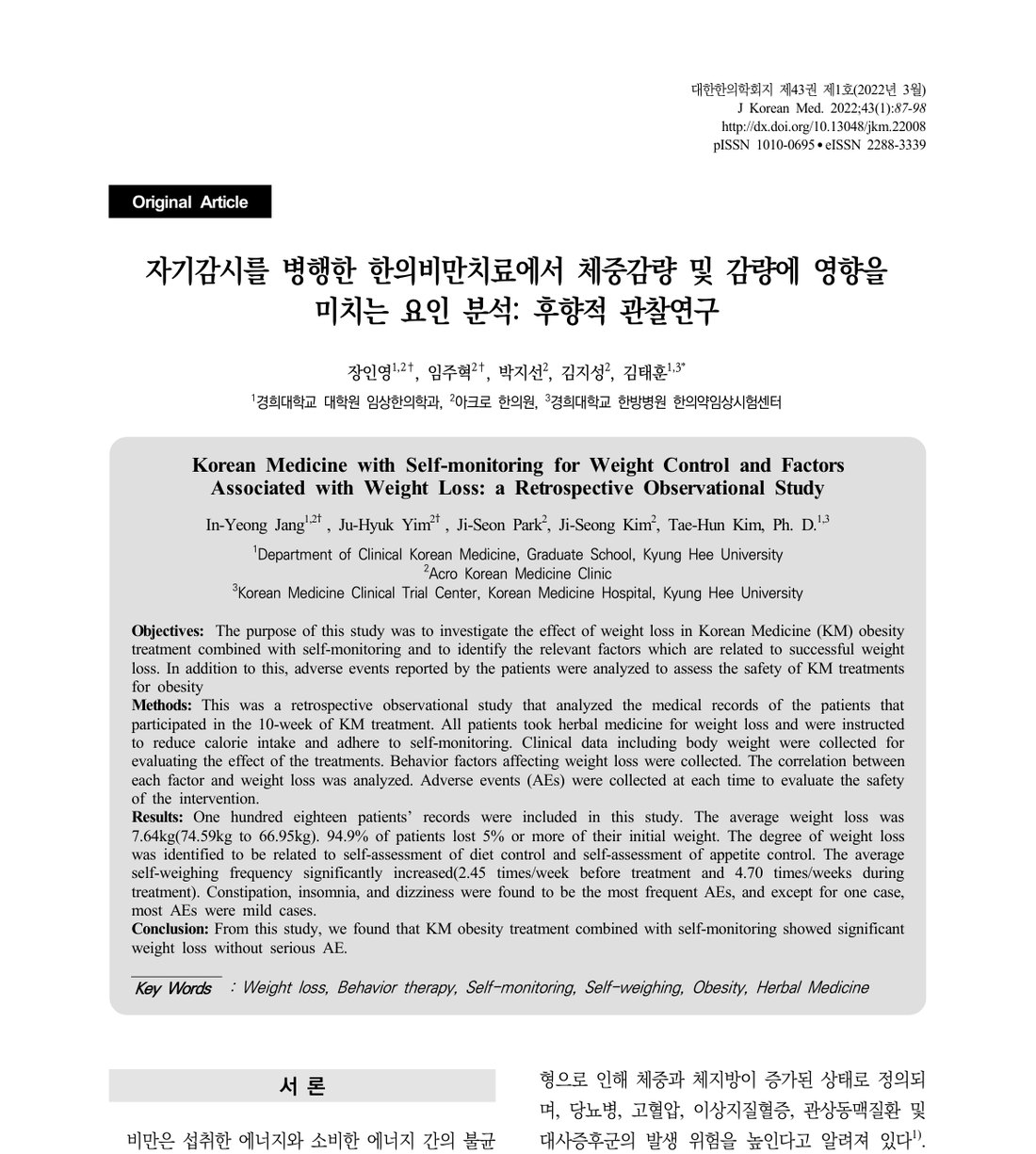
“Korean Medicine with Self-monitoring for Weight Control and Factors Associated with Weight Loss: a Retrospective Observational Study”
Jang In-young · Lim Joo-hyuk · Park Ji-seon · Kim Ji-seong · Kim Tae-hun · J Korean Med 2022;43(1):87–98
Dr. Yim Ju-hyuk and Dr. Park Ji-seon, who see patients at ACRO today, are co-authors
01 · Who
Who took part in the 10 weeks
Among those who started herbal diet medicine between February and May 2021, we analyzed the records of the 118 who completed all 10 weeks
286 started treatment118 completed 10 weeks · analyzed
- 106 women · 12 menAverage age 38
- Average 74.6kgAverage BMI 28 at the start
- 69 of 118had taken diet medication before
All results on this page come from the 118 people who completed 10 weeks
02 · What they did
It wasn't just ten weeks of herbal medicine
While taking herbal medicine, patients ate less and wrote down their weight and meals every day. No exercise was prescribed
- HerbsTaking herbal diet medicineProgress was checked at visits in weeks 2, 6 and 10
- MealsEating lessWomen were advised 1,000–1,200 kcal a day
- RecordsWriting down weight and mealsWeigh-ins rose from 2.45 to 4.70 times a week
03 · Results
After 10 weeks, weight fell by 7.64kg on average
9/ 10 people
lost more than 5% of their starting weight
94.9% · 112 of 118
8/ 10 people
lost more than 7% of their starting weight
79.7% · 94 people
5/ 10 people
lost more than 10% of their starting weight
48.3% · 57 people
These are averages; how much and how fast weight drops differs from person to person
04 · What made the difference
What people who lost the most
had in common
The better people felt they controlled their eating, the more weight they lost
- StrongestDiet controlHigher self-rated diet control went with greater weight loss (r=0.412)
- AlsoAppetite controlThose who felt their appetite was under control also lost more (r=0.207)
- No clear linkAge · Sex · Sleep timeNor was the dose of ephedra (ma huang) in the herbs clearly linked
That's why, at every visit, ACRO still goes over your meal and weight records with you and adjusts the prescription
05 · Discomfort
Discomfort while taking it was mostly mild,
and decreased over time
Of 281 discomforts recorded over 10 weeks, 280 were mild and did not affect daily life (CTCAE grade 1). The remaining one was insomnia in a patient who was already taking sleeping pills
- Week 2127 cases63.6% reported discomfort
- Week 681 cases53.2%
- Week 1073 cases47.5%
Most frequent discomforts (cases)
| Wk 2 | Wk 6 | 10 wks | |
| Constipation | 31 | 31 | 27 |
| Insomnia | 24 | 18 | 18 |
| Dizziness | 21 | 10 | 9 |
| Palpitations | 15 | 6 | 5 |
| Headache | 11 | 6 | 6 |
| Indigestion | 10 | 7 | 1 |
Blood pressure and stopping treatment
No one's blood pressure rose because of the herbs. In those with a BMI of 25 or more, systolic blood pressure fell significantly after weight loss, while pulse rate rose slightly in all groups
8 of the 283 who started treatment stopped because of discomfort (headache 3; palpitations, cystitis, hair loss, insomnia and hives 1 each)
At ACRO we check blood pressure at every visit and adjust dosing and the prescription if discomfort appears
This is an observational study looking back at clinical records, with no comparison group, and it analyzed only those who completed 10 weeks. The same change cannot be expected for everyone, nor attributed to the herbs alone
Consultation
How can these findings apply to you?
We discuss this together during consultations
We check your current health and medications
and then guide your prescription
1 min walk from Sinnonhyeon Stn. Exit 3Weekdays 10:30 – 20:30 · Lunch 13:00 – 14:00Sat · Sun · Holidays 10:00 – 15:30 (no lunch break)02-6925-1175